







Question: please give an in depth answer for question 2, its out of 30 marks. Question 2 (30 Marks) While flexible work arrangements may improve employees'
please give an in depth answer for question 2, its out of 30 marks. 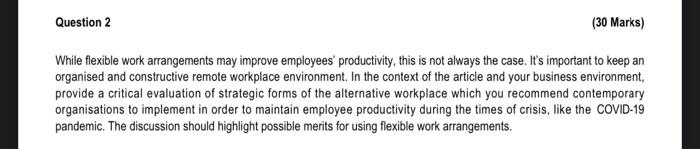
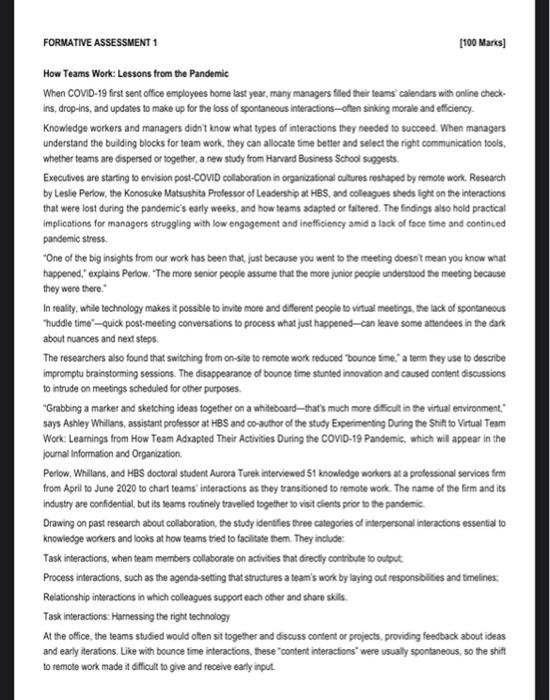
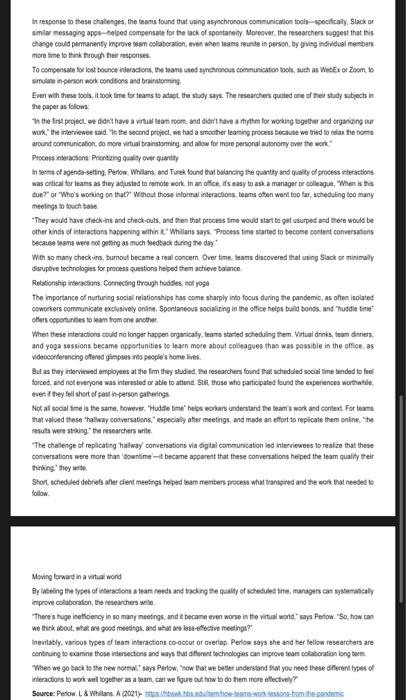
Question 2 (30 Marks) While flexible work arrangements may improve employees' productivity, this is not always the case. It's important to keep an organised and constructive remote workplace environment. In the context of the article and your business environment, provide a critical evaluation of strategic forms of the alternative workplace which you recommend contemporary organisations to implement in order to maintain employee productivity during the times of crisis, like the COVID-19 pandemic. The discussion should highlight possible merits for using flexible work arrangements. FORMATIVE ASSESSMENT 1 [100 Mars] How Teams Work: Lessons from the Pandemic When COVID-19 first sent office employees home last year, many managers filed their teams calendars with online check- ins, drop-ins, and updates to make up for the loss of spontaneous interactions--ohen sinking morale and efficiency Knowledge workers and managers didn't know what types of interactions they needed to succeed. When managers understand the building blocks for team work, they can allocate time better and select the right communication tools, whether teams are dispersed or together, a new study from Harvard Business School suggests. Executives are starting to envision post-COVID collaboration in organizational cultures restaped by remote work. Research by Leslie Perlow, the Konosuke Matsushita Professor of Leadership at HBS, and colleagues sheds light on the interactions that were lost during the pandemic's early weeks, and how teams adapted or faltered. The findings also hold practical implications for managers struggling with low engagement and inefficiency amid a lack of face time and continued pandemic stress One of the big insights from our work has been that, just because you went to the meeting doesn't mean you know what happened." explains Pertow. "The more senior people assume that the more junior people understood the meeting because they were there. In reality, while technology makes it possible to invite more and different people to virtual meetings, the lack of spontaneous Thuddle time-quick post-meeting conversations to process what just happened-can leave some attendees in the dark about nuances and next steps The researchers also found that switching from on-site to remote work reduced "bounce time." a term they use to describe impromptu brainstorming sessions. The disappearance of bounce time stunted innovation and caused content discussions to intrude on meetings scheduled for other purposes "Grabbing a marker and sketching ideas together on a whiteboardthat's much more ticut in the virtual environment." says Ashley Whillans, assistant professor at HBS and co-author of the study Experimenting During the Shift to Virtual Team Work: Learnings from How Team Adxapted Their Activities During the COVID-19 Pandemic, which will appear in the Journal Information and Organization Perlow. Whilans, and HBS doctoral student Aurora Turek interviewed 51 knowledge workers at a professional services fem from April to June 2020 to chart teams interactions as they transitioned to remote work. The name of the firm and its industry are confidential, but its tears routinely travelled together to visit cients prior to the pandemic Drawing on past research about collaboration, the study identifies three categories of interpersonal interactions essential to knowledge workers and looks at how teams tried to facilitate them. They include: Task interactions, when team members collaborate on activities that directly contbute to output Process interactions, such as the agenda-setting that structures a team's work by laying out responsbilities and timelines Relationship interactions in which colleagues support each other and share skills. Task interactions: Harnessing the right technology At the office, the teams studied would often sit together and discuss content or projects, providing feedback about ideas and early iterations. Like with bounce time interactions, these content interactions were usually spontaneous, so the shift to remote work made it difficult to give and receive early input In response to these challenges the teams found that using asynchronous communication tools-specifically, Slack or similar messaging apps-helped compensate for the lack of spontanely. Moreover, the researchers sugest that this change could permanenty improve team colaboration, even when trans reunite in person, by giving individual members more time to think through their responses To compensate for lost bounce interactions, the ans uted synchronous communication tools, such as Wetex or Zoom. simulate in person work conditions and brainstorming Even with these tools, it took time for teams to adapt the study says. The researchers quoted one of their study subjects in the paper as follows: In the first project we didn't have a vitean room and didn't have anythm for working together and organizing our work," the interviewee said in the second project, we had a smoother teaming process because we tried to relax the noms around communication, do more virtual brainstorming and allow for more personal autonomy over the work Process interaction Protizing quality over Quantity In terms of agenda-setting, Pertow. Whilans, and Turek found that balancing the quantity and quality of process interactions was critical foram as they adjusted to remote work in an office is easy to ask a manager or colleague,"What is this due?" or "Who's working on that?' Without those formal interactions teams often went too far, scheduling too many meetings to Douchbase They would have check-ins and check outs and then that process fine would start to get usurped and there would be other kinds of interactions happening within " Whilans says Process time started to become content conversations because dama were not geting as much feedback during the day With so many check-ins, bumout became a real concern. Over time. Sans discovered that using Slack or minimal disruptive technologies for process questions helped them achieve balance Relationship interactions. Comecting through huddles, not yoga The importance of nurturing social relationships has come sharply into focus during the pandemic, as often isolated coworters communicate exclusively online Spontaneous socializing in the office helps build bonds, and huddle time offers opportunities to learn from one another When these interactions could no longer happen organically, tears started scheduling them. Virtual drinks, team dinners and yoga sessions became opportunities to learn more about colleagues than was possible in the office, as Videoconferencing offered gimpses into people's home lives. But as they interviewed employees at the firm they studied the researchers found that scheduled social time tended to feel forced and not everyone was interested or able to attend. Still, those who participated found the experiences worthwhile. event they fell short of past in person gatherings Not al social ime is the same, however. Hudde time has workers understand the team work and context. Forleans that valued these "halteny conversations especially after meetings and made an effort to replicate them onine. The results were sting' the researchers write "The challenge of replicating hallway conversations vin digital communication led interviewees to realize that these conversations were more than downtime--became apparent that these conversations helped the team quality their thinking they were Short scheduled debriets after cient meetings heped team members process what transpired and the work that needed to follow Moving forward in a virtual world By labeling the types of interacions a team needs and tracking the quality of scheduled tre, managers can systematically improve colaboration, the researchers write. There's huge nettoiency in so many meetings, and became even worse in the virtual world." says Perlow. "So how can we think about what are good meetings, and what-effective Meetings? Inevitably, various types of an interactions co-occur or overlap Perlow says she and her fellow researchers are continuing to examine those intersections and ways that different technologies can improve to collaboration long term When we go back to the new mal' says Perlow. now that we beter understand that you need these different types of interactions to work well together as a team can we figure out how to do them more effectively Source: Pertow. L&Whians. A 2021) Sochawk baduteho-ostrom Bendeni Step by Step Solution
There are 3 Steps involved in it
1 Expert Approved Answer
Step: 1 Unlock

Question Has Been Solved by an Expert!
Get step-by-step solutions from verified subject matter experts
Step: 2 Unlock
Step: 3 Unlock
 Study Help