



Question: please give me tha solution of this question CLASSIFICATIONS OR GRADES Generally speaking, oil with an API gravity between 40 and 45 commands the highest
please give me tha solution of this question
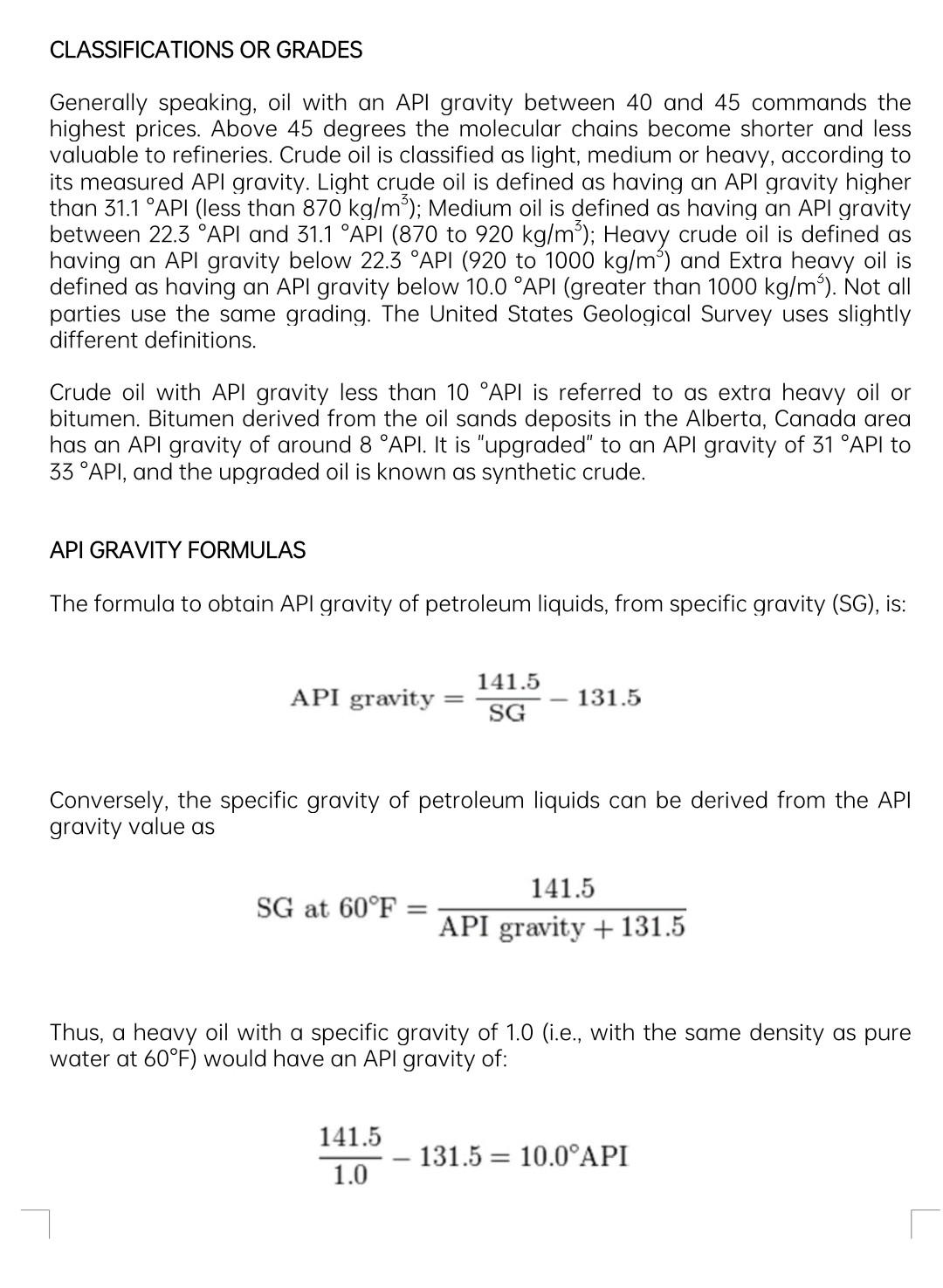
CLASSIFICATIONS OR GRADES Generally speaking, oil with an API gravity between 40 and 45 commands the highest prices. Above 45 degrees the molecular chains become shorter and less valuable to refineries. Crude oil is classified as light, medium or heavy, according to its measured API gravity. Light crude oil is defined as having an API gravity higher than 31.1API (less than 870kg/m3 ); Medium oil is defined as having an API gravity between 22.3API and 31.1API(870 to 920kg/m3); Heavy crude oil is defined as having an API gravity below 22.3API(920 to 1000kg/m3 ) and Extra heavy oil is defined as having an API gravity below 10.0API (greater than 1000kg/m5 ). Not all parties use the same grading. The United States Geological Survey uses slightly different definitions. Crude oil with API gravity less than 10API is referred to as extra heavy oil or bitumen. Bitumen derived from the oil sands deposits in the Alberta, Canada area has an API gravity of around 8API. It is "upgraded" to an API gravity of 31API to 33API, and the upgraded oil is known as synthetic crude. API GRAVITY FORMULAS The formula to obtain API gravity of petroleum liquids, from specific gravity (SG), is: APIgravity=SG141.5131.5 Conversely, the specific gravity of petroleum liquids can be derived from the API gravity value as SGat60F=APIgravity+131.5141.5 Thus, a heavy oil with a specific gravity of 1.0 (i.e., with the same density as pure water at 60F ) would have an API gravity of: 1.0141.5131.5=10.0API
Step by Step Solution
There are 3 Steps involved in it

Get step-by-step solutions from verified subject matter experts