



Question: PLEASE HAVE YOUR GRAPH AND THE FORMULA CLEARLY WRITTEN ON THE PAPER IF POSSIBLE(NOT THE CODE SNIPPET), SO I CAN UNDERSTAND YOUR SOLUTION! THANK U
"PLEASE HAVE YOUR GRAPH AND THE FORMULA CLEARLY WRITTEN ON THE PAPER IF POSSIBLE"(NOT THE CODE SNIPPET), SO I CAN UNDERSTAND YOUR SOLUTION! THANK U SO MUCH!
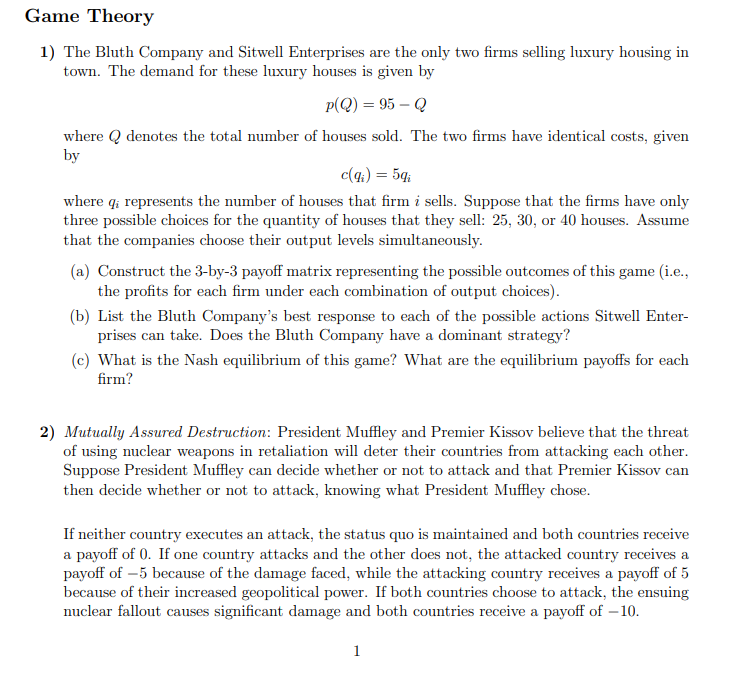
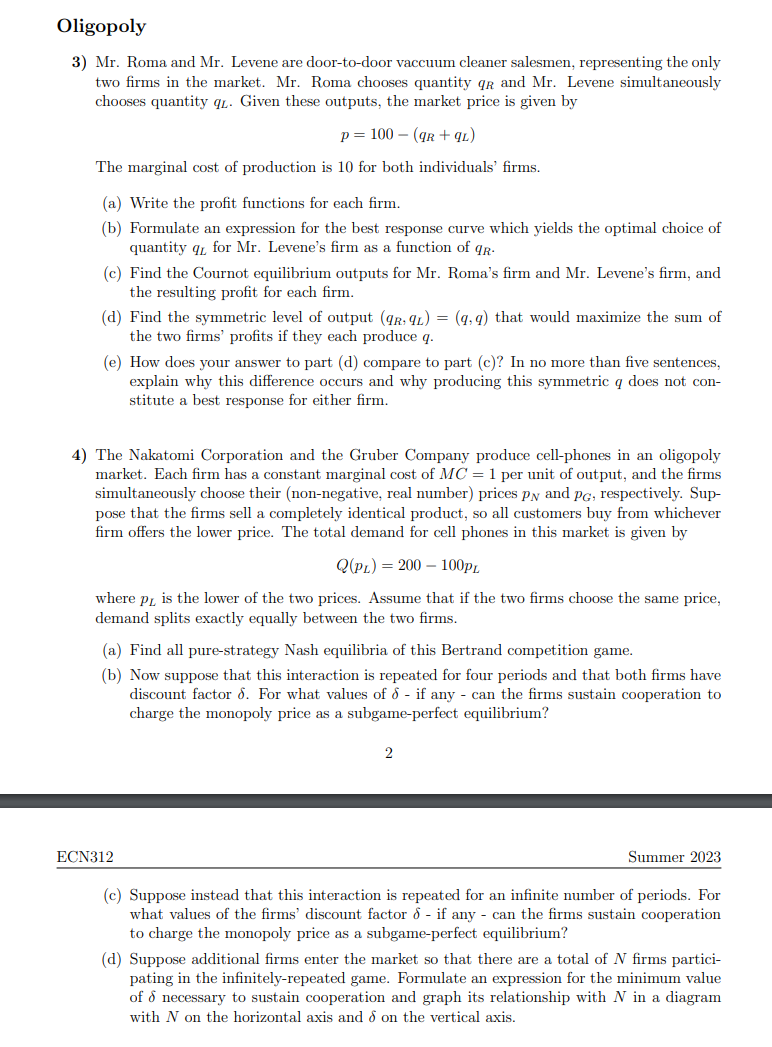
Game Theory 1) The Bluth Company and Sitwell Enterprises are the only two firms selling luxury housing in town. The demand for these luxury houses is given by P(Q) = 95 - Q where Q denotes the total number of houses sold. The two firms have identical costs, given by c(9:) = 5qi where q; represents the number of houses that firm & sells. Suppose that the firms have only three possible choices for the quantity of houses that they sell: 25, 30, or 40 houses. Assume that the companies choose their output levels simultaneously. (a) Construct the 3-by-3 payoff matrix representing the possible outcomes of this game (i.e., the profits for each firm under each combination of output choices) (b) List the Bluth Company's best response to each of the possible actions Sitwell Enter- prises can take. Does the Bluth Company have a dominant strategy? (c) What is the Nash equilibrium of this game? What are the equilibrium payoffs for each firm? 2) Mutually Assured Destruction: President Muffley and Premier Kissov believe that the threat of using nuclear weapons in retaliation will deter their countries from attacking each other. Suppose President Muffley can decide whether or not to attack and that Premier Kissov can then decide whether or not to attack, knowing what President Muffley chose. If neither country executes an attack, the status quo is maintained and both countries receive a payoff of 0. If one country attacks and the other does not, the attacked country receives a payoff of -5 because of the damage faced, while the attacking country receives a payoff of 5 because of their increased geopolitical power. If both countries choose to attack, the ensuing nuclear fallout causes significant damage and both countries receive a payoff of -10.Oligopoly 3) Mr. Roma and Mr. Levene are door-to-door vaccuum cleaner salesmen, representing the only two firms in the market. Mr. Roma chooses quantity qa and Mr. Levene simultaneously chooses quantity qu. Given these outputs, the market price is given by p = 100 - (qR + qL) The marginal cost of production is 10 for both individuals' firms. (a) Write the profit functions for each firm. (b) Formulate an expression for the best response curve which yields the optimal choice of quantity qu for Mr. Levene's firm as a function of qR- (c) Find the Cournot equilibrium outputs for Mr. Roma's firm and Mr. Levene's firm, and the resulting profit for each firm. (d) Find the symmetric level of output (qR: 91) = (q, q) that would maximize the sum of the two firms' profits if they each produce q. (e) How does your answer to part (d) compare to part (c)? In no more than five sentences, explain why this difference occurs and why producing this symmetric q does not con- stitute a best response for either firm. 4) The Nakatomi Corporation and the Gruber Company produce cell-phones in an oligopoly market. Each firm has a constant marginal cost of MC = 1 per unit of output, and the firms simultaneously choose their (non-negative, real number) prices py and pc, respectively. Sup- pose that the firms sell a completely identical product, so all customers buy from whichever firm offers the lower price. The total demand for cell phones in this market is given by Q(PL) = 200 - 100PL where pr is the lower of the two prices. Assume that if the two firms choose the same price, demand splits exactly equally between the two firms. (a) Find all pure-strategy Nash equilibria of this Bertrand competition game. (b) Now suppose that this interaction is repeated for four periods and that both firms have discount factor 6. For what values of o - if any - can the firms sustain cooperation to charge the monopoly price as a subgame-perfect equilibrium? 2 ECN312 Summer 2023 (c) Suppose instead that this interaction is repeated for an infinite number of periods. For what values of the firms' discount factor o - if any - can the firms sustain cooperation to charge the monopoly price as a subgame-perfect equilibrium? (d) Suppose additional firms enter the market so that there are a total of N firms partici- pating in the infinitely-repeated game. Formulate an expression for the minimum value of o necessary to sustain cooperation and graph its relationship with N in a diagram with N on the horizontal axis and o on the vertical axis
Step by Step Solution
There are 3 Steps involved in it

Get step-by-step solutions from verified subject matter experts