







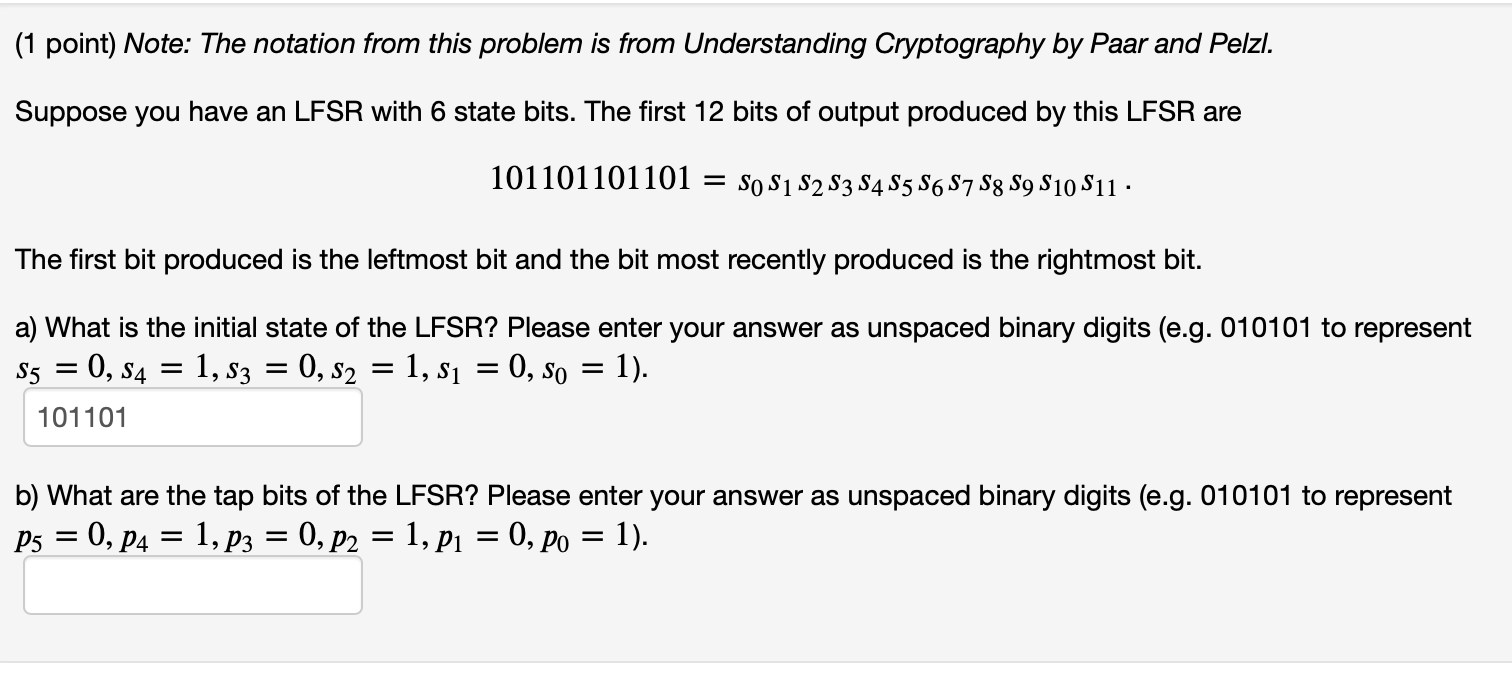
Question: Please help. 1. 2. (1 point) Note: The notation from this problem is from Understanding Cryptography by Paar and Pelzl. Suppose you have an LFSR
Please help.
1.
2.
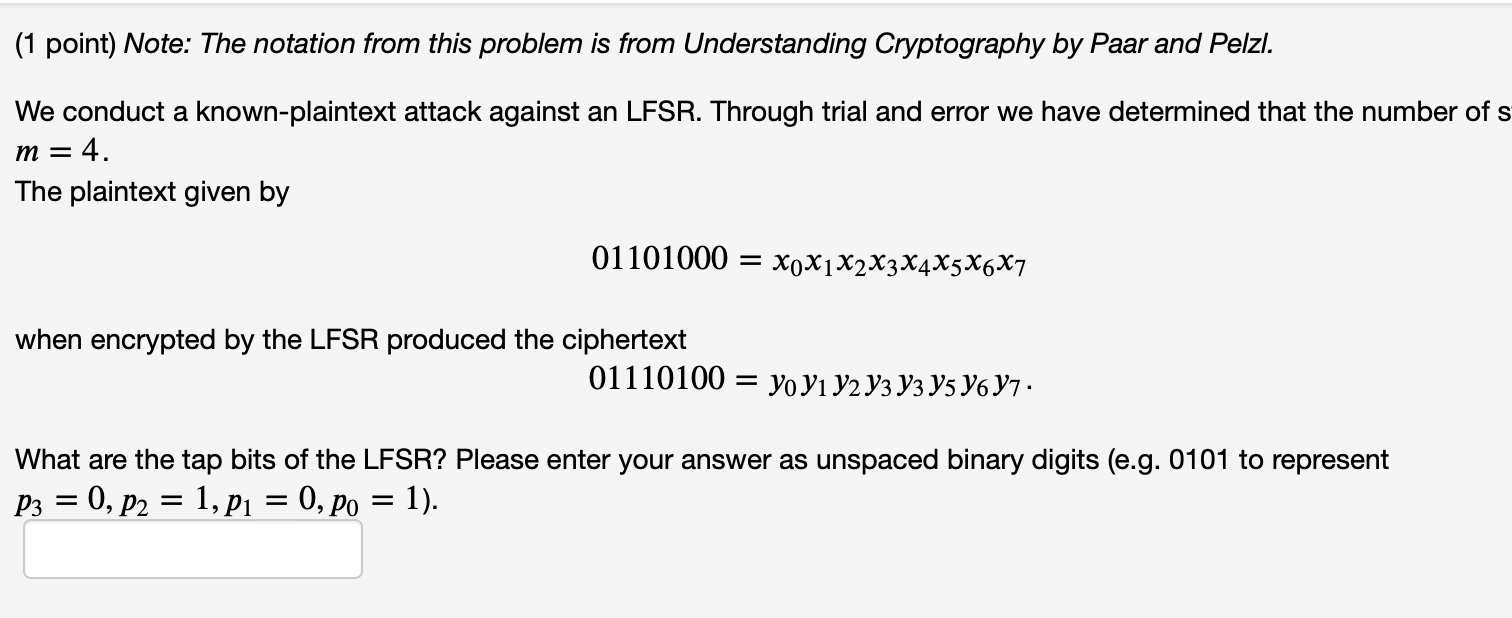
(1 point) Note: The notation from this problem is from Understanding Cryptography by Paar and Pelzl. Suppose you have an LFSR with 6 state bits. The first 12 bits of output produced by this LFSR are 101101101101=s0s1s2s3s4s5s6s7s8s9s10s11 The first bit produced is the leftmost bit and the bit most recently produced is the rightmost bit. a) What is the initial state of the LFSR? Please enter your answer as unspaced binary digits (e.g. 010101 to represent s5=0,s4=1,s3=0,s2=1,s1=0,s0=1 ). b) What are the tap bits of the LFSR? Please enter your answer as unspaced binary digits (e.g. 010101 to represent p5=0,p4=1,p3=0,p2=1,p1=0,p0=1) (1 point) Note: The notation from this problem is from Understanding Cryptography by Paar and Pelzl. We conduct a known-plaintext attack against an LFSR. Through trial and error we have determined that the number m=4. The plaintext given by 01101000=x0x1x2x3x4x5x6x7 when encrypted by the LFSR produced the ciphertext 01110100=y0y1y2y3y3y5y6y7. What are the tap bits of the LFSR? Please enter your answer as unspaced binary digits (e.g. 0101 to represent p3=0,p2=1,p1=0,p0=1)
Step by Step Solution
There are 3 Steps involved in it

Get step-by-step solutions from verified subject matter experts
 Study Help