







Question: Please help 1. (2 points) Consider the function Is f differentiable at (0,0)? f(xy) = 6+ (x, y) # (0,0) 10, (x,y) = (0,0) .
Please help
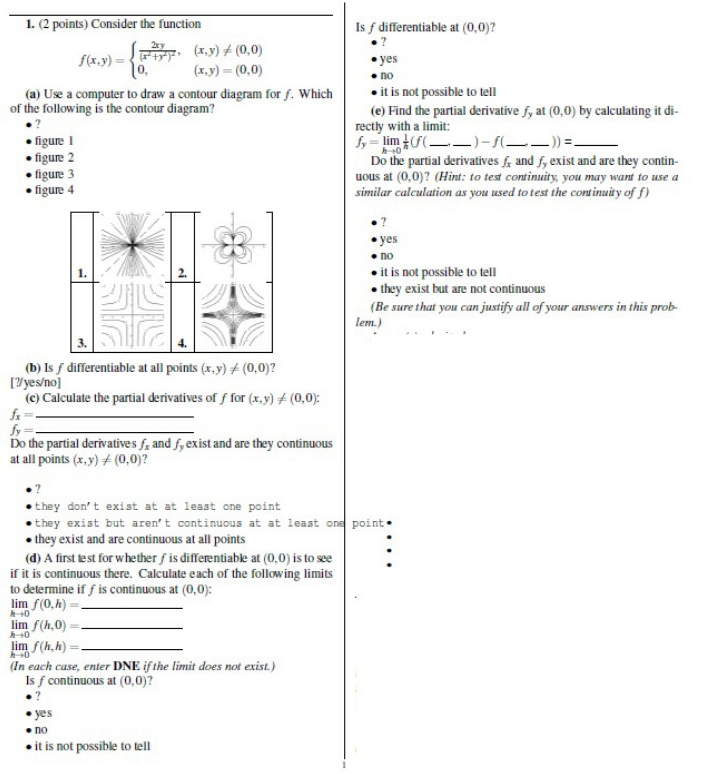
1. (2 points) Consider the function Is f differentiable at (0,0)? f(xy) = 6+ (x, y) # (0,0) 10, (x,y) = (0,0) . yes . no (a) Use a computer to draw a contour diagram for f. Which it is not possible to tell of the following is the contour diagram? (e) Find the partial derivative f, at (0,0) by calculating it di- rectly with a limit: . figure I fy = lim = U(_ -)-f(- . figure 2 . figure 3 Do the partial derivatives f and f, exist and are they contin- figure 4 uous at (0,0)? (Hint: to test continuity, you may want to use a similar calculation as you used to test the continuity of f) eyes .no . it is not possible to tell . they exist but are not continuous Be sure that you can justify all of your answers in this prob- [em.) (b) Is f differentiable at all points (x, y) * (0,0)? [?/yeso] (c) Calculate the partial derivatives of f for (x,y) / (0,0): fy =_ Do the partial derivatives fr and fy exist and are they continuous at all points (x, y) * (0,0)? they don't exist at at least one point they exist but aren't continuous at at least one point. they exist and are continuous at all points (d) A first test for whether f is differentiable at (0,0) is to see . if it is continuous there. Calculate each of the following limits to determine if f is continuous at (0,0): lim f (0,h) = 4 +0 lim f(h, 0) = lim f(h, h) = (In each case, enter DNE if the limit does not exist.) Is f continuous at (0,0)? .no . it is not possible to tell
Step by Step Solution
There are 3 Steps involved in it

Get step-by-step solutions from verified subject matter experts
 Study Help