







Question: I need help sloving this applied statistics question In a clinical trial of 2122 subjects treated with a certain dnJg, 29 reported headaches. In a
I need help sloving this applied statistics question
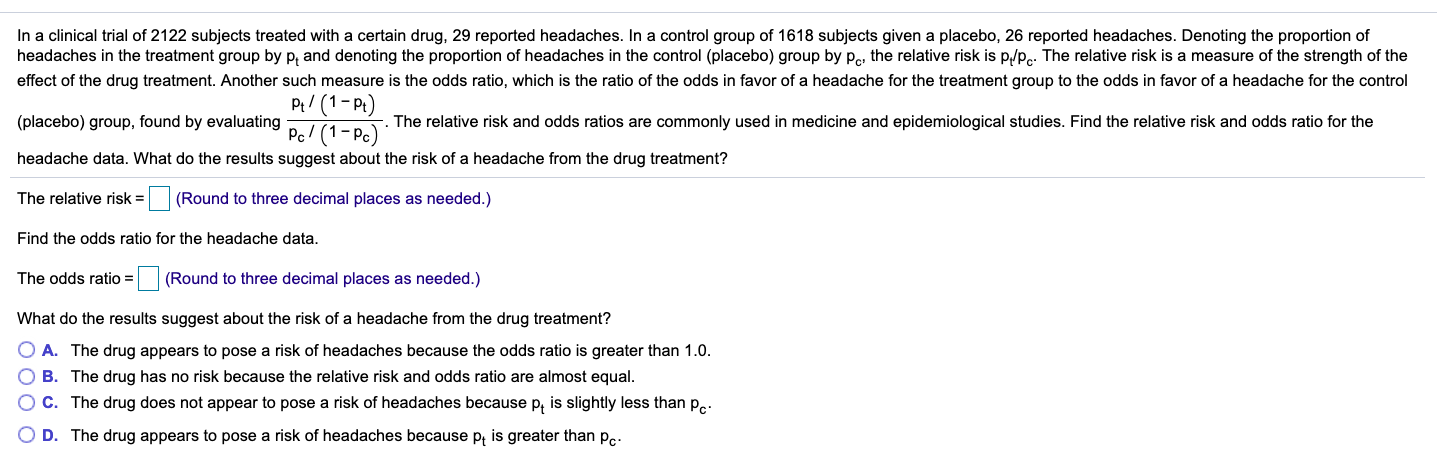
In a clinical trial of 2122 subjects treated with a certain dnJg, 29 reported headaches. In a control group of 1618 subjects given a placebo, 26 reported headaches. Denoting the proportion of headaches in the treatment group by P1 and denoting the proportion of headaches in the control (placebo) group by pc. the relative risk is pllpu. The relative risk is a measure of the strength of the effect of the dmg treatment. Another such measure is the odds ratio. which is the ratio of the odds in favor of a headache for the treatment group to the odds in favor of a headache for the control w (1 - pt) pc I (1 - an] headache data. What do the results suggest about the risk of a headache from the drug treatment? (placebo) group, found by evaluating . The relative risk and odds ratios are commonly used in medicine and epidemiological studies. Find the relative risk and odds ratio for the The relative risk = (Round to three decimal places as needed.) Find the odds ratio for the headache data. The odds ratio = (Round to three decimal places as needed.) What do the results suggest about the risk of a headache from the drug treatment? 0 A. The drug appears to pose a risk of headaches because the odds ratio is greater than 1.0. O B. The drug has no risk because the relative risk and odds ratio are almost equal. O C. The dru does not appear to pose a risk of headaches because p is sli htl less than p . Q t 9 Y c O D. The drug appears to pose a risk of headaches because Pt is greater than pc
Step by Step Solution
There are 3 Steps involved in it

Get step-by-step solutions from verified subject matter experts
 Study Help