







Question: please help 1. Go to StatKey and click on 'Test for a Single Proportion' under the 'Randomization Hy- pothesis Tests' tab. Using the data set
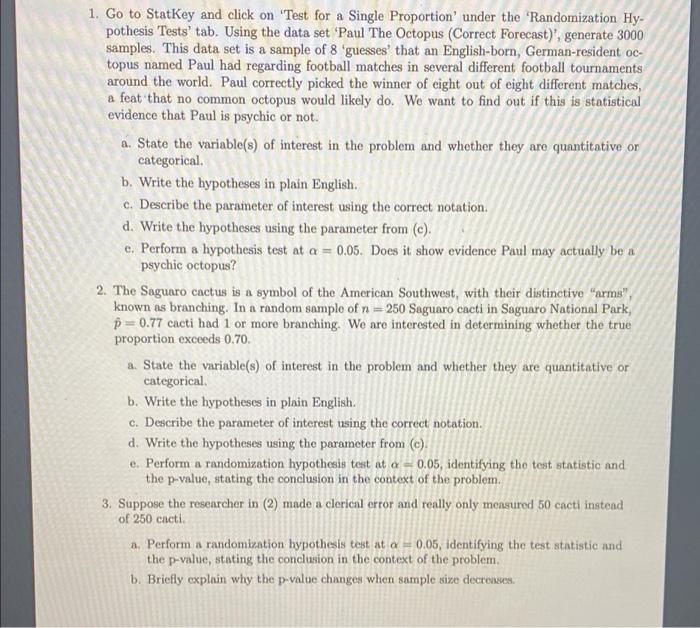
1. Go to StatKey and click on 'Test for a Single Proportion' under the 'Randomization Hy- pothesis Tests' tab. Using the data set 'Paul The Octopus (Correct Forecast)', generate 3000 samples. This data set is a sample of 8 'guesses' that an English-born, German-resident oc- topus named Paul had regarding football matches in several different football tournaments around the world. Paul correctly picked the winner of cight out of eight different matches, a feat that no common octopus would likely do. We want to find out if this is statistical evidence that Paul is psychic or not. a. State the variable(s) of interest in the problem and whether they are quantitative or categorical. b. Write the hypotheses in plain English. c. Describe the parameter of interest using the correct notation. d. Write the hypotheses using the parameter from (c). e. Perform a hypothesis test at a = 0.05. Does it show evidence Paul may actually be a psychic octopus? 2. The Saguaro cactus is a symbol of the American Southwest, with their distinctive "arms", known as branching. In a random sample of n = 250 Saguaro cacti in Saguaro National Park, p=0.77 cacti had 1 or more branching. We are interested in determining whether the true proportion exceeds 0.70. 2. State the variable(s) of interest in the problem and whether they are quantitative or categorical b. Write the hypotheses in plain English. c. Describe the parameter of interest using the correct notation. d. Write the hypotheses using the parameter from (C). e. Perform a randomization hypothesis test at a = 0.05, identifying the test statistio and the p-value, stating the conclusion in the context of the problem. 3. Suppose the researcher in (2) made a clerical error and really only measured 50 cacti instead of 250 cacti. 1. Perform a randomization hypothesis test at a = 0,05, identifying the test statistic and the p-value, stating the conclusion in the context of the problem. b. Briefly explain why the p-value changes when sample size decreases
Step by Step Solution
There are 3 Steps involved in it

Get step-by-step solutions from verified subject matter experts
 Study Help