







Question: please help 39 Problems with the IRR method Aoma Onoitatore is considering an investment project that has the following rather unusual cash flow pattem Year

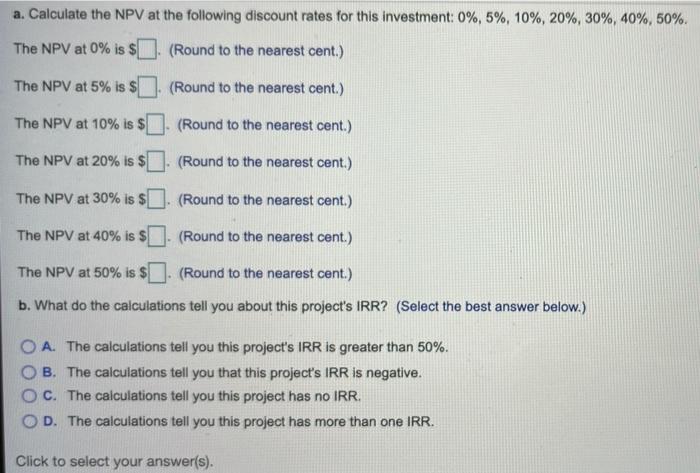
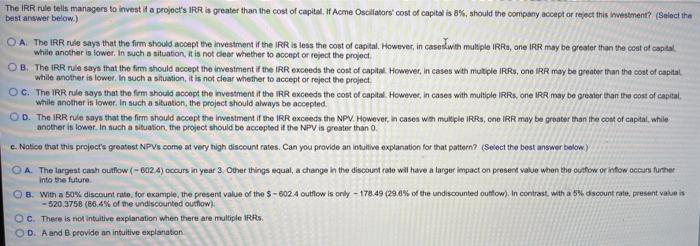
39 Problems with the IRR method Aoma Onoitatore is considering an investment project that has the following rather unusual cash flow pattem Year Cash Flow 0 1 -462 2 792 3 - 6024 171.8 .. Calculate the project's NPV at each of the following discount rates 0% 5% 10% 20% 30%, 40%, 50% b. What do the calculations tell you about this project's IRR? The IRR rule tells managers to invest la project's IRR is greater than the cost of capitalAome Oscillators cost of capital is 8%, should the company acomp or reject this investment? c. Notice that this project's greatest NPVs come at very high discount rates. Can you provide an intuitive explanation for that pattern? a. Calculate the NPV at the following discount rates for this investment: 0%, 5%, 10%, 20%, 30%, 40%, 50%. The NPV at 0% is $ (Round to the nearest cent.) The NPV at 5% is $ (Round to the nearest cent.) The NPV at 10% is $ (Round to the nearest cent.) The NPV at 20% is $. (Round to the nearest cent.) The NPV at 30% is $ . (Round to the nearest cent.) The NPV at 40% is $ (Round to the nearest cent.) The NPV at 50% is $. (Round to the nearest cent.) b. What do the calculations tell you about this project's IRR? (Select the best answer below.) O A. The calculations tell you this project's IRR is greater than 50%. OB. The calculations tell you that this project's IRR is negative. O c. The calculations tell you this project has no IRR. OD. The calculations tell you this project has more than one IRR. Click to select your answer(s). The IRR rule tells managers to invest if a project's IRR is greater than the cost of capital. If Acme Oscilators' cost of capital is 8%, should the company accept or reject this vestment? (Select the best answer below.) OA. The IRR rue says that the firm should accept the investment in the IRR is less the cost of capital. However, in caserkwith multiple IRRA, one IRR may be greater than the cost of capital while another is lower. In such a situation, it is not clear whether to accept or reject the project OB, The IRR rule says that the firm should accept the investment if the IRR exceeds the cost of capital. However, in cases with multiple IRRs, one IRR may be greater than the cost of capital while another is lower. In such a situation, it is not clear whether to accept or reject the project O C. The IRR rule says that the firm should accept the investment if the IRR exceeds the cost of capital. However, in cases with multiple IRRs, one IRR may be greater than the cost of capital while another is lower. In such a situation, the project should always be accepted OD. The IRR U says that the firm should accept the investment of the IRR exceeds the NPV. However, in cases with multiple IRRs, one IRR may be greater than the cost of capital, while another is lower. In such a situation, the project should be accepted at the NPV is greater than 0 c. Notice that this project's greatest NPV come at very high discount rates. Can you provide an intuitive explanation for that pattern? (Select the best answer below) OA. The largest cash outlow (-1024) occurs in year 3. Other things equal, a change in the discount rate will have a larger impact on prosent value when the custow or infow occurs further into the future OB. With a 50% discount rato, for example, the present value of the S-602A outflow is only - 178.49 (290% of the undiscounted outliow). In contrast with a 5% discount rate, present values -520.3758 (86.4% of the undiscounted outflow) OC. There is not intuitive explanation when there are multiple IRRs. OD. A and B provide an intuitive explanation
Step by Step Solution
There are 3 Steps involved in it

Get step-by-step solutions from verified subject matter experts
 Study Help