







Question: Please help! 40. 40. III A 50 kg sprinter, starting from rest, runs 50 In in 7.0 s at constant acceleration. a. What is the
Please help!
40.
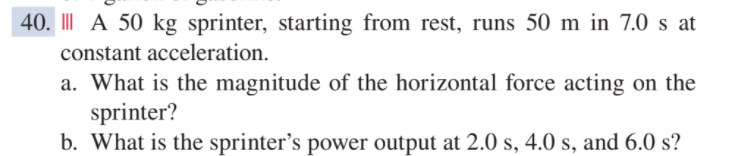

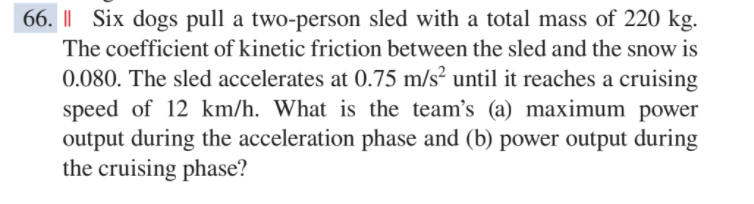
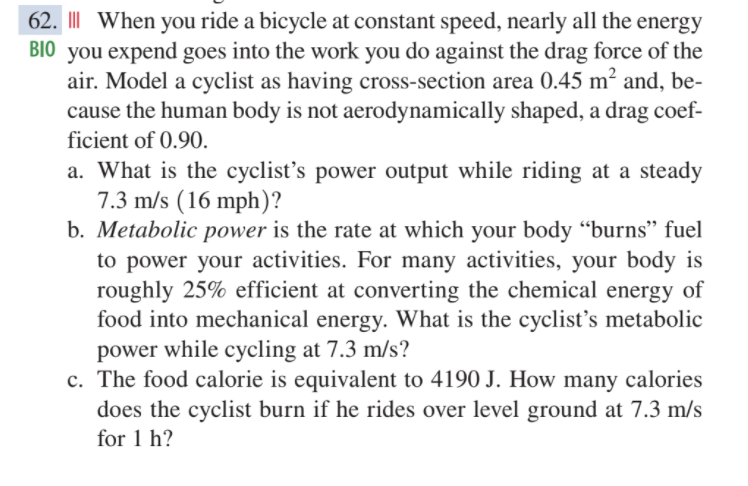
40. III A 50 kg sprinter, starting from rest, runs 50 In in 7.0 s at constant acceleration. a. What is the magnitude of the horizontal force acting on the sprinter? b. What is the sprinter's power output at 2.0 s, 4.0 s, and 6.0 s? 63. II A farmer uses a tractor to pull a 150 kg bale of hay up a 150 incline to the barn at a steady 5.0 km/h. The coefficient of kinetic friction between the bale and the ramp is 0.45. What is the tractor's power output?66. II Six dogs pull a two-person sled with a total mass of 220 kg. The coefficient of kinetic friction between the sled and the snow is 0.080. The sled accelerates at 0.75 m/s2 until it reaches a cruising speed of 12 km/h. What is the team's (a) maximum power output during the acceleration phase and (b) power output during the cruising phase? 62. I" When you ride a bicycle at constant speed, nearly all the energy BIO you expend goes into the work you do against the drag force of the air. Model a cyclist as having cross-section area 0.45 m2 and, be- cause the human body is not aerodynamically shaped, a drag coef- cient of 0.90. a. What is the cyclist's power output while riding at a steady 7.3 111/5 (16 mph)? b. Metabolic power is the rate at which your body \"burns\" fuel to power your activities. For many activities, your body is roughly 25% efficient at converting the chemical energy of food into mechanical energy. What is the cyclist's metabolic power while cycling at 7.3 mfs? c. The food calorie is equivalent to 4190 J. How many calories does the cyclist burn if he rides over level ground at 7.3 mfs for l h
Step by Step Solution
There are 3 Steps involved in it

Get step-by-step solutions from verified subject matter experts
 Study Help