







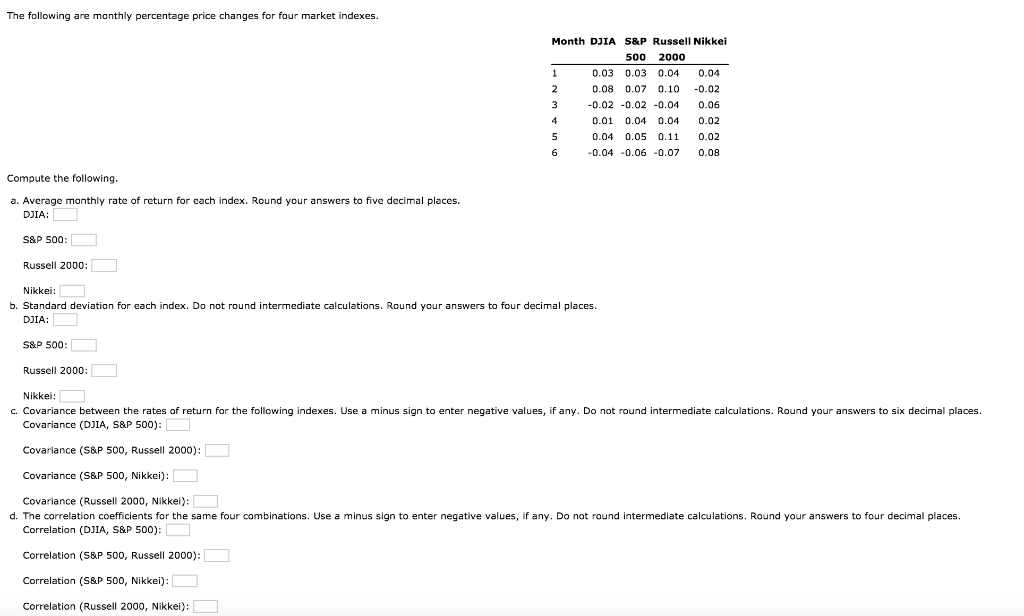
Question: Please help, A - E :) The following are monthly percentage price changes for four market indexes Month DJIA S&P Russell Nikkei 500 2000 0.03
 Please help, A - E :)
The following are monthly percentage price changes for four market indexes Month DJIA S&P Russell Nikkei 500 2000 0.03 0.03 0.04 0.04 0.08 0.07 0.10 -0.02 0.02-0.02-0.04 0.06 0.01 0.04 0.04 0.02 0.04 0.05 0.11 0.02 0.04 -0.06 -0.07 0.08 Compute the following a. Average monthly rate of return for each index. Round your answers to five decimal places. DJIA S&P 500 Russell 2000 Nikkei: b. Standard deviation for each index. Do not round intermediate calculations. Round your answers to four decimal places DJIA S&P 500 Russell 2000 Nikkei: C. Covariance between the rates of return for the following indexes. Use a minus sign to enter negative values, if any. Do not round intermediate calculations. Round your answers to six decimal places. Covariance (DJIA, S&P 500) Covariance (S&P 500, Russell 2000): Covariance (S&P 500, Nikkei): Covariance (Russell 2000, Nikkei): Correlation (DJIA, S&P 500) Correlation (S&P 500, Russell 2000) Correlation (S&P 500, Nikkei) Correlation (Russell 2000, Nikkei): d. The correlation coefficients for the same four combinations. Use a minus sign to enter negative values, if any. Do not round intermediate calculations. Round your answers to four decimal places. e. Using the unrounded answers from parts (a), (b), and (d), calculate the expected return and standard deviation of a portfolio consisting of equal parts of (1) the S&P and the Russell 2000 and (2) the 5&P and the Nikkei. Do not round intermediate calculations, Round your answers to five decimal places, Expected return (S&P 500 and Russell 2000) Standard deviation (S&P sa and Russell 2000) Expected return (S&P 500 and Nikkei): Standard deviation (SBP 500 and Nikkei): Since S&P 500 and Russell 2000 have strong-Select-# correlation, meaningful reduction in risk -Select- Since S&P s00 and Nikkei have a strong Selectcorrelation, meaningful reduction in risk -SalectIf they are combinod if they are combined. The following are monthly percentage price changes for four market indexes Month DJIA S&P Russell Nikkei 500 2000 0.03 0.03 0.04 0.04 0.08 0.07 0.10 -0.02 0.02-0.02-0.04 0.06 0.01 0.04 0.04 0.02 0.04 0.05 0.11 0.02 0.04 -0.06 -0.07 0.08 Compute the following a. Average monthly rate of return for each index. Round your answers to five decimal places. DJIA S&P 500 Russell 2000 Nikkei: b. Standard deviation for each index. Do not round intermediate calculations. Round your answers to four decimal places DJIA S&P 500 Russell 2000 Nikkei: C. Covariance between the rates of return for the following indexes. Use a minus sign to enter negative values, if any. Do not round intermediate calculations. Round your answers to six decimal places. Covariance (DJIA, S&P 500) Covariance (S&P 500, Russell 2000): Covariance (S&P 500, Nikkei): Covariance (Russell 2000, Nikkei): Correlation (DJIA, S&P 500) Correlation (S&P 500, Russell 2000) Correlation (S&P 500, Nikkei) Correlation (Russell 2000, Nikkei): d. The correlation coefficients for the same four combinations. Use a minus sign to enter negative values, if any. Do not round intermediate calculations. Round your answers to four decimal places. e. Using the unrounded answers from parts (a), (b), and (d), calculate the expected return and standard deviation of a portfolio consisting of equal parts of (1) the S&P and the Russell 2000 and (2) the 5&P and the Nikkei. Do not round intermediate calculations, Round your answers to five decimal places, Expected return (S&P 500 and Russell 2000) Standard deviation (S&P sa and Russell 2000) Expected return (S&P 500 and Nikkei): Standard deviation (SBP 500 and Nikkei): Since S&P 500 and Russell 2000 have strong-Select-# correlation, meaningful reduction in risk -Select- Since S&P s00 and Nikkei have a strong Selectcorrelation, meaningful reduction in risk -SalectIf they are combinod if they are combined
Step by Step Solution
There are 3 Steps involved in it

Get step-by-step solutions from verified subject matter experts
 Study Help