







Question: Please help and explain these two probability questions. (Problem 10) Should you drop your decision-analysis course? Suppose you faced the following problem: If you drop
Please help and explain these two probability questions.
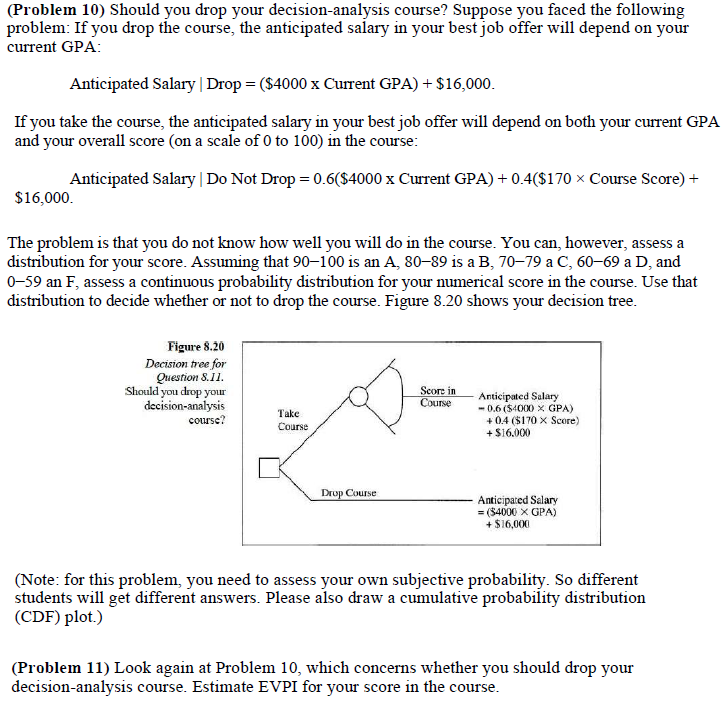
(Problem 10) Should you drop your decision-analysis course? Suppose you faced the following problem: If you drop the course, the anticipated salary in your best job offer will depend on your current GPA: Anticipated Salary | Drop = ($4000 x Current GPA) + $16,000. If you take the course, the anticipated salary in your best job offer will depend on both your current GPA and your overall score (on a scale of 0 to 100) in the course: Anticipated Salary | Do Not Drop = 0.6($4000 x Current GPA) + 0.4($170 x Course Score) + $16,000. The problem is that you do not know how well you will do in the course. You can, however, assess a distribution for your score. Assuming that 90-100 is an A, 80-89 is a B, 70-79 a C, 60-69 a D, and 0-59 an F, assess a continuous probability distribution for your numerical score in the course. Use that distribution to decide whether or not to drop the course. Figure 8.20 shows your decision tree. Figure 8.20 Decision tree for Question S.11. Should you drop your Score in Anticipated Salary decision-analysis Course Take = D.6 ($4000 X GPA) course? Course + 04 ($170 X Score) + $16.000 Drop Course Anticipated Salary = ($4000 X GPA) + $16,000 (Note: for this problem, you need to assess your own subjective probability. So different students will get different answers. Please also draw a cumulative probability distribution (CDF) plot.) (Problem 11) Look again at Problem 10, which concerns whether you should drop your decision-analysis course. Estimate EVPI for your score in the course
Step by Step Solution
There are 3 Steps involved in it

Get step-by-step solutions from verified subject matter experts
 Study Help