







Question: Please help answer question 1 to 5 a CASE 4.2: TROUBLES WITH ALCOHOLISM Randy Minor was a boy wonder when he joined the sales force
Please help answer question 1 to 5 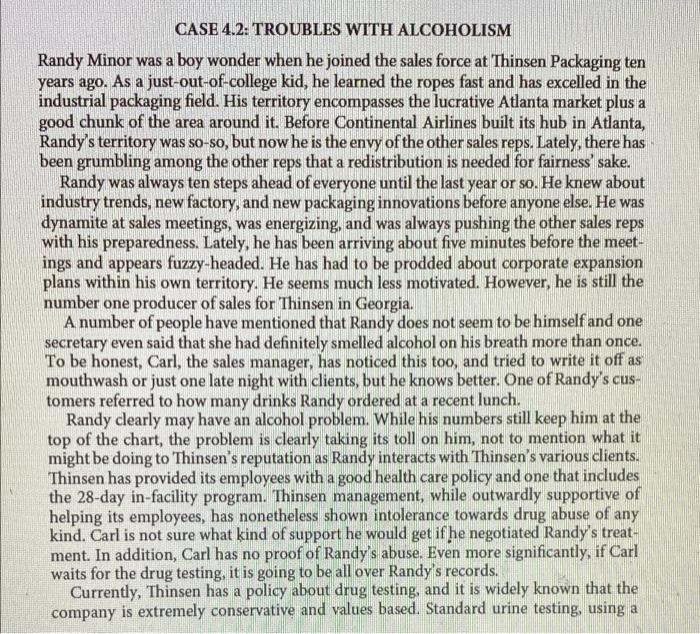
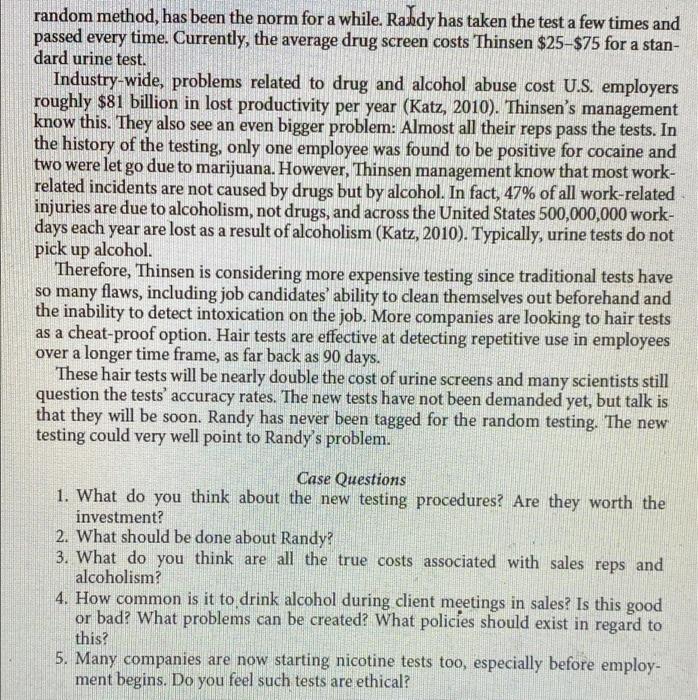
a CASE 4.2: TROUBLES WITH ALCOHOLISM Randy Minor was a boy wonder when he joined the sales force at Thinsen Packaging ten years ago. As a just-out-of-college kid, he learned the ropes fast and has excelled in the industrial packaging field. His territory encompasses the lucrative Atlanta market plus a good chunk of the area around it. Before Continental Airlines built its hub in Atlanta, Randy's territory was so-so, but now he is the envy of the other sales reps. Lately, there has been grumbling among the other reps that a redistribution is needed for fairness' sake. Randy was always ten steps ahead of everyone until the last year or so. He knew about industry trends, new factory, and new packaging innovations before anyone else. He was dynamite at sales meetings, was energizing, and was always pushing the other sales reps with his preparedness. Lately, he has been arriving about five minutes before the meet- ings and appears fuzzy-headed. He has had to be prodded about corporate expansion plans within his own territory. He seems much less motivated. However, he is still the number one producer of sales for Thinsen in Georgia. A number of people have mentioned that Randy does not seem to be himself and one secretary even said that she had definitely smelled alcohol on his breath more than once. To be honest, Carl, the sales manager, has noticed this too, and tried to write it off as mouthwash or just one late night with clients, but he knows better. One of Randy's cus- tomers referred to how many drinks Randy ordered at a recent lunch. Randy clearly may have an alcohol problem. While his numbers still keep him at the top of the chart, the problem is clearly taking its toll on him, not to mention what it might be doing to Thinsen's reputation as Randy interacts with Thinsen's various clients. Thinsen has provided its employees with a good health care policy and one that includes the 28-day in-facility program. Thinsen management, while outwardly supportive of helping its employees, has nonetheless shown intolerance towards drug abuse of any kind. Carl is not sure what kind of support he would get if he negotiated Randy's treat- ment. In addition, Carl has no proof of Randy's abuse. Even more significantly, if Carl waits for the drug testing, it is going to be all over Randy's records. Currently, Thinsen has a policy about drug testing, and it is widely known that the company is extremely conservative and values based. Standard urine testing, using a random method, has been the norm for a while. Randy has taken the test a few times and passed every time. Currently, the average drug screen costs Thinsen $25-$75 for a stan- dard urine test. Industry-wide, problems related to drug and alcohol abuse cost U.S. employers roughly $81 billion in lost productivity per year (Katz, 2010). Thinsen's management know this. They also see an even bigger problem: Almost all their reps pass the tests. In the history of the testing, only one employee was found to be positive for cocaine and two were let go due to marijuana. However, Thinsen management know that most work- related incidents are not caused by drugs but by alcohol. In fact, 47% of all work-related injuries are due to alcoholism, not drugs, and across the United States 500,000,000 work- days each year are lost as a result of alcoholism (Katz, 2010). Typically, urine tests do not pick up alcohol. Therefore, Thinsen is considering more expensive testing since traditional tests have so many flaws, including job candidates' ability to clean themselves out beforehand and the inability to detect intoxication on the job. More companies are looking to hair tests as a cheat-proof option. Hair tests are effective at detecting repetitive use in employees over a longer time frame, as far back as 90 days. These hair tests will be nearly double the cost of urine screens and many scientists still question the tests' accuracy rates. The new tests have not been demanded yet, but talk is that they will be soon. Randy has never been tagged for the random testing. The new testing could very well point to Randy's problem. Case Questions 1. What do you think about the new testing procedures? Are they worth the investment? 2. What should be done about Randy? 3. What do you think are all the true costs associated with sales reps and alcoholism? 4. How common is it to drink alcohol during client meetings in sales? Is this good or bad? What problems can be created? What policies should exist in regard to this? 5. Many companies are now starting nicotine tests too, especially before employ- ment begins. Do you feel such tests are ethical Step by Step Solution
There are 3 Steps involved in it
1 Expert Approved Answer
Step: 1 Unlock

Question Has Been Solved by an Expert!
Get step-by-step solutions from verified subject matter experts
Step: 2 Unlock
Step: 3 Unlock
 Study Help