Question: PLEASE HELP. ANSWERS FOR ALL THE REQUIREMENTS. PLEASE. THIS IS THE DATA ABOVE. PLEASE HELP Part 2. Pareto Analysis An organization called Student MoveTO conducted
 PLEASE HELP.
ANSWERS FOR ALL THE REQUIREMENTS. PLEASE.
 THIS IS THE DATA ABOVE. PLEASE HELP
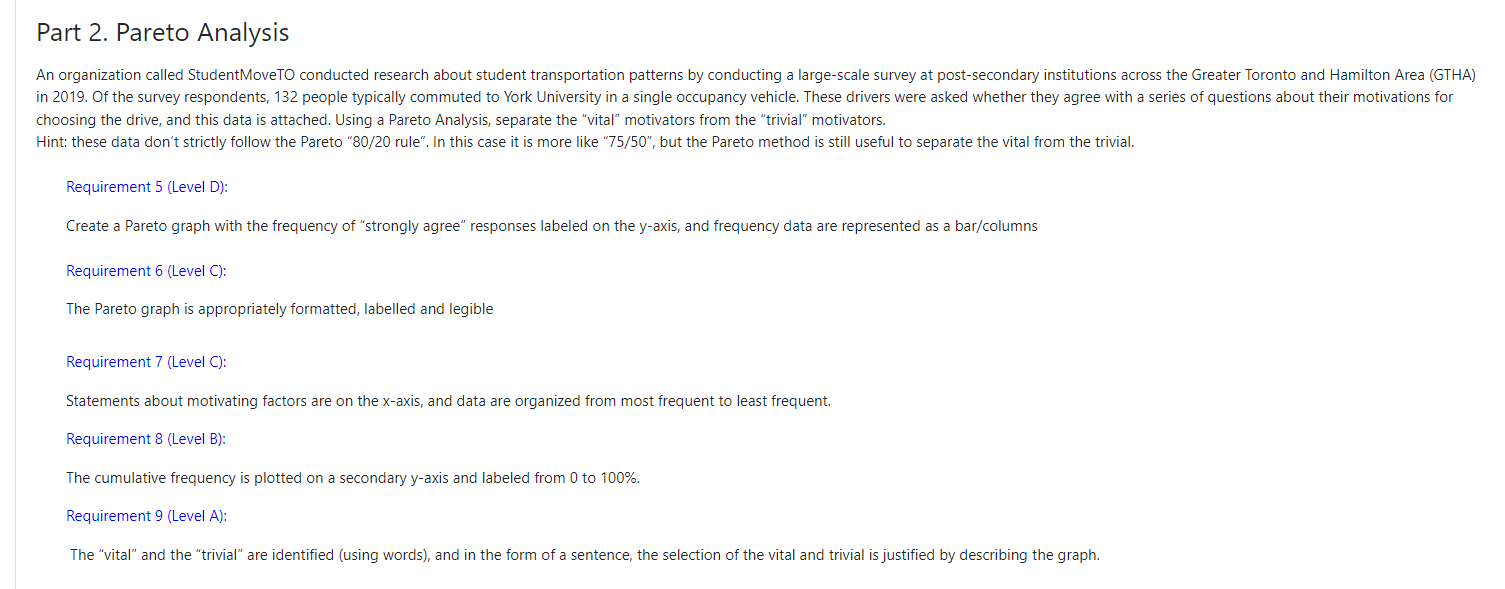
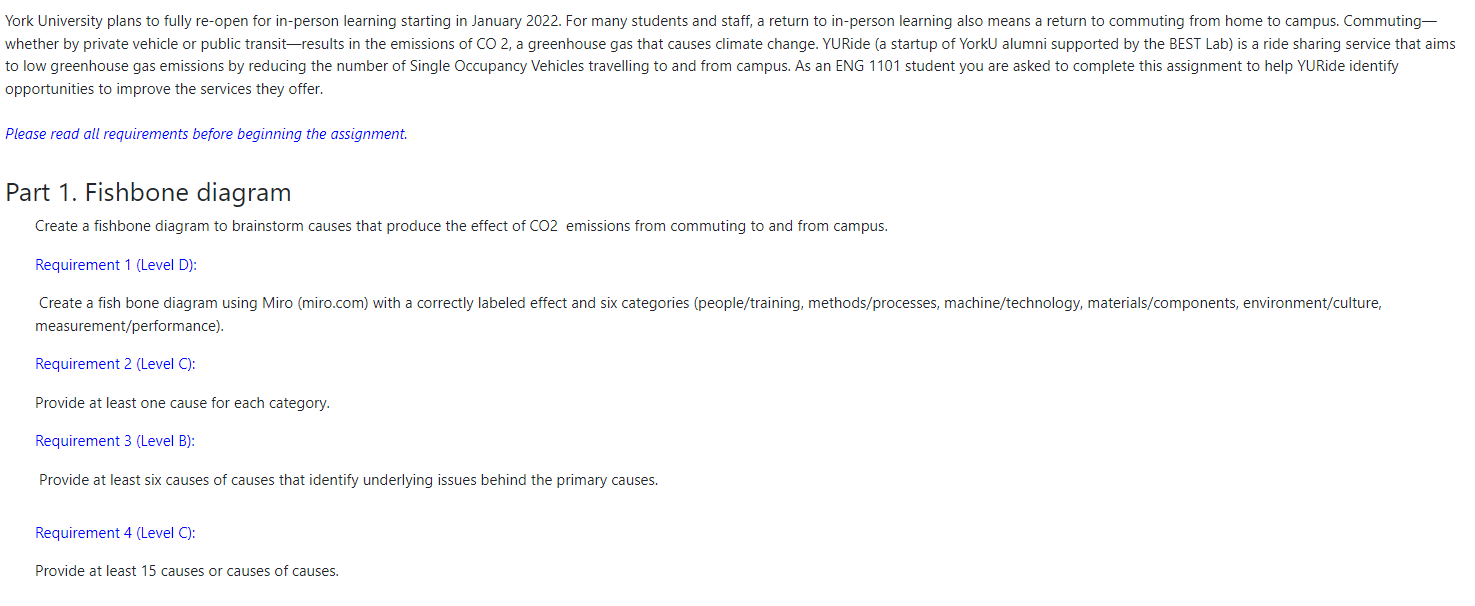
Part 2. Pareto Analysis An organization called Student MoveTO conducted research about student transportation patterns by conducting a large-scale survey at post-secondary institutions across the Greater Toronto and Hamilton Area (GTHA) in 2019. Of the survey respondents, 132 people typically commuted to York University in a single occupancy vehicle. These drivers were asked whether they agree with a series of questions about their motivations for choosing the drive, and this data is attached. Using a Pareto Analysis, separate the "vital" motivators from the "trivial" motivators. Hint: these data don't strictly follow the Pareto "80/20 rule". In this case it is more like "75/50", but the Pareto method is still useful to separate the vital from the trivial. Requirement 5 (Level D): Create a Pareto graph with the frequency of "strongly agree" responses labeled on the y-axis, and frequency data are represented as a bar/columns Requirement 6 (Level C): The Pareto graph is appropriately formatted, labelled and legible Requirement 7 (Level C): Statements about motivating factors are on the x-axis, and data are organized from most frequent to least frequent. Requirement 8 (Level B): The cumulative frequency is plotted on a secondary y-axis and labeled from 0 to 100%. Requirement 9 (Level A): The "vital" and the "trivial" are identified (using words), and in the form of a sentence, the selection of the vital and trivial is justified by describing the graph. York University plans to fully re-open for in-person learning starting in January 2022. For many students and staff, a return to in-person learning also means a return to commuting from home to campus. Commuting, whether by private vehicle or public transit-results in the emissions of CO 2, a greenhouse gas that causes climate change. YURide (a startup of Yorku alumni supported by the BEST Lab) is a ride sharing service that aims to low greenhouse gas emissions by reducing the number of Single Occupancy Vehicles travelling to and from campus. As an ENG 1101 student you are asked to complete this assignment to help YURide identify opportunities to improve the services they offer. Please read all requirements before beginning the assignment Part 1. Fishbone diagram Create a fishbone diagram to brainstorm causes that produce the effect of CO2 emissions from commuting to and from campus. Requirement 1 (Level D): Create a fish bone diagram using Miro (miro.com) with a correctly labeled effect and six categories (people/training, methods/processes, machine/technology, materials/components, environment/culture, measurement/performance). Requirement 2 (Level C): Provide at least one cause for each category. Requirement 3 (Level B): Provide at least six causes of causes that identify underlying issues behind the primary causes. Requirement 4 (Level C): Provide at least 15 causes or causes of causes. Part 2. Pareto Analysis An organization called Student MoveTO conducted research about student transportation patterns by conducting a large-scale survey at post-secondary institutions across the Greater Toronto and Hamilton Area (GTHA) in 2019. Of the survey respondents, 132 people typically commuted to York University in a single occupancy vehicle. These drivers were asked whether they agree with a series of questions about their motivations for choosing the drive, and this data is attached. Using a Pareto Analysis, separate the "vital" motivators from the "trivial" motivators. Hint: these data don't strictly follow the Pareto "80/20 rule". In this case it is more like "75/50", but the Pareto method is still useful to separate the vital from the trivial. Requirement 5 (Level D): Create a Pareto graph with the frequency of "strongly agree" responses labeled on the y-axis, and frequency data are represented as a bar/columns Requirement 6 (Level C): The Pareto graph is appropriately formatted, labelled and legible Requirement 7 (Level C): Statements about motivating factors are on the x-axis, and data are organized from most frequent to least frequent. Requirement 8 (Level B): The cumulative frequency is plotted on a secondary y-axis and labeled from 0 to 100%. Requirement 9 (Level A): The "vital" and the "trivial" are identified (using words), and in the form of a sentence, the selection of the vital and trivial is justified by describing the graph. York University plans to fully re-open for in-person learning starting in January 2022. For many students and staff, a return to in-person learning also means a return to commuting from home to campus. Commuting, whether by private vehicle or public transit-results in the emissions of CO 2, a greenhouse gas that causes climate change. YURide (a startup of Yorku alumni supported by the BEST Lab) is a ride sharing service that aims to low greenhouse gas emissions by reducing the number of Single Occupancy Vehicles travelling to and from campus. As an ENG 1101 student you are asked to complete this assignment to help YURide identify opportunities to improve the services they offer. Please read all requirements before beginning the assignment Part 1. Fishbone diagram Create a fishbone diagram to brainstorm causes that produce the effect of CO2 emissions from commuting to and from campus. Requirement 1 (Level D): Create a fish bone diagram using Miro (miro.com) with a correctly labeled effect and six categories (people/training, methods/processes, machine/technology, materials/components, environment/culture, measurement/performance). Requirement 2 (Level C): Provide at least one cause for each category. Requirement 3 (Level B): Provide at least six causes of causes that identify underlying issues behind the primary causes. Requirement 4 (Level C): Provide at least 15 causes or causes of causes









 Study Help