







Question: please help as much as you can !!! and 1. Software engineering is different from other types of engineering in a number of ways. Some
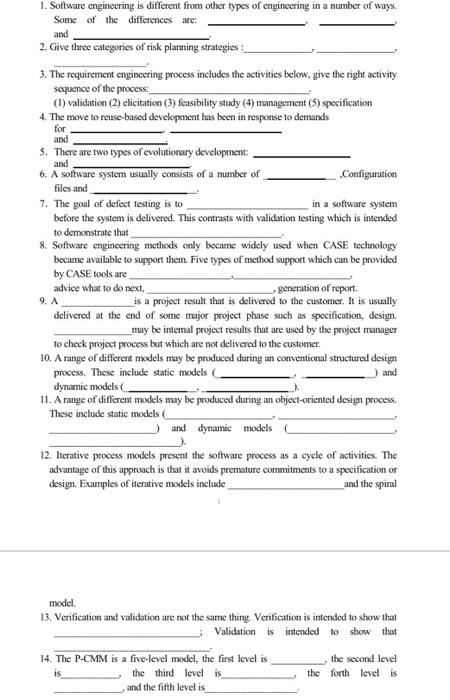
and 1. Software engineering is different from other types of engineering in a number of ways. Some of the differences are and 2. Give three categories of risk plarning strategies : 3. The requirement engineering process includes the activities below, give the right activity sequence of the process (1) validation (2) clicitation (3) feasibility study (4) management (5) specification 4. The move to reuse-based development has been in response to demands for and 5. There are two types of evolutionary development: 6. A software system usually consists of a number of Configuration files and 7. The goal of defect testing is to in a software system before the system is delivered. This contrasts with validation testing which is intended to demonstrate that 8. Software engineering methods only became wickly used when CASE technology became available to support them Five types of method support which can be provided by CASE tools are advice what to do next generation of report. 9. A is a project result that is delivered to the customer. It is usually delivered at the end of some major project phase such as specification, design. may be interal project results that are used by the project manager to check project process but which are not delivered to the customer 10. A range of different models may be produced during an conventional structured design process. These include static models and dynamic models 11. A range of different models may be produced during an object-oriented design process. These include static models and dynamic models 12. Iterative process models present the software process as a cycle of activities. The advantage of this approach is that it avoids premature commitments to a specification or design. Examples of iterative models include _and the spiral model 13. Verification and validation are not the same thing Verification is intended to show that Validation is intended to show that 14. The P-CMM is a five-level model, the first level is is the third level is and the fifth level is the second level the forth level is
Step by Step Solution
There are 3 Steps involved in it

Get step-by-step solutions from verified subject matter experts
 Study Help