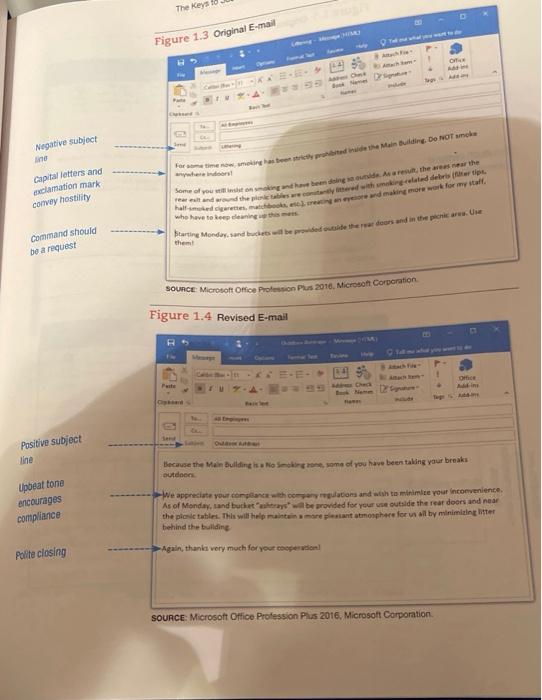
Question: please help ! below are the pictures that include info about the question. please revise and fix (first pic) the communication to remove inappropriate tone
please help ! below are the pictures that include info about the question. please revise and fix (first pic) the communication to remove inappropriate tone or content . please also justify your revison and explain why. thank you
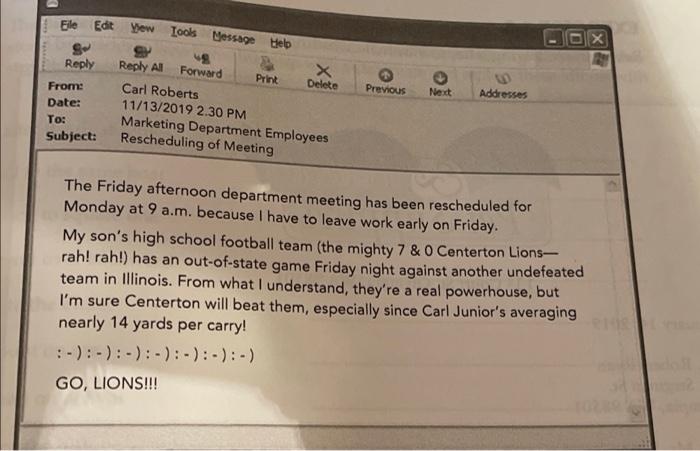
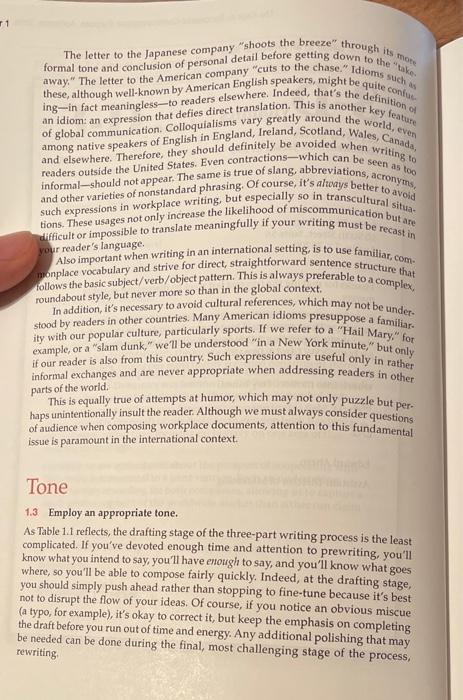
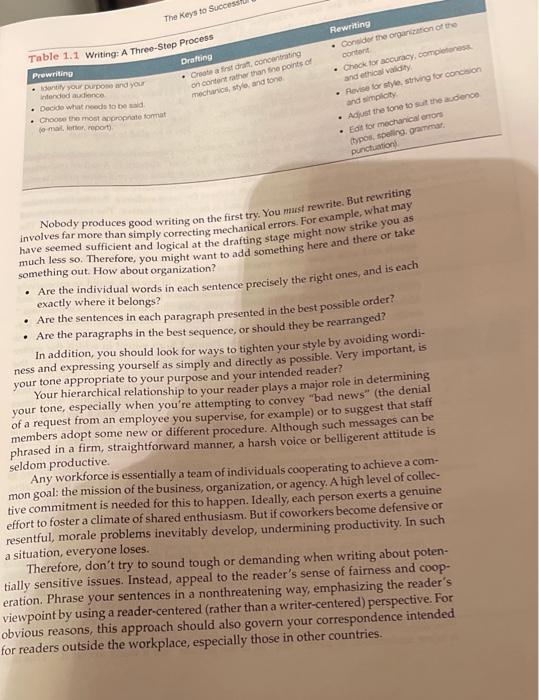
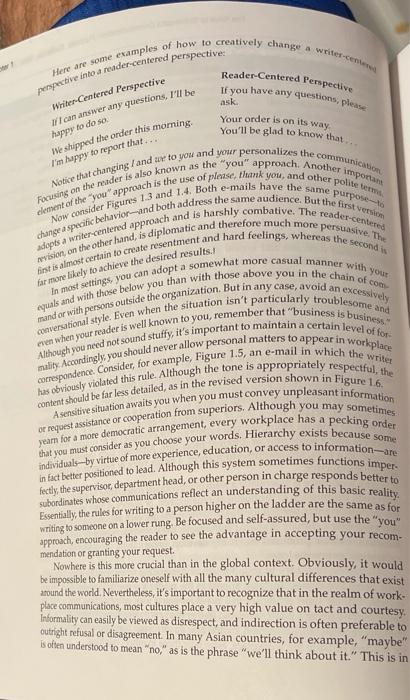
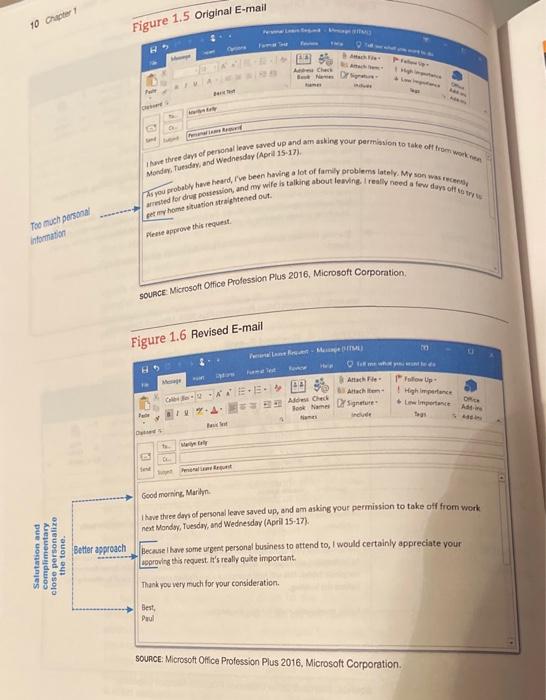
9 Reply Eile Edit Yew Tools Message Help Reply All Forward Print Delete Carl Roberts 11/13/2019 2.30 PM Marketing Department Employees Rescheduling of Meeting Previous Next Addresses From: Date: To: Subject: The Friday afternoon department meeting has been rescheduled for Monday at 9 a.m. because I have to leave work early on Friday. My son's high school football team (the mighty 7 & 0 Centerton Lions- rah! rah!) has an out-of-state game Friday night against another undefeated team in Illinois. From what I understand, they're a real powerhouse, but I'm sure Centerton will beat them, especially since Carl Junior's averaging nearly 14 yards per carry! :-):-):-):-):-):-):-) GO, LIONS!!! T1 The letter to the Japanese company "shoots the breeze" through its mot formal tone and conclusion of personal detail before getting down to the away." The letter to the American company "cuts to the chase." Idioms such as ing-in fact meaningless-to readers elsewhere. Indeed, that's the definition of these, although well-known by American English speakers, might be quite con of global communication Colloquialisms vary greatly around the world, even an idiom: an expression that defies direct translation. This is another key feature among native speakers of English in England, Ireland, Scotland, Wales, Canada, readers outside the United States. Even contractions which can be seen as too and elsewhere. Therefore, they should definitely be avoided when writing to and other varieties of nonstandard phrasing. Of course, it's always better to avoid informal should not appear. The same is true of slang, abbreviations, acronyms, such expressions in workplace writing, but especially so in transcultural situa difficult or impossible to translate meaningfully if your writing must be recast in tions. These usages not only increase the likelihood of miscommunication but are familiar.com your reader's language. Also important when writing in an international setting, is to use monplace vocabulary and strive for direct, straightforward sentence structure that follows the basic subject/verb/object pattern. This is always preferable to a complex, roundabout style, but never more so than in the global context. In addition, it's necessary to avoid cultural references, which may not be under. ity with our popular culture, particularly sports. If we refer to a "Hail Mary." for stood by readers in other countries. Many American idioms presuppose a familiar. example, or a "slam dunk," we'll be understood "in a New York minute, but only if our reader is also from this country. Such expressions are useful only in rather informal exchanges and are never appropriate when addressing readers in other parts of the world. This is equally true of attempts at humor, which may not only puzzle but of audience when composing workplace documents, attention to this fundamental haps unintentionally insult the reader Although we must always consider questions issue is paramount in the international context. Tone 1.3 Employ an appropriate tone. As Table 1.1 reflects the drafting stage of the three-part writing process is the least complicated. If you've devoted enough time and attention to prewriting, you'll know what you intend to say, you'll have enough to say, and you'll know what goes where, so you'll be able to compose fairly quickly. Indeed, at the drafting stage, you should simply push ahead rather than stopping to fine-tune because it's best not to disrupt the flow of your ideas. Of course, if you notice an obvious miscue (a typo, for example), it's okay to correct it, but keep the emphasis on completing the draft before you run out of time and energy. Any additional polishing that may be needed can be done during the final, most challenging stage of the process, rewriting The keys to Success Table 1.1 Writing: A Three-Step Process Prewriting til your Du and your tended audience Decide what needs to be . Choose the most appropriate format to malo oport) Drafting Create a first concentrating on content than the points of mechanics and tone Rewriting . Consider the organization of the conto Check for accuracy, compass and ethical validity Reviseforstyle striving forconcision and simploty Adjust the one to set the audience Edit for mechanical errors typos sping, grammar Dunction . Nobody produces good writing on the first try. You must rewrite. But rewriting involves far more than simply correcting mechanical errors. For example, what may much less so. Therefore, you might want to add something here and there or take have seemed sufficient and logical at the drafting stage might now strike you as something out. How about organization? Are the individual words in each sentence precisely the right ones, and is each exactly where it belongs? Are the sentences in each paragraph presented in the best possible order? Are the paragraphs in the best sequence, or should they be rearranged? In addition, you should look for ways to tighten your style by avoiding wordi- ness and expressing yourself as simply and directly as possible. Very important, is your tone appropriate to your purpose and your intended reader? Your hierarchical relationship to your reader plays a major role in determining your tone, especially when you're attempting to convey "bad news" (the denial of a request from an employee you supervise, for example) or to suggest that staff members adopt some new or different procedure. Although such messages can be phrased in a firm, straightforward manner, a harsh voice or belligerent attitude is seldom productive Any workforce is essentially a team of individuals cooperating to achieve a com- mon goal: the mission of the business, organization, or agency. A high level of collec- tive commitment is needed for this to happen. Ideally, each person exerts a genuine effort to foster a climate of shared enthusiasm. But if coworkers become defensive or resentful, morale problems inevitably develop, undermining productivity. In such a situation, everyone loses. Therefore, don't try to sound tough or demanding when writing about poten- tially sensitive issues. Instead, appeal to the reader's sense of fairness and coop- eration. Phrase your sentences in a nonthreatening way, emphasizing the reader's viewpoint by using a reader-centered (rather than a writer-centered) perspective. For obvious reasons, this approach should also govern your correspondence intended for readers outside the workplace, especially those in other countries. Here are some examples of how to creatively change a writer- perpective into a reader centered perspectives Reader-Centered Perspective If you have any questions, please ask. Writer-Centered Perspective It can answer any questions. I'll be Your order is on its way, happy to do so in happy to report that... far more likely to achieve the desired results. excessively You'll be glad to know that Ne slupped the order this morning. Focusing on the rander is also known as the "you" approach. Another importa element of the you approach is the use of pinase, thank you, and other polite te Notice that changing land to you and your personalizes the communication change a specific behavior and both address the same audience. But the first version Now consider Figures 1.3 and 1.4. Both e-mails have the same purpose adopts a writer-centered approach and is harshly combative. The reader-centered ist is almost certain to create resentment and hard feelings, whereas the second vision on the other hand, is diplomatic and therefore much more persuasive the us and with those below you than with those above you in the chain of com In most settings, you can adopt a somewhat more casual manner with you mand or with persons outside the onganization. But in any case, avoid an even when your rader is well known to you remember that "business is business conversational style. Even when the situation isn't particularly troublesome and Although you need not sound stuffy, it's important to maintain a certain level of for mality. Accordingly, you should never allow personal matters to appear in workplace correspondence. Consider, for example, Figure 1.5, an e-mail in which the writer has obviously violated this rule. Although the tone is appropriately respectful, the content should be far less detailed, as in the revised version shown in Figure 16. or request assistance or cooperation from superiors. Although you may sometimes year for a more democratic arrangement, every workplace has a pecking order A sensitive situation awaits you when you must convey unpleasant information individuals by virtue of more experience, education, or access to information are that you must consider as you choose your words. Hierarchy exists because some in fact better positioned to lead. Although this system sometimes functions imper fectly the supervisor department head, or other person in charge responds better to subordinates whose communications reflect an understanding of this basic reality Essentially , the rules for writing to a person higher on the ladder are the same as for approach, encouraging the reader to see the advantage in accepting your recom- writing to someone on a lower rung. Be focused and self-assured, but use the "you" mendation or granting your request. Nowhere is this more crucial than in the global context. Obviously, it would be impossible to familiarize oneself with all the many cultural differences that exist around the world. Nevertheless, it's important to recognize that in the realm of work- place communications, most cultures place a very high value on tact and courtesy Informality can easily be viewed as disrespect, and indirection is often preferable to outright refusal or disagreement. In many Asian countries, for example, "maybe" is often understood to mean no," as is the phrase "we'll think about it." This is in The keys to Figure 1.3 Original E- mail KEEL One Negative subject anywhere Capital letters and exclamation mark convey hostility mening hatte der Main Building Do NOT neke e voe on mingestione dei dating sa amin., the rest near the the correlated debertips hammed for my staff who have to keep cleaning this mes Command should be a request Berthe Monday. sand betwee root wisde ter doors and in the pecnicure. Une them! SOURCE: Microsoft Office Profession Plus 2010, Microson Corporation Figure 1.4 Revised E-mail Oce Check Positive subject tine Uposattone encourages compliance Because the Main building is No Smoking room of you have been taking your break outdoor We appreciate your compliance with company regulations and wish to minimize your inconvenience As of Monday, and buchetrays be provided for your use outside the rear doors and near the planetales. This will help maintain area atmosphere for us wil by minimitinglitter behind the building Again, thanks very much for your cooperation Polte closing SOURCE: Microsoft Office Profession Plus 2016, Microsoft Corporation TO Chapter 1 Figure 1.5 Original E-mail DAE Chee Dri Tave three days of personave ved up and am asking your permission to take off from work As you probably have heard Ive been having a lot of family problems lately. My son was arrested for drug pression, and my wife is talking about leaving really need a few days of Monday Tuesday, and Wednesday (Apr 15-17). per my home situation straightened out. Too much personal information Plente approve this request SOURCE Microsoft Office Profession Plus 2016. Microsoft Corporation, Figure 1.6 Revised E-mail Lame MMU Follow Up Attache Attache Signature nude XX.108 Aldest Check Book Name OR Importante tes Good morning, Marilyn I have three days of personal lewe saved up, and am asking your permission to take off from work next Monday, Tuesday, and Wednesday (April 15-17). Salutation and complimentary close personalizo the tone. Better approach because I have some urgent personal business to attend to, I would certainly appreciate your proving the request it's really quite important Thank you very much for your consideration, Best, Puul SOURCE: Microsoft Office Profession Plus 2016. Microsoft Corporation









 Study Help