Question: Please help me to revise my first draft for my rhetorical analysis essay. The article, instructions, and my teacher's comments is uploaded below. Feel free
Please help me to revise my first draft for my rhetorical analysis essay. The article, instructions, and my teacher's comments is uploaded below. Feel free to checkout, thank you!
Here is my draft:
Rhetorical Analysis of "Porn Isn't Free Speech on the Web or Anywhere"
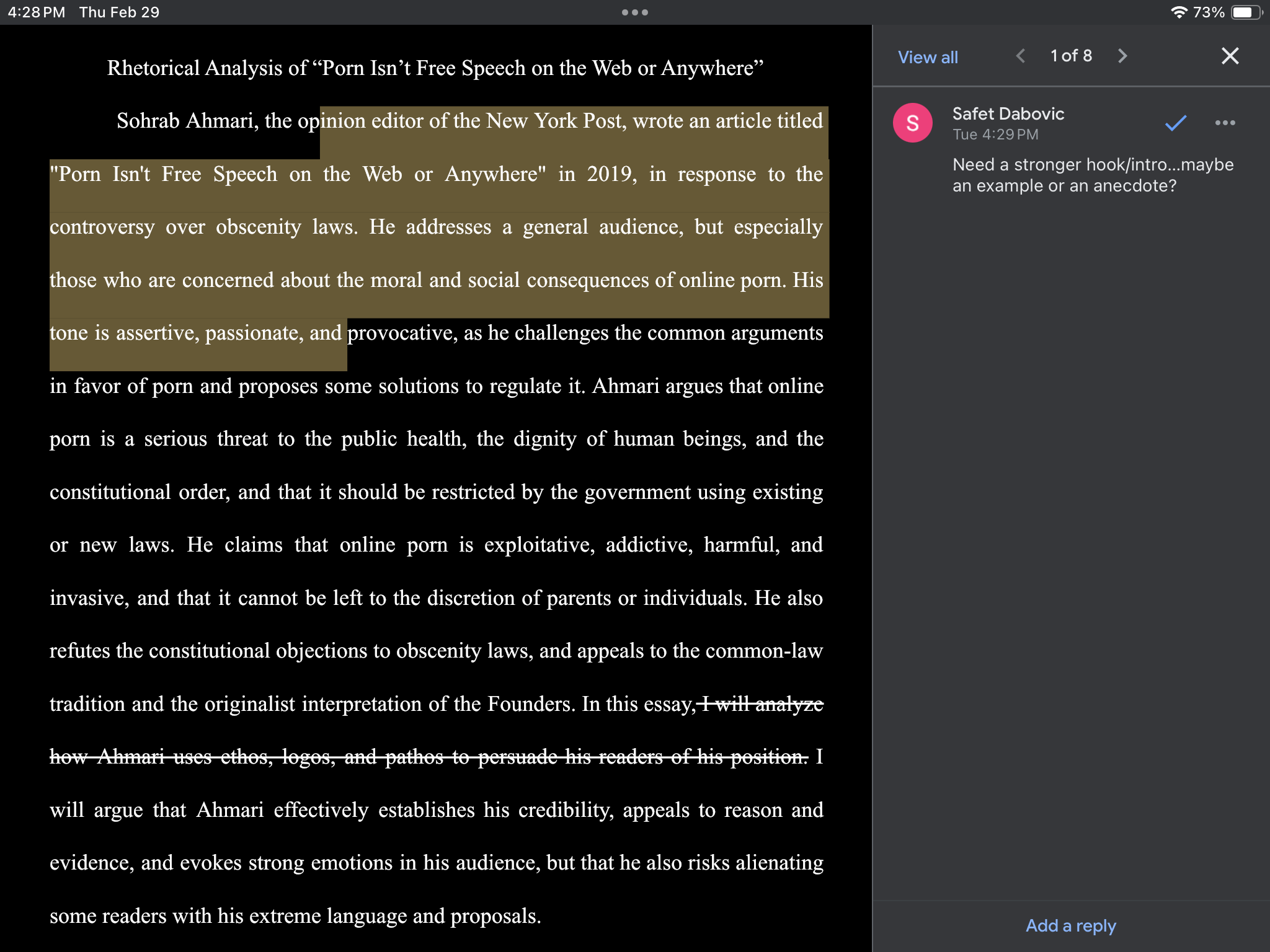
Sohrab Ahmari, the opinion editor of the New York Post, wrote an article titled "Porn Isn't Free Speech on the Web or Anywhere" in 2019, in response to the controversy over obscenity laws. He addresses a general audience, but especially those who are concerned about the moral and social consequences of online porn. His tone is assertive, passionate, and provocative, as he challenges the common arguments in favor of porn and proposes some solutions to regulate it. Ahmari argues that online porn is a serious threat to the public health, the dignity of human beings, and the constitutional order, and that it should be restricted by the government using existing or new laws. He claims that online porn is exploitative, addictive, harmful, and invasive, and that it cannot be left to the discretion of parents or individuals. He also refutes the constitutional objections to obscenity laws, and appeals to the common-law tradition and the originalist interpretation of the Founders. In this essay, I will analyze how Ahmari uses ethos, logos, and pathos to persuade his readers of his position. I will argue that Ahmari effectively establishes his credibility, appeals to reason and evidence, and evokes strong emotions in his audience, but that he also risks alienating some readers with his extreme language and proposals.
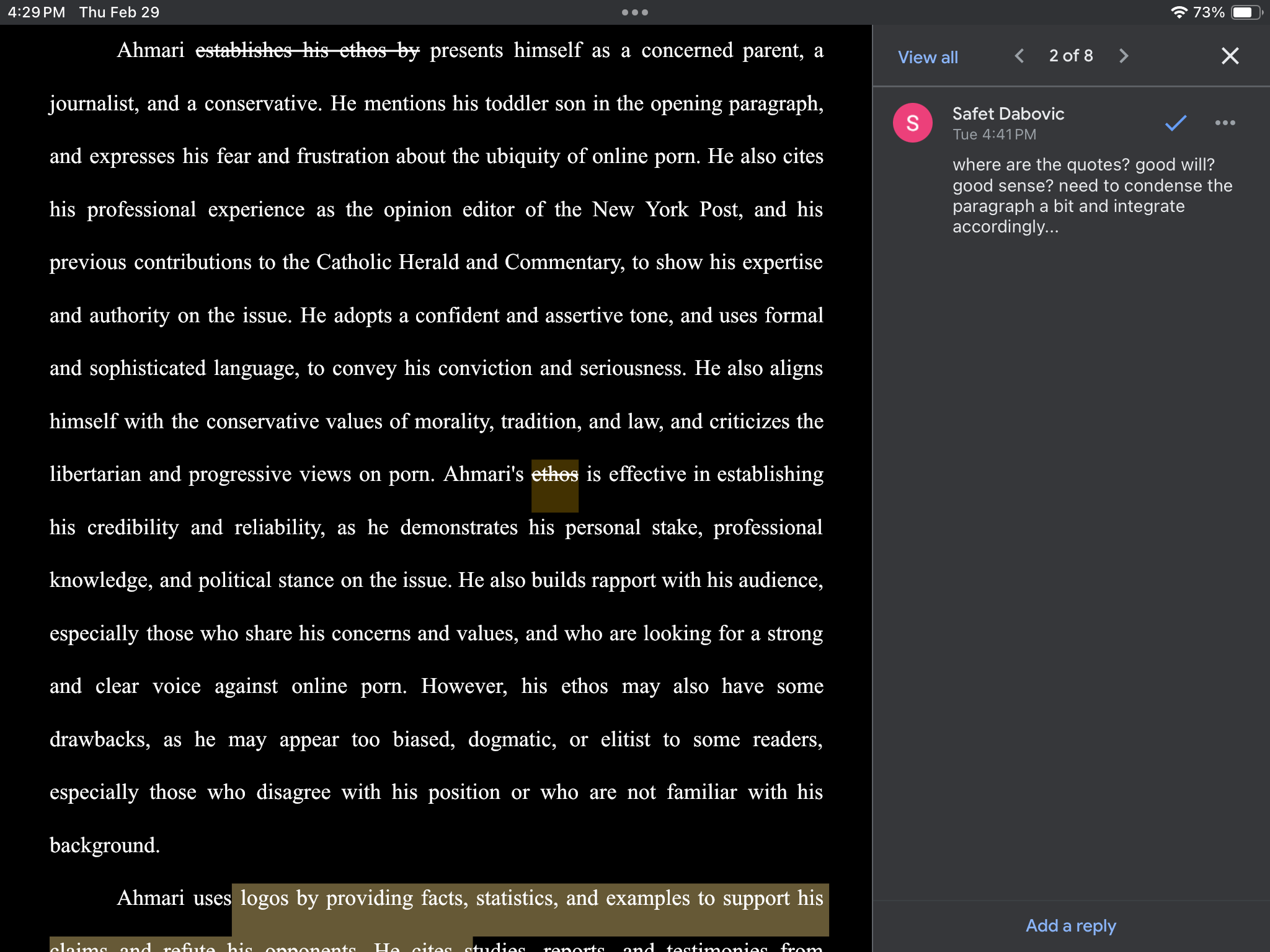
Ahmari establishes his ethos by presents himself as a concerned parent, a journalist, and a conservative. He mentions his toddler son in the opening paragraph, and expresses his fear and frustration about the ubiquity of online porn. He also cites his professional experience as the opinion editor of the New York Post, and his previous contributions to the Catholic Herald and Commentary, to show his expertise and authority on the issue. He adopts a confident and assertive tone, and uses formal and sophisticated language, to convey his conviction and seriousness. He also aligns himself with the conservative values of morality, tradition, and law, and criticizes the libertarian and progressive views on porn. Ahmari'sethos is effective in establishing his credibility and reliability, as he demonstrates his personal stake, professional knowledge, and political stance on the issue. He also builds rapport with his audience, especially those who share his concerns and values, and who are looking for a strong and clear voice against online porn. However, his ethos may also have some drawbacks, as he may appear too biased, dogmatic, or elitist to some readers, especially those who disagree with his position or who are not familiar with his background.
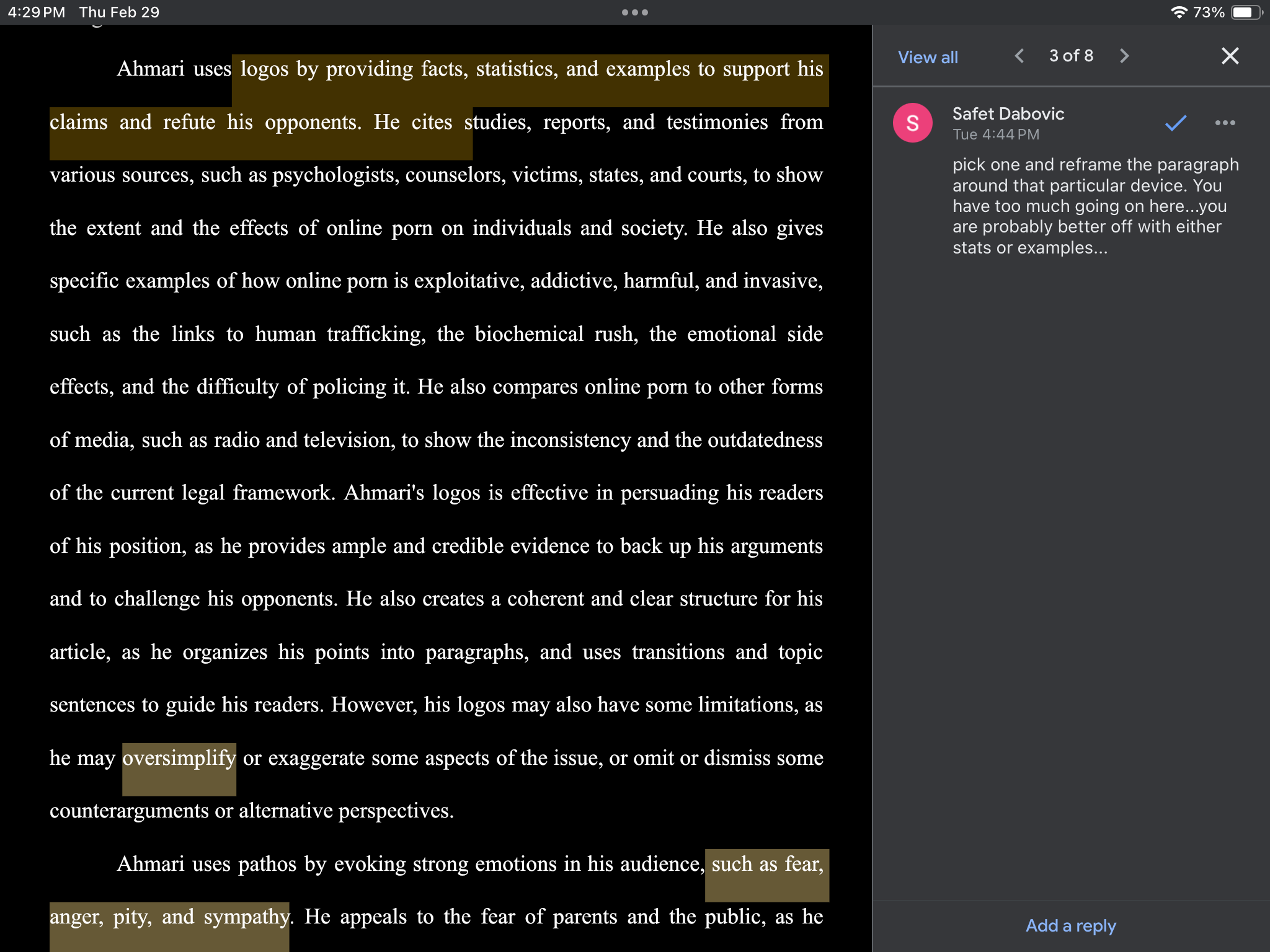
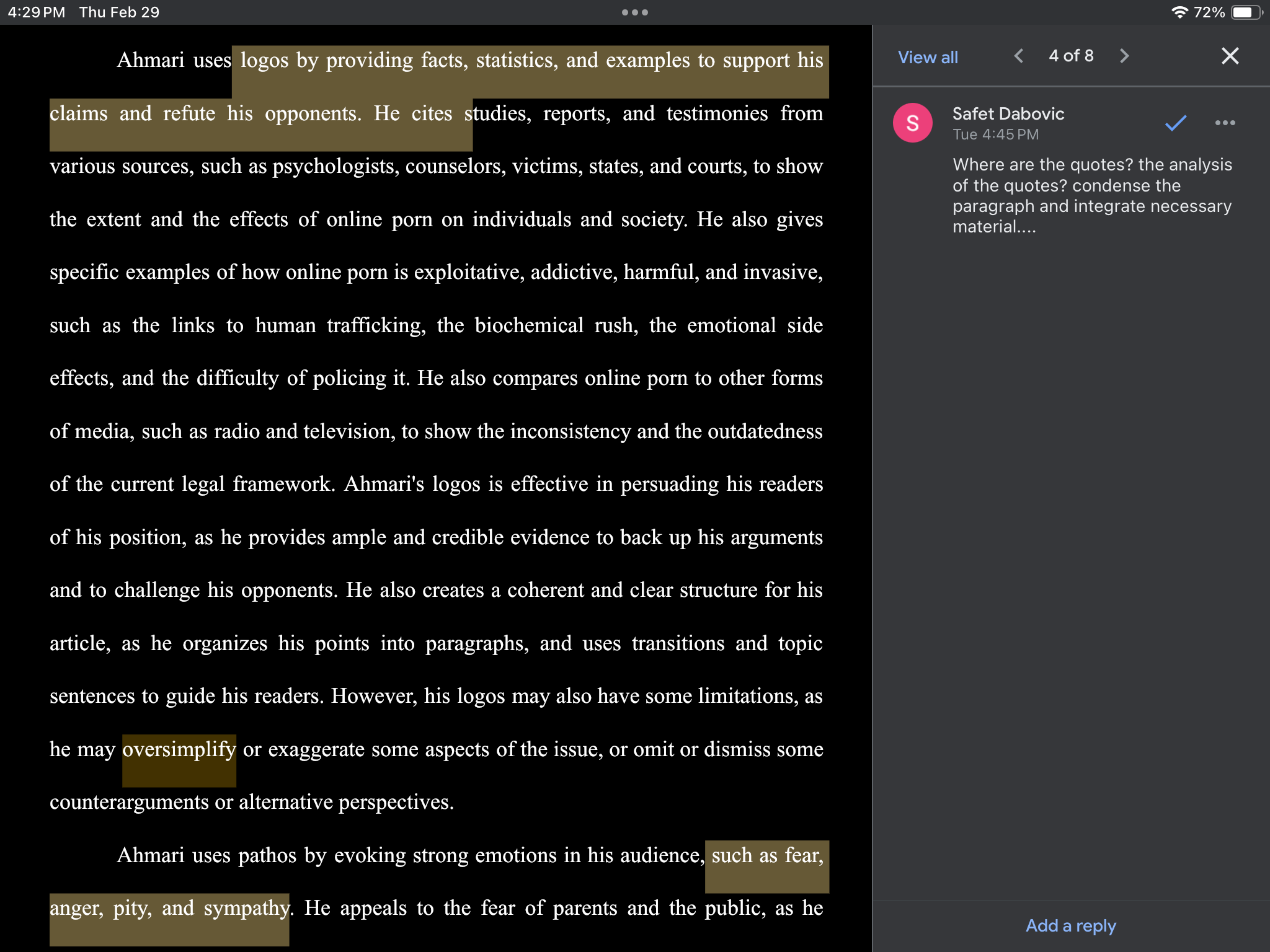
Ahmari uses logos by providing facts, statistics, and examples to support his claims and refute his opponents. He cites studies, reports, and testimonies from various sources, such as psychologists, counselors, victims, states, and courts, to show the extent and the effects of online porn on individuals and society. He also gives specific examples of how online porn is exploitative, addictive, harmful, and invasive, such as the links to human trafficking, the biochemical rush, the emotional side effects, and the difficulty of policing it. He also compares online porn to other forms of media, such as radio and television, to show the inconsistency and the outdatedness of the current legal framework. Ahmari's logos is effective in persuading his readers of his position, as he provides ample and credible evidence to back up his arguments and to challenge his opponents. He also creates a coherent and clear structure for his article, as he organizes his points into paragraphs, and uses transitions and topic sentences to guide his readers. However, his logos may also have some limitations, as he may oversimplify or exaggerate some aspects of the issue, or omit or dismiss some counterarguments or alternative perspectives.
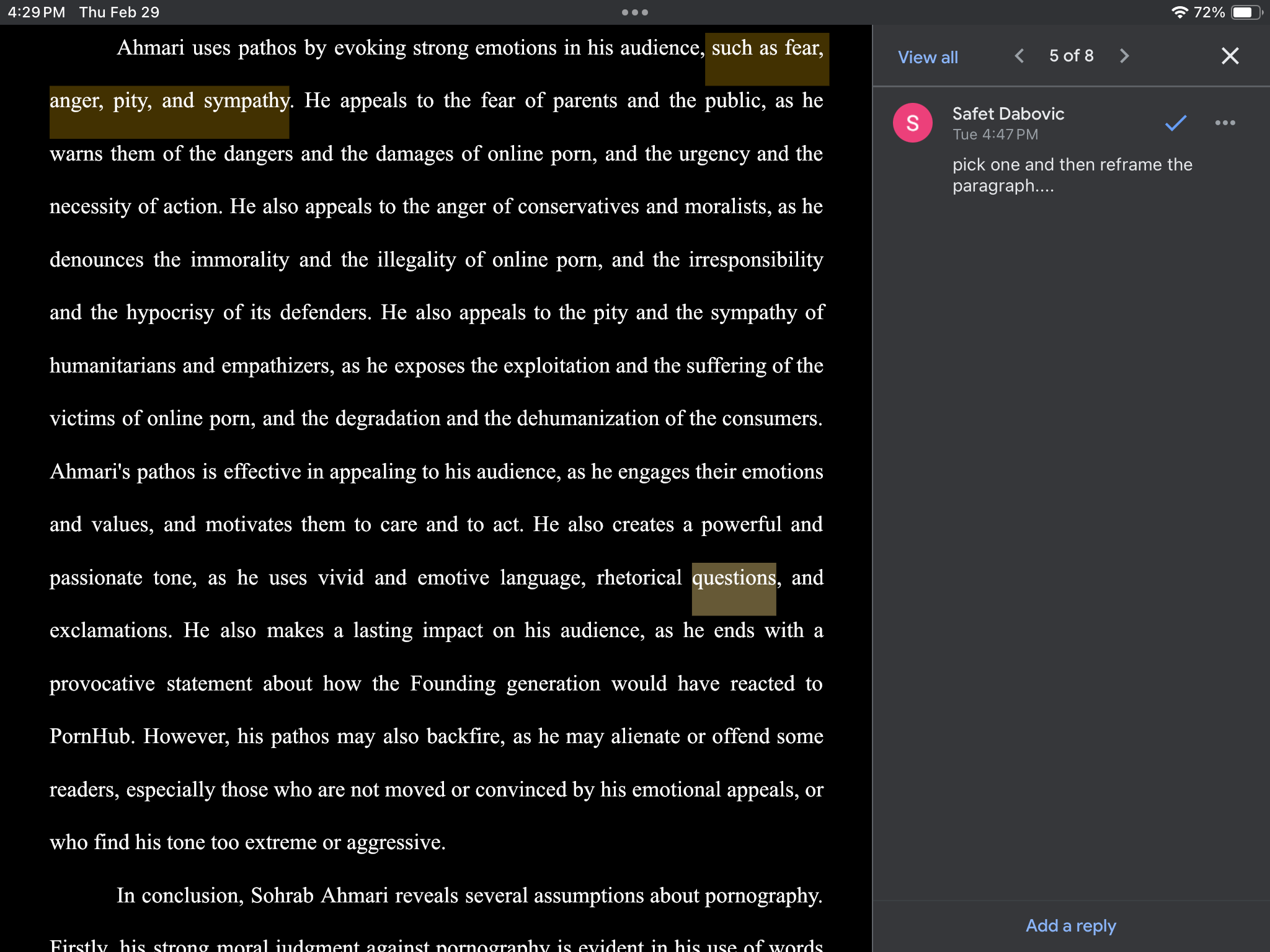
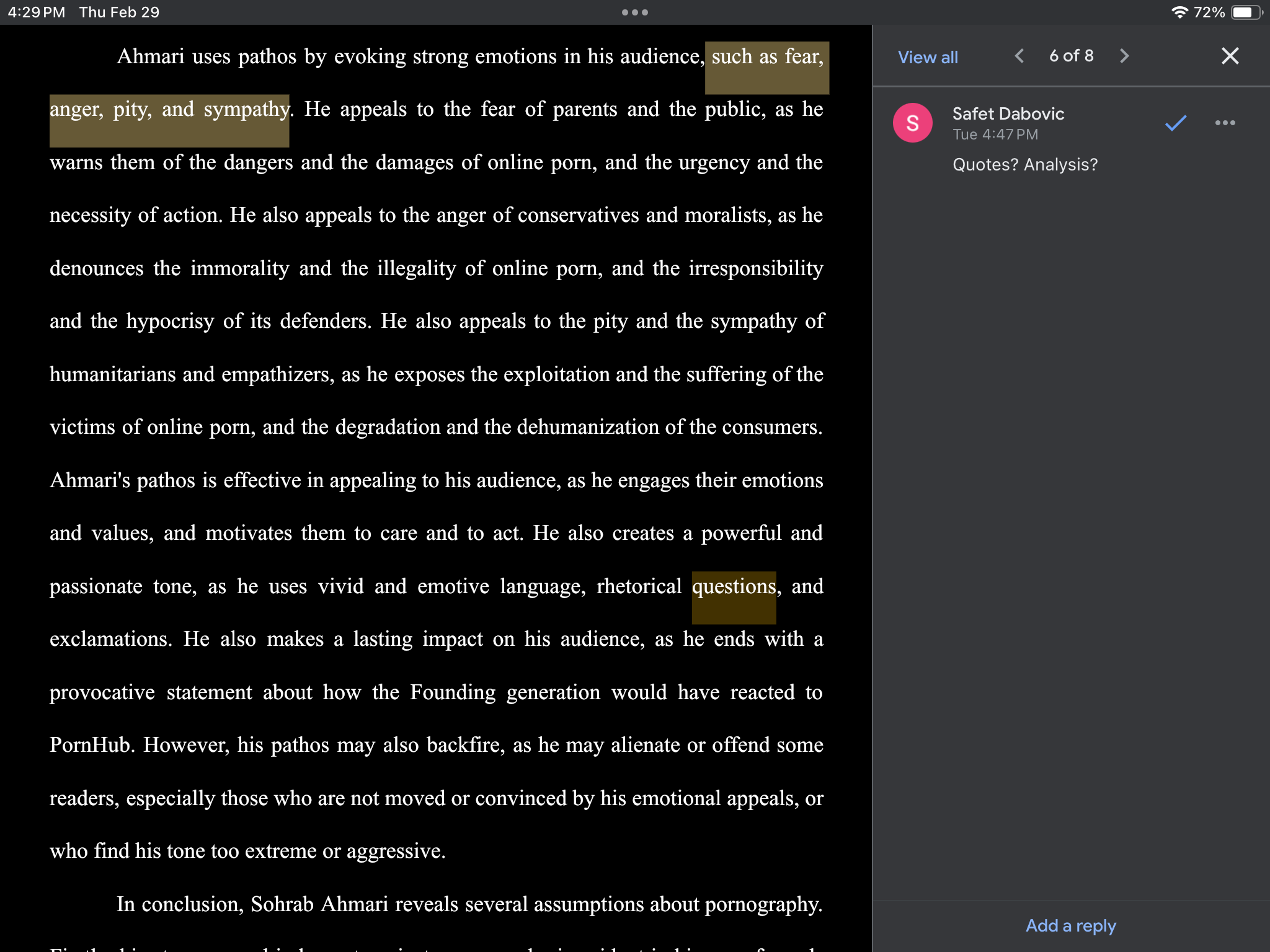
Ahmari uses pathos by evoking strong emotions in his audience, such as fear, anger, pity, and sympathy. He appeals to the fear of parents and the public, as he warns them of the dangers and the damages of online porn, and the urgency and the necessity of action. He also appeals to the anger of conservatives and moralists, as he denounces the immorality and the illegality of online porn, and the irresponsibility and the hypocrisy of its defenders. He also appeals to the pity and the sympathy of humanitarians and empathizers, as he exposes the exploitation and the suffering of the victims of online porn, and the degradation and the dehumanization of the consumers. Ahmari's pathos is effective in appealing to his audience, as he engages their emotions and values, and motivates them to care and to act. He also creates a powerful and passionate tone, as he uses vivid and emotive language, rhetorical questions, and exclamations. He also makes a lasting impact on his audience, as he ends with a provocative statement about how the Founding generation would have reacted to PornHub. However, his pathos may also backfire, as he may alienate or offend some readers, especially those who are not moved or convinced by his emotional appeals, or who find his tone too extreme or aggressive.
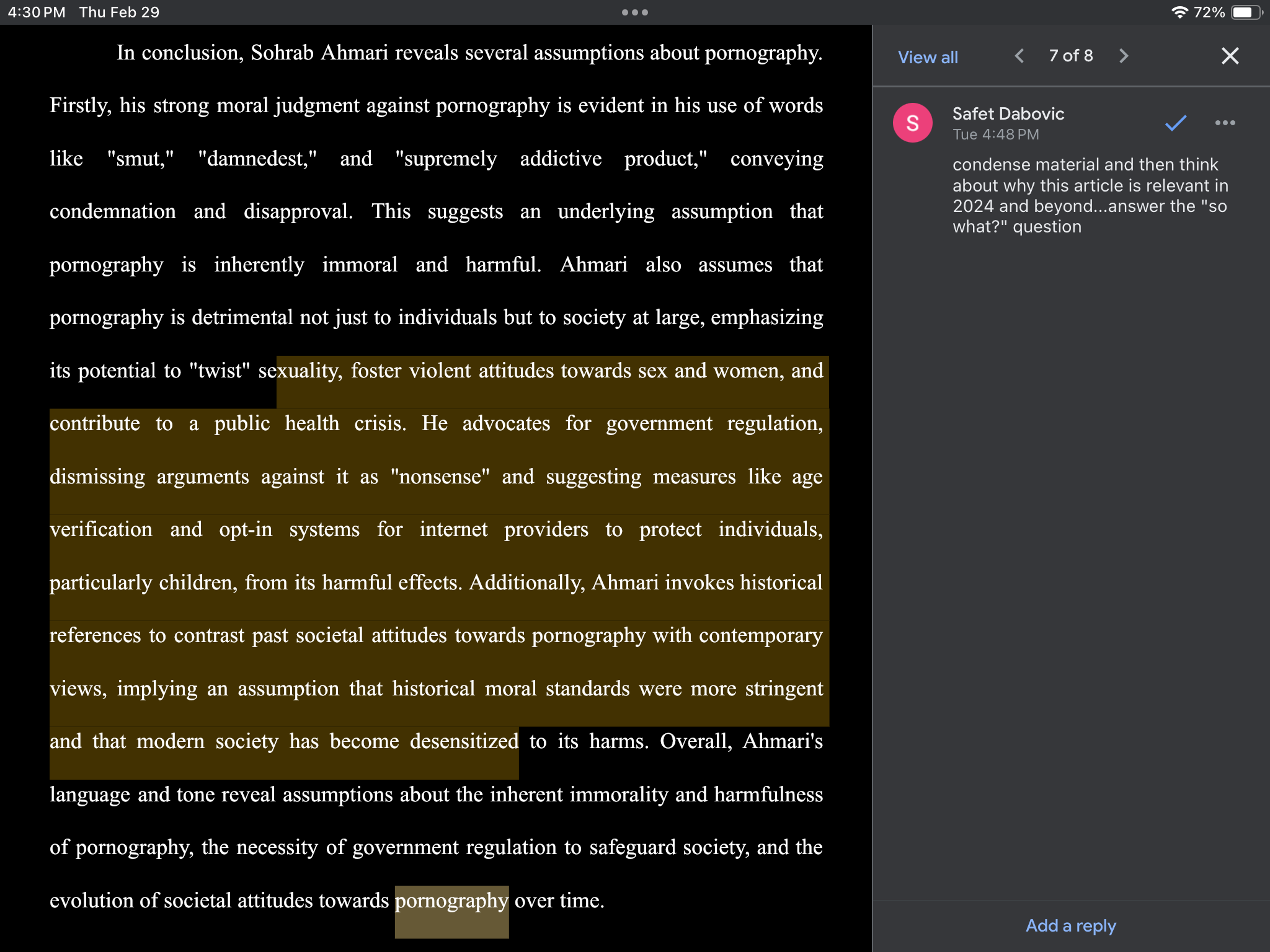
In conclusion, Sohrab Ahmari reveals several assumptions about pornography. Firstly, his strong moral judgment against pornography is evident in his use of words like "smut," "damnedest," and "supremely addictive product," conveying condemnation and disapproval. This suggests an underlying assumption that pornography is inherently immoral and harmful. Ahmari also assumes that pornography is detrimental not just to individuals but to society at large, emphasizing its potential to "twist" sexuality, foster violent attitudes towards sex and women, and contribute to a public health crisis. He advocates for government regulation, dismissing arguments against it as "nonsense" and suggesting measures like age verification and opt-in systems for internet providers to protect individuals, particularly children, from its harmful effects. Additionally, Ahmari invokes historical references to contrast past societal attitudes towards pornography with contemporary views, implying an assumption that historical moral standards were more stringent and that modern society has become desensitized to its harms. Overall, Ahmari's language and tone reveal assumptions about the inherent immorality and harmfulness of pornography, the necessity of government regulation to safeguard society, and the evolution of societal attitudes towards pornography over time.
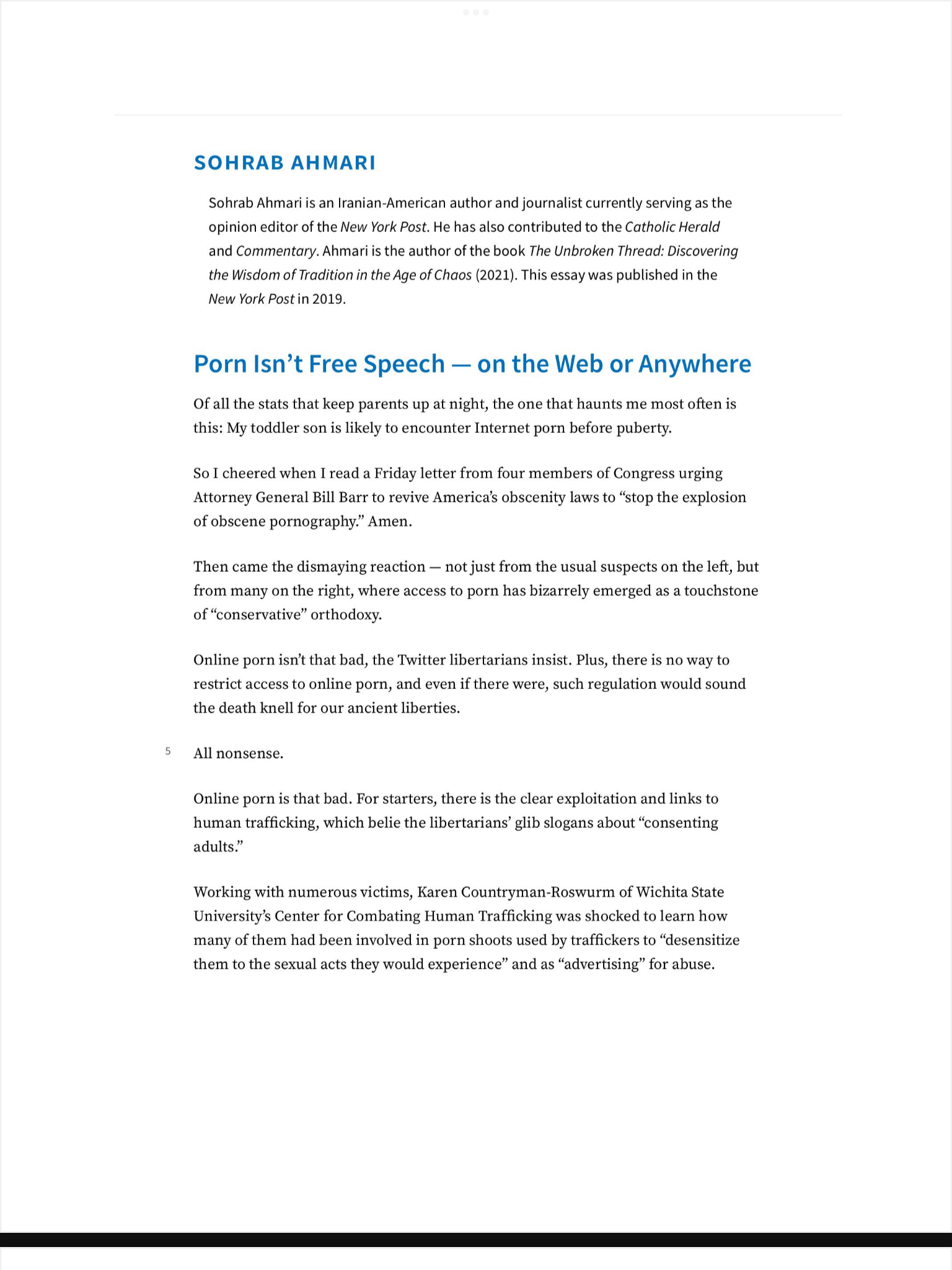
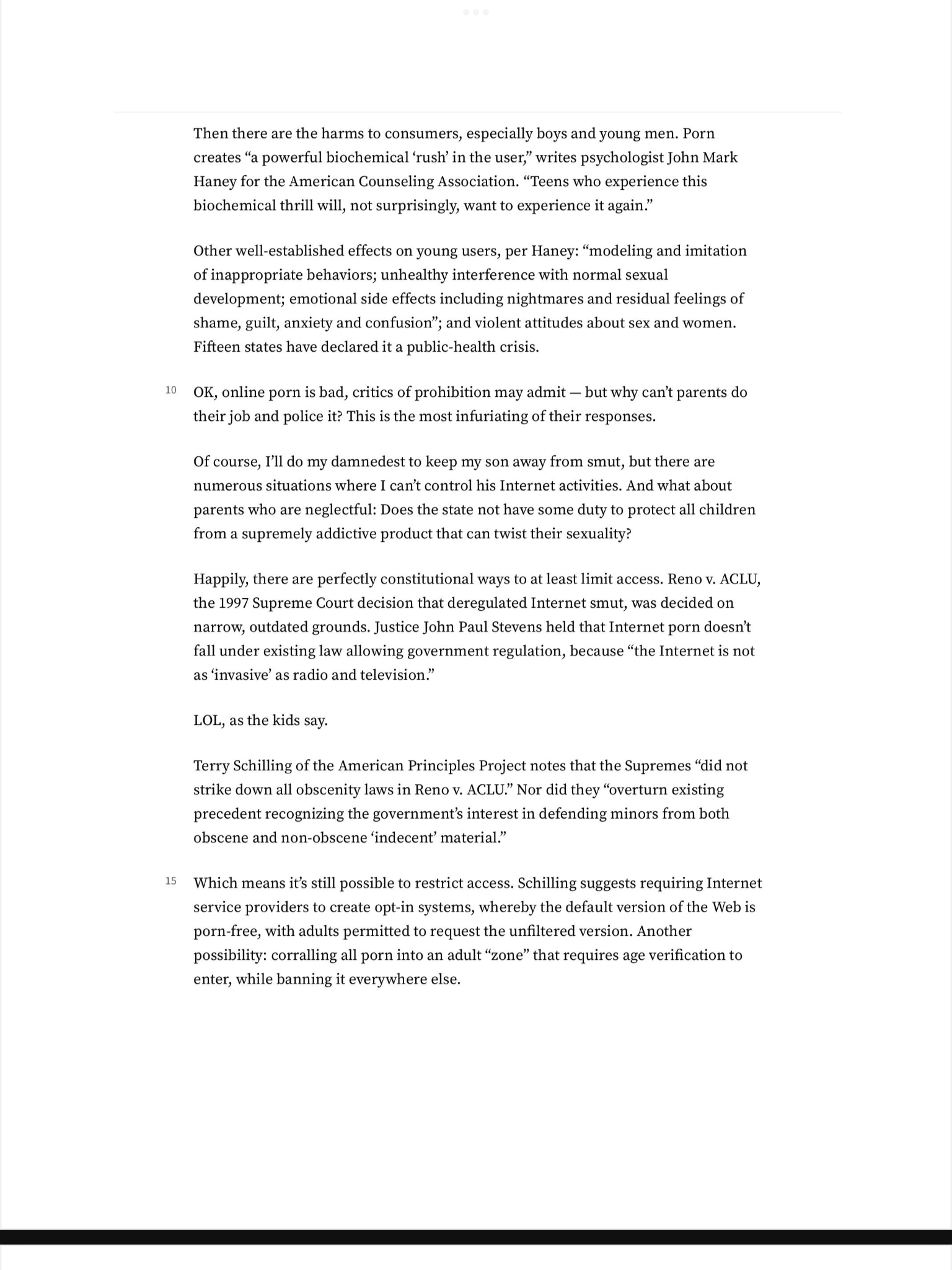
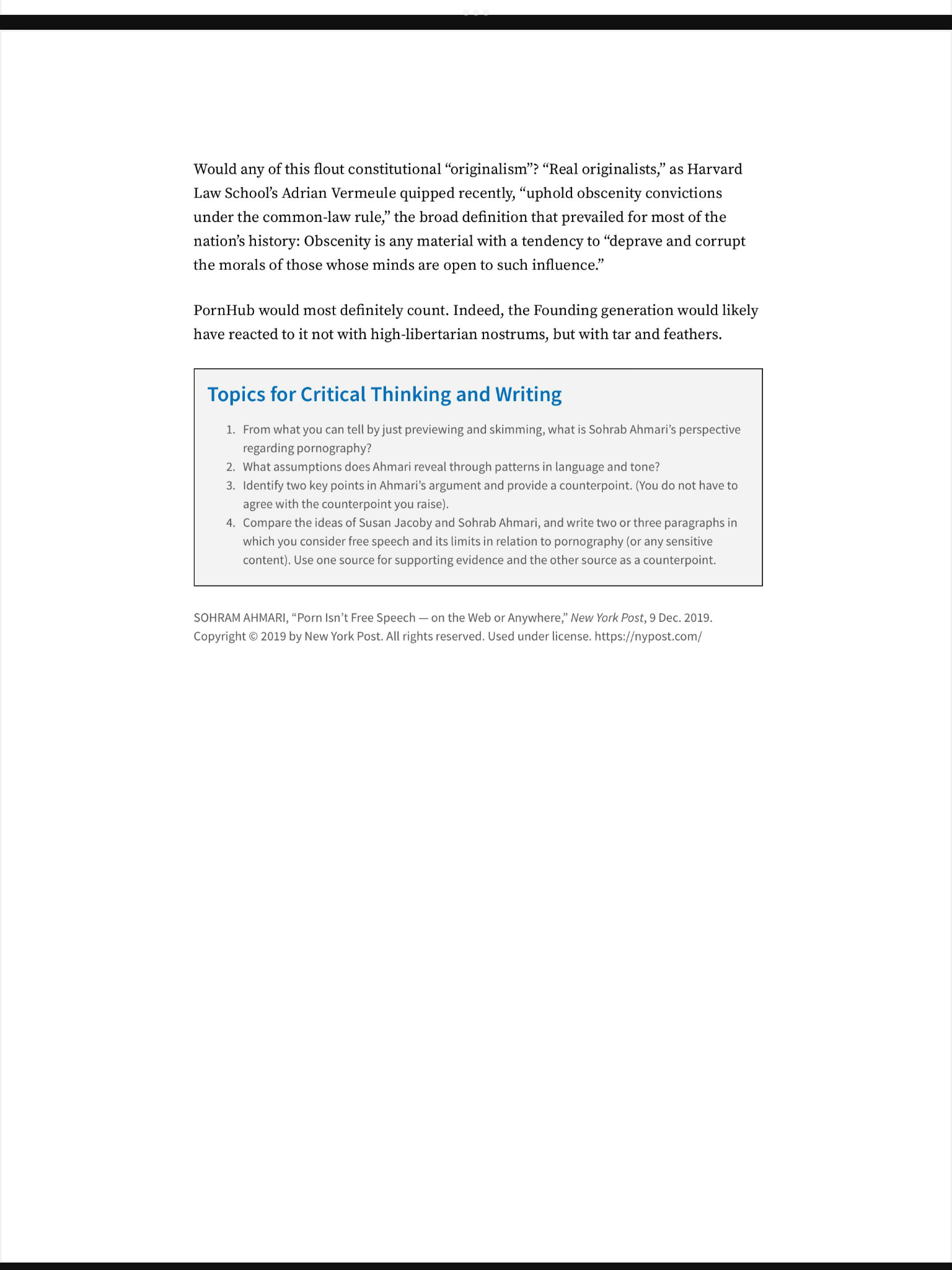
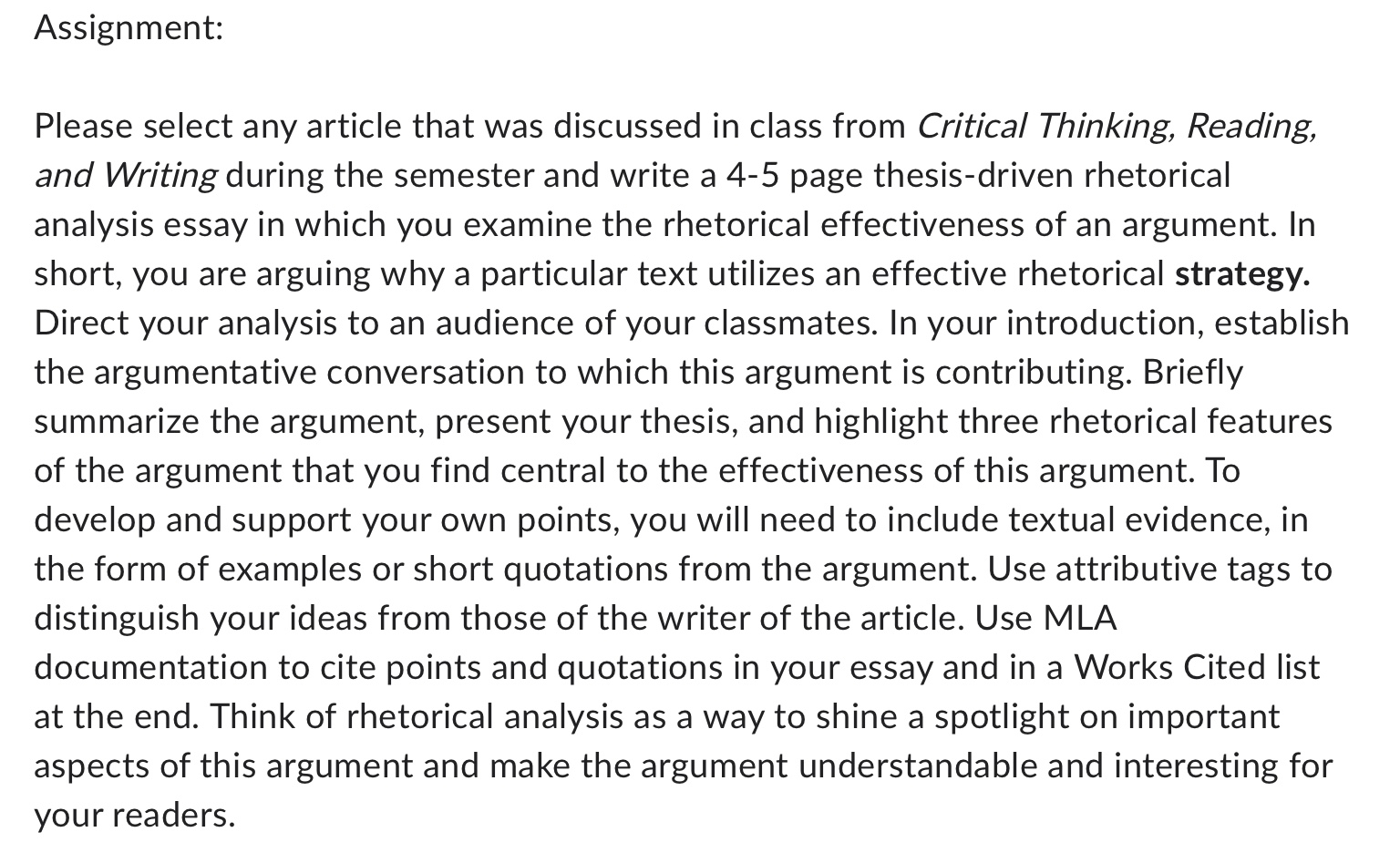
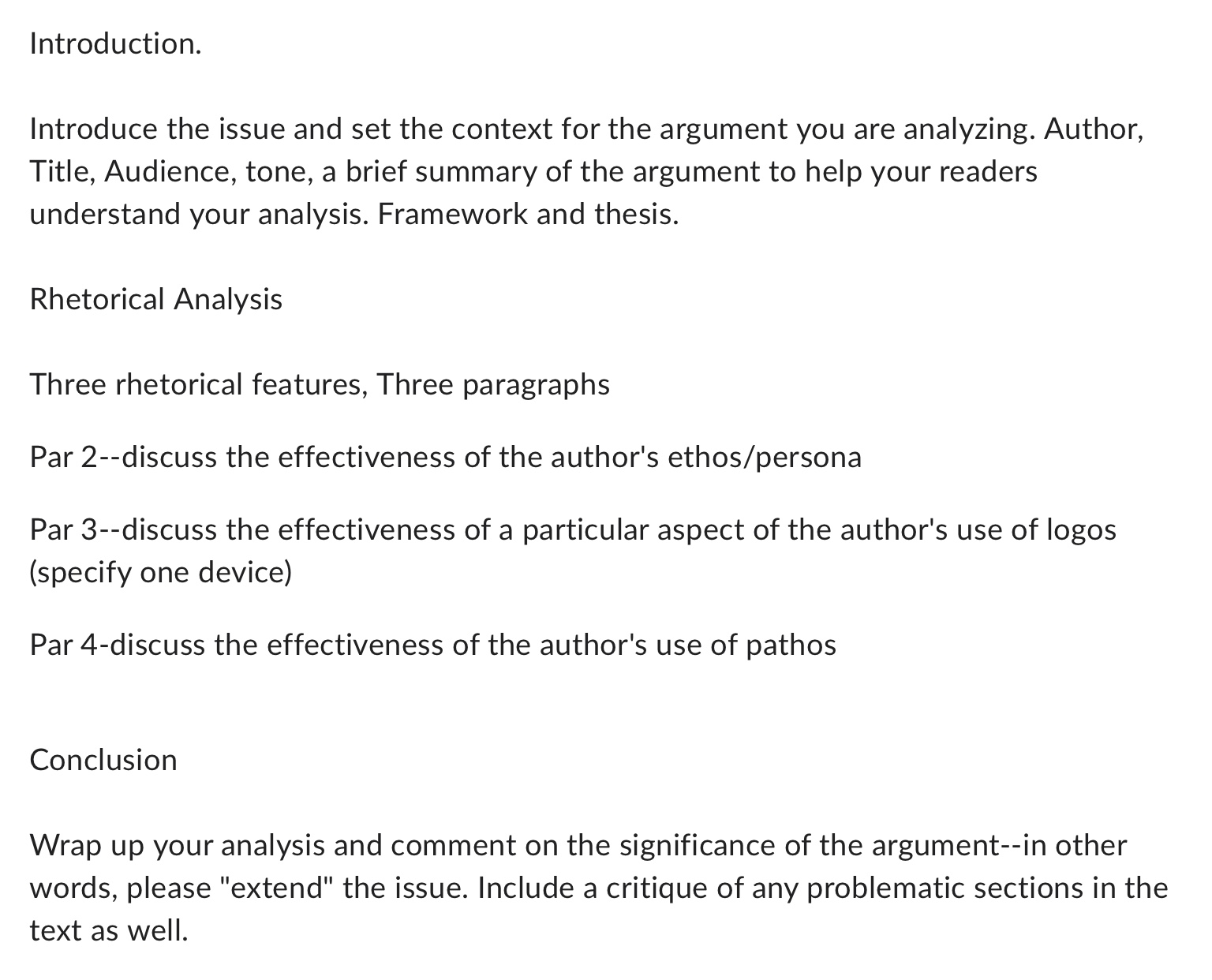
SOHRAB AHMARI Sohrab Ahmariis an Iranian-American author and journalist currently serving as the opinion editor of the New York Post. He has also contributed to the Catholic Herald and Commentary. Ahmari is the author of the book The Unbroken Thread: Discovering the Wisdom of Tradition in the Age of Chaos (2021). This essay was published in the New York Post in 2019. Porn Isn't Free Speech on the Web or Anywhere Of all the stats that keep parents up at night, the one that haunts me most often is this: My toddler son is likely to encounter Internet porn before puberty. So I cheered when I read a Friday letter from four members of Congress urging Attorney General Bill Barr to revive America's obscenity laws to \"stop the explosion of obscene pornography.\" Amen. Then came the dismaying reaction not just from the usual suspects on the left, but from many on the right, where access to porn has bizarrely emerged as a touchstone of \"conservative\" orthodoxy. Online porn isn't that bad, the Twitter libertarians insist. Plus, there is no way to restrict access to online porn, and even if there were, such regulation would sound the death knell for our ancient liberties. All nonsense. Online porn is that bad. For starters, there is the clear exploitation and links to human trafficking, which belie the libertarians' glib slogans about \"consenting adults.\" Working with numerous victims, Karen Countryman-Roswurm of Wichita State University's Center for Combating Human Trafficking was shocked to learn how many of them had been involved in porn shoots used by traffickers to \"desensitize them to the sexual acts they would experience\" and as \"advertising\" for abuse. Then there are the harms to consumers, especially boys and young men. Porn creates \"a powerful biochemical 'rush' in the user,\" writes psychologist John Mark Haney for the American Counseling Association. \"Teens who experience this biochemical thrill will, not surprisingly, want to experience it again.\" Other well-established effects on young users, per Haney: \"modeling and imitation of inappropriate behaviors; unhealthy interference with normal sexual development; emotional side effects including nightmares and residual feelings of shame, guilt, anxiety and confusion\"; and violent attitudes about sex and women. Fifteen states have declared it a public-health crisis. OK, online porn is bad, critics of prohibition may admit but why can't parents do their job and police it? This is the most infuriating of their responses. Of course, I'll do my damnedest to keep my son away from smut, but there are numerous situations where I can't control his Internet activities. And what about parents who are neglectful: Does the state not have some duty to protect all children from a supremely addictive product that can twist their sexuality? Happily, there are perfectly constitutional ways to at least limit access. Reno v. ACLU, the 1997 Supreme Court decision that deregulated Internet smut, was decided on narrow, outdated grounds. Justice John Paul Stevens held that Internet porn doesn''t fall under existing law allowing government regulation, because \"the Internet is not as 'invasive' as radio and television.\" LOL, as the kids say. Terry Schilling of the American Principles Project notes that the Supremes \"did not strike down all obscenity laws in Reno v. ACLU.\" Nor did they \"overturn existing precedent recognizing the government's interest in defending minors from both obscene and non-obscene 'indecent' material.\" Which means it's still possible to restrict access. Schilling suggests requiring Internet service providers to create opt-in systems, whereby the default version of the Web is porn-free, with adults permitted to request the unfiltered version. Another possibility: corralling all porn into an adult \"zone\" that requires age verification to enter, while banning it everywhere else. Would any of this flout constitutional \"originalism\"? \"Real originalists,\" as Harvard Law School's Adrian Vermeule quipped recently, \"uphold obscenity convictions under the common-law rule,\" the broad definition that prevailed for most of the nation's history: Obscenity is any material with a tendency to \"deprave and corrupt the morals of those whose minds are open to such influence.\" PornHub would most definitely count. Indeed, the Founding generation would likely have reacted to it not with high-libertarian nostrums, but with tar and feathers. Topics for Critical Thinking and Writing 1. From what you can tell by just previewing and skimming, what is Sohrab Ahmari's perspective regarding pornography? 2. What assumptions does Ahmari reveal through patterns in language and tone? 3. Identify two key points in Ahmari's argument and provide a counterpoint. (You do not have to agree with the counterpoint you raise). 4. Compare the ideas of Susan Jacoby and Sohrab Ahmari, and write two or three paragraphs in which you consider free speech and its limits in relation to pornography (or any sensitive content). Use one source for supporting evidence and the other source as a counterpoint. SOHRAM AHMARI, \"Porn Isn't Free Speech on the Web or Anywhere,\" New York Post, 9 Dec. 2019. Copyright 2019 by New York Post. All rights reserved. Used under license. https:/ypost.com/ 4:28PM Thu Feb 29 v B Rhetorical Analysis of \"Porn Isn't Free Speech on the Web or Anywhere\" e B Sohrab Ahmari, the opinion editor of the New York Post, wrote an article titled ?afit_ ,?Ja;?"ic ue 4:29 PM Need a stronger hook/intro...maybe "Porn Isn't Free Speech on the Web or Anywhere" in 2019, in response to the an example or an anecdote? controversy over obscenity laws. He addresses a general audience, but especially those who are concerned about the moral and social consequences of online porn. His tone is assertive, passionate, and provocative, as he challenges the common arguments in favor of porn and proposes some solutions to regulate it. Ahmari argues that online porn is a serious threat to the public health, the dignity of human beings, and the constitutional order, and that it should be restricted by the government using existing or new laws. He claims that online porn is exploitative, addictive, harmful, and invasive, and that it cannot be left to the discretion of parents or individuals. He also refutes the constitutional objections to obscenity laws, and appeals to the common-law tradition and the originalist interpretation of the Founders. In this essay, wiltanalyze will argue that Ahmari effectively establishes his credibility, appeals to reason and evidence, and evokes strong emotions in his audience, but that he also risks alienating some readers with his extreme language and proposals. I 4:29 PM Thu Feb 29 73% Ahmari establishes his ethos by presents himself as a concerned parent, a View all Ahmari uses logos by providing facts, statistics, and examples to support his e Safet Dabovic claims and refute his opponents. He cites studies, reports, and testimonies from A pick one and reframe the paragraph around that particular device. You have too much going on here...you the extent and the effects of online porn on individuals and society. He also gives are probably better off with either stats or examples... various sources, such as psychologists, counselors, victims, states, and courts, to show specific examples of how online porn is exploitative, addictive, harmful, and invasive, such as the links to human trafficking, the biochemical rush, the emotional side effects, and the difficulty of policing it. He also compares online porn to other forms of media, such as radio and television, to show the inconsistency and the outdatedness of the current legal framework. Ahmari's logos is effective in persuading his readers of his position, as he provides ample and credible evidence to back up his arguments and to challenge his opponents. He also creates a coherent and clear structure for his article, as he organizes his points into paragraphs, and uses transitions and topic sentences to guide his readers. However, his logos may also have some limitations, as he may oversimplify or exaggerate some aspects of the issue, or omit or dismiss some counterarguments or alternative perspectives. Ahmari uses pathos by evoking strong emotions in his audience,/such as fear, anger, pity, and sympathy. He appeals to the fear of parents and the public, as he Add a reply 4:29PM Thu Feb 29 A7y B Ahmari uses logos by providing facts, statistics, and examples to support his VLD AL claims and refute his opponents. He cites studies, reports, and testimonies from NI B YV Tue 4:45PM various sources, such as psychologists, counselors, victims, states, and courts, to show Where are the quotes? the analysis of the quotes? condense the R e ge . R . paragraph and integrate necessary the extent and the effects of online porn on individuals and society. He also gives e specific examples of how online porn is exploitative, addictive, harmful, and invasive, such as the links to human trafficking, the biochemical rush, the emotional side effects, and the difficulty of policing it. He also compares online porn to other forms of media, such as radio and television, to show the inconsistency and the outdatedness of the current legal framework. Ahmari's logos is effective in persuading his readers of his position, as he provides ample and credible evidence to back up his arguments and to challenge his opponents. He also creates a coherent and clear structure for his article, as he organizes his points into paragraphs, and uses transitions and topic sentences to guide his readers. However, his logos may also have some limitations, as he may oversimplify or exaggerate some aspects of the issue, or omit or dismiss some counterarguments or alternative perspectives. Ahmari uses pathos by evoking strong emotions in his audience, such as fear, anger, pity, and sympathy. He appeals to the fear of parents and the public, as he Add a reply 4:29PM Thu Feb 29 see A7y B Ahmari uses pathos by evoking strong emotions in his audience, such as fear, View all T T anger, pity, and sympathy. He appeals to the fear of parents and the public, as he e Tue 4:47PM warns them of the dangers and the damages of online porn, and the urgency and the eI e B G (U paragraph.... necessity of action. He also appeals to the anger of conservatives and moralists, as he denounces the immorality and the illegality of online porn, and the irresponsibility and the hypocrisy of its defenders. He also appeals to the pity and the sympathy of humanitarians and empathizers, as he exposes the exploitation and the suffering of the victims of online porn, and the degradation and the dehumanization of the consumers. Ahmari's pathos is effective in appealing to his audience, as he engages their emotions and values, and motivates them to care and to act. He also creates a powerful and passionate tone, as he uses vivid and emotive language, rhetorical questions, and exclamations. He also makes a lasting impact on his audience, as he ends with a provocative statement about how the Founding generation would have reacted to PornHub. However, his pathos may also backfire, as he may alienate or offend some readers, especially those who are not moved or convinced by his emotional appeals, or who find his tone too extreme or aggressive. In conclusion, Sohrab Ahmari reveals several assumptions about pornography. Add a reply 4:29PM Thu Feb 29 eee EFFA B Ahmari uses pathos by evoking strong emotions in his audience, such as fear, View all anger, pity, and sympathy. He appeals to the fear of parents and the public, as he (R AT e Tue 4:47PM warns them of the dangers and the damages of online porn, and the urgency and the Quotes? Analysis? necessity of action. He also appeals to the anger of conservatives and moralists, as he denounces the immorality and the illegality of online porn, and the irresponsibility and the hypocrisy of its defenders. He also appeals to the pity and the sympathy of humanitarians and empathizers, as he exposes the exploitation and the suffering of the victims of online porn, and the degradation and the dehumanization of the consumers. Ahmari's pathos is effective in appealing to his audience, as he engages their emotions and values, and motivates them to care and to act. He also creates a powerful and passionate tone, as he uses vivid and emotive language, rhetorical questions, and exclamations. He also makes a lasting impact on his audience, as he ends with a provocative statement about how the Founding generation would have reacted to PornHub. However, his pathos may also backfire, as he may alienate or offend some readers, especially those who are not moved or convinced by his emotional appeals, or who find his tone too extreme or aggressive. In conclusion, Sohrab Ahmari reveals several assumptions about pornography. Add a reply 4:30PM Thu Feb 29 see A7 B In conclusion, Sohrab Ahmari reveals several assumptions about pornography. e Firstly, his strong moral judgment against pornography is evident in his use of words [T Tue 4:48 PM like "smut," "damnedest," and "supremely addictive product," conveying e ERse mEierE ama ke ik about why this article is relevant in condemnation and disapproval. This suggests an underlying assumption that 2024 and beyond...answer the "so what?" question pornography is inherently immoral and harmful. Ahmari also assumes that pornography is detrimental not just to individuals but to society at large, emphasizing its potential to "twist" sexuality, foster violent attitudes towards sex and women, and contribute to a public health crisis. He advocates for government regulation, dismissing arguments against it as "nonsense" and suggesting measures like age verification and opt-in systems for internet providers to protect individuals, particularly children, from its harmful effects. Additionally, Ahmari invokes historical references to contrast past societal attitudes towards pornography with contemporary views, implying an assumption that historical moral standards were more stringent and that modern society has become desensitized to its harms. Overall, Ahmari's language and tone reveal assumptions about the inherent immorality and harmfulness of pornography, the necessity of government regulation to safeguard society, and the evolution of societal attitudes towards pornography over time. Add a reply Assignment: Please select any article that was discussed in class from Critical Thinking, Reading, and Writing during the semester and write a 4-5 page thesis-driven rhetorical analysis essay in which you examine the rhetorical effectiveness of an argument. In short, you are arguing why a particular text utilizes an effective rhetorical strategy. Direct your analysis to an audience of your classmates. In your introduction, establish the argumentative conversation to which this argument is contributing. Briefly summarize the argument, present your thesis, and highlight three rhetorical features of the argument that you find central to the effectiveness of this argument. To develop and support your own points, you will need to include textual evidence, in the form of examples or short quotations from the argument. Use attributive tags to distinguish your ideas from those of the writer of the article. Use MLA documentation to cite points and quotations in your essay and in a Works Cited list at the end. Think of rhetorical analysis as a way to shine a spotlight on important aspects of this argument and make the argument understandable and interesting for your readers. Introduction. Introduce the issue and set the context for the argument you are analyzing. Author, Title, Audience, tone, a brief summary of the argument to help your readers understand your analysis. Framework and thesis. Rhetorical Analysis Three rhetorical features, Three paragraphs Par 2--discuss the effectiveness of the author's ethos/persona Par 3--discuss the effectiveness of a particular aspect of the author's use of logos (specify one device) Par 4-discuss the effectiveness of the author's use of pathos Conclusion Wrap up your analysis and comment on the significance of the argument--in other words, please "extend" the issue. Include a critique of any problematic sections in the text as well
Step by Step Solution
There are 3 Steps involved in it
1 Expert Approved Answer
Step: 1 Unlock
Question Has Been Solved by an Expert!
Get step-by-step solutions from verified subject matter experts
Step: 2 Unlock
Step: 3 Unlock
Students Have Also Explored These Related Business Writing Questions!