



Question: please help Data Sheet The Determination of Acid Content in Vinegar Reading assignment: Chang, Chemistry 10 edition, pages 153-156. We will use a titration to
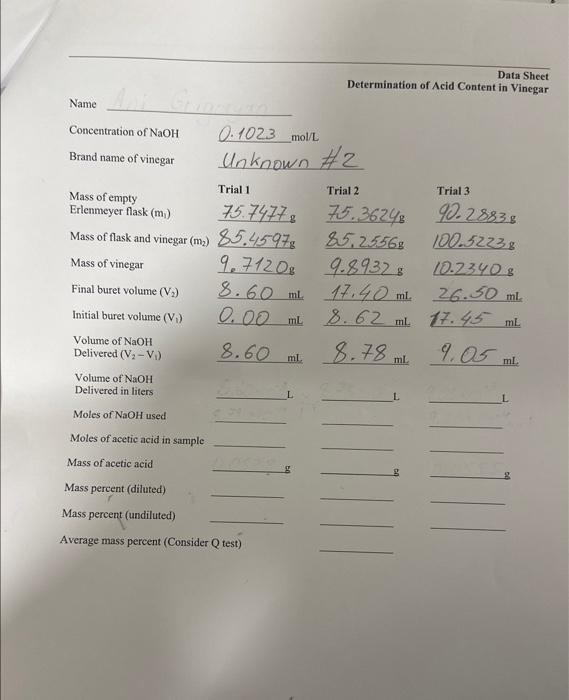
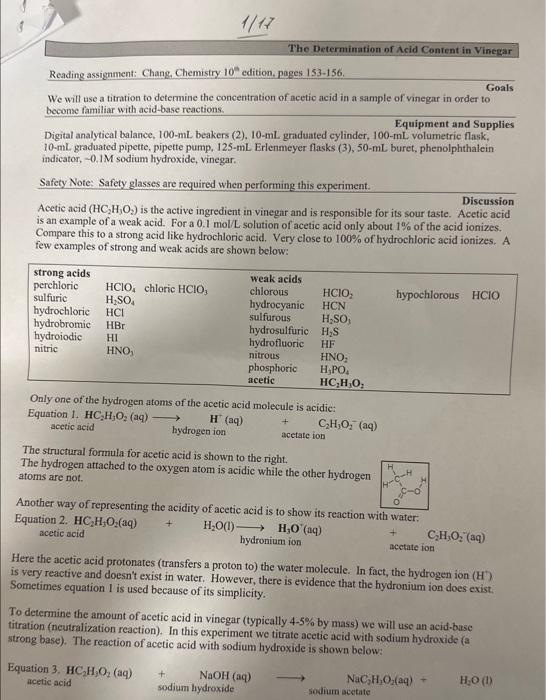
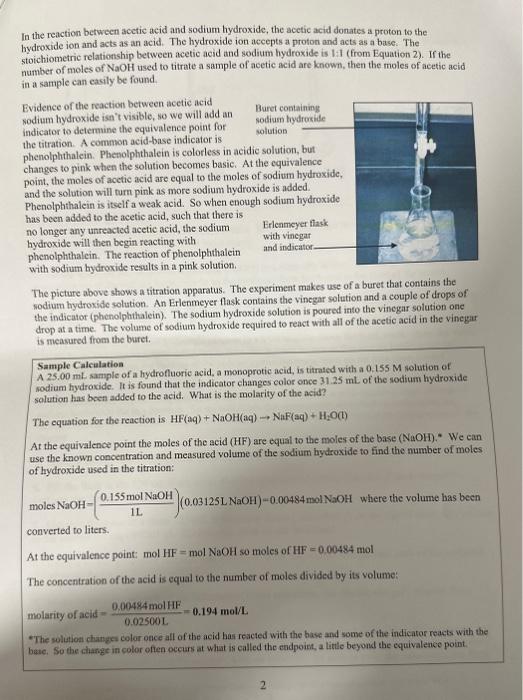
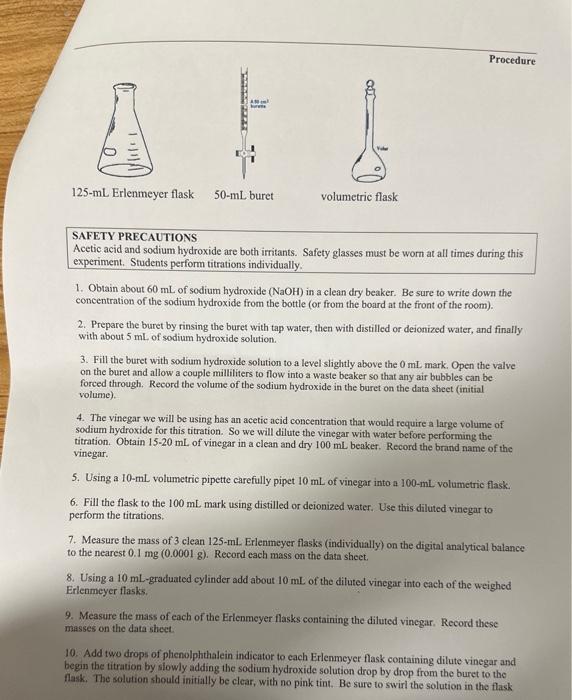
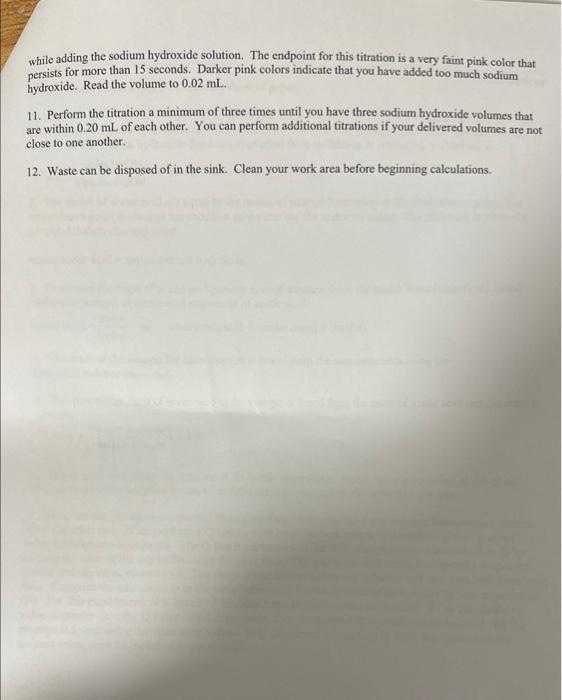
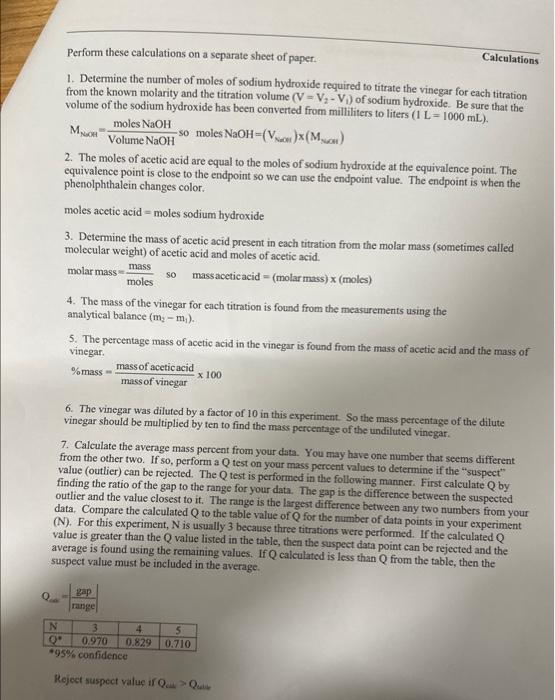
Data Sheet The Determination of Acid Content in Vinegar Reading assignment: Chang, Chemistry 10 edition, pages 153-156. We will use a titration to determine the concentration of acetic acid in a sample of vinegar in order to become familiar with acid-base reactions. Equipment and Supplies Digital analytical balance, 100-mL beakers (2), 10-mL graduated cylinder, 100-mL volumetric flask, 10-mL graduated pipette, pipette pump, 125-mL Erlenmeyer flasks (3), 50-mL buret, phenolphthalein indicator, 0.1M sodium hydroxide, vinegar. Safety Note: Safety glasses are required when performing this experiment. Acetic acid (HC2H3O2) is the active ingredient in vinegar and is responsible for its sour taste. Acetic acid is an example of a weak acid. For a 0.1molL solution of acetic acid only about 1% of the acid ionizes. Compare this to a strong acid like hydrochloric acid. Very close to 100% of hydrochloric acid ionizes. A few examples of strong and weak acids are shown below: Only one of the hydrogen atoms of the acetic acid molecule is acidic: Equation 1. HC2H3O2(aq)hyaH+(aq) +C2H3O2(aq) The structural formula for acetic acid is shown to the right. The hydrogen attached to the oxygen atom is acidic while the other hydrogen atoms are not. Another way of representing the acidity of acetic acid is to show its reaction with Equation 2. HC2H5O2(aq)+H2O(l)H3O+(aq) it acetic acid +C2H3O2 (aq) Here the acetic acid protonates (transfers a proton to) the water molecule. In fact, the hydrogen ion ( H ) is very reactive and doesn't exist in water. However, there is evidence that the hydronium ion does exist. Sometimes equation 1 is used because of its simplicity. To determine the amount of acetic acid in vinegar (typically 45% by mass) we will use an acid-buse titration (neutralization reaction). In this experiment we titrate acetic acid with sodium hydroxide (a strong base). The reaction of acetic acid with sodium hydroxide is shown below: Equation 3. HC2H3O2(aq)+sodiumhydroxideNaOH(aq)NaC2H3O2(aq)+H2O (1) In the reaction berween acctic acid and sodium hydroxide, the acctic acid donates a proton to the hydroxide ion and acts as an acid. The hydroxide ion accepts a proton and acts as a base. The. stoichiometric relationship between acetio acid and sodium hydroxide is 1:1 (from Equation 2). If the number of moles of NaOH used to titrate a sample of acetic acid are known, then the moles of acetic acid in a sample can casily be found Evidence of the reaction between acetic acid sodium hydroxide isn't visible, so we will add an . Bui indicator to determine the equivalence point for sod the titration. A common acid-base indicator is phenolphthalein. Phenolphthalein is colorless in acidic st changes to pink when the solution becomes basic. At the point, the moles of acctic acid are equal to the moles of s and the solution will turn pink as more sodium hydroxide Phenolphthalein is itself a weak acid. So when enough s has been added to the acetic acid, such that there is no longer any unreacted acetic acid, the sodium hydroxide will then begint reacting with phenolphthalein. The reaction of phenolphthalein with sodium bydroxide results in a pink solution. The picture above shows a titration apparatus. The experiment makes use of a buret that contains the nodium bydroxide solution. An Erlenmeyer flask contains the vincgar solution and a couple of drops of the indicator (phenolphthalein). The sodium bydroxide solution is poured into the vinegar solution one drop at a time. The volume of sodium hydroxide reguired to react with all of the acctic acid in the vinegar is measured from the buret. Sample Calculation A 25.00ml sample of a hydrofluoric acid, a monoprotic acid, is titraled with a 0.155M solution of sodium hydroxide. It is found that the indicator changes color once 31.25mL of the sodium hydroxide solution has been added to the acid. What is the molarity of the acid? The equation for the reaction is HF(aq)+NaOH(aq)NaF(aq)+H2O(l) At the equivalence point the moles of the acid (HF) are equal to the moles of the base ( NaOH)." We can use the known concentration and measured volume of the sodium hydroxide to find the number of moles of hydroxide used in the titration: moles NaOH=(1L0.155molNaOH)(0.03125LNaOH)=0.00484molNaOH where the volume has been converted to liters. At the equivalence point: mol HF = mol NaOH so moles of HF =0.00484 mol The concentration of the acid is equal to the number of moles divided by its volume: molarity of acid =0.02500L0.00484molHF=0.194mol/L *The solutioa changes color once all of the acid has reacied with the have and some of the indicator reacts with the base. So the charyge in color often ocears at what is called the endpoint, a little beyond the equivalence point. SAFETY PRECAUTIONS Acetic acid and sodium hydroxide are both irritants. Safety glasses must be worn at all times during this experiment. Students perform titrations individually. 1. Obtain about 60mL of sodium hydroxide (NaOH) in a clean dry beaker. Be sure to write down the concentration of the sodium hydroxide from the bottle (or from the board at the front of the room). 2. Prepare the buret by rinsing the buret with tap water, then with distilled or deionized water, and finally with about 5mL of sodium hydroxide solution. 3. Fill the buret with sodium hydroxide solution to a level slightly above the 0mL mark. Open the valve on the buret and allow a couple milliliters to flow into a waste beaker so that any air bubbles can be forced through. Record the volume of the sodium hydroxide in the buret on the data shicet (initial volume). 4. The vinegar we will be using has an acetic acid concentration that would require a large volume of sodium hydroxide for this titration. So we will dilute the vinegar with water before performing the titration. Obtain 15-20 mL of vinegar in a clean and dry 100mL beaker. Record the brand name of the vinegar. 5. Using a 10-mL volumetric pipette carefully pipet 10mL of vinegar into a 100mL volumetric flask. 6. Fill the flask to the 100mL mark using distilled or deionized water. Use this diluted vinegar to perform the titrations. 7. Measure the mass of 3 clean 125mL. Erlenmeyer flasks (individually) on the digital analytical balance to the nearest 0.1mg(0.0001g). Record each mass on the data sheet. 8. Using a 10mL-graduated cylinder add about 10mL of the diluted vinegar into each of the weighed Erlenmeyer flasks. 9. Measure the mass of each of the Erlenmeyer flasks containing the diluted vinegar. Record these masses on the data shect. 10. Add two drops of phenolphthalein indieator to each Erlenmeyer flask containing dilute vinegar and begin the titration by slowly adding the sodium hydroxide solution drop by drop from the buret to the flask. The solution should initially be clear, with no pink tint. Be sure to swirl the solution in the flask while adding the sodium hydroxide solution. The endpoint for this titration is a very faint pink color that persists for more than 15 seconds. Darker pink colors indicate that you have added too much sodium hydroxide. Read the volume to 0.02mL. 11. Perform the titration a minimum of three times until you have three sodium hydroxide volumes that are within 0.20mL of each other. You can perform additional titrations if your delivered volumes are not close to one another. 12. Waste can be disposed of in the sink. Clean your work area before beginning calculations. 1. Determine the number of moles of sodium hydroxide required to titrate the vinegar for each titration from the known molarity and the titration volume (V=V2V1) of sodium hydroxide. Be sure that the volume of the sodium hydroxide has been converted from milliliters to liters (1L=1000mL). MNoot=VolumeNaOHmolesNaOHsomolesNaOH=(VNacol)(MNoch) 2. The moles of acetic acid are equal to the moles of sodium hydroxide at the equivalence point. The equivalence point is close to the endpoint so we can use the endpoint value. The endpoint is when the phenolphthalein changes color. moles acetic acid = moles sodium hydroxide 3. Determine the mass of acetic acid present in each titration from the molar mass (sometimes called molecular weight) of acetic acid and moles of acetic acid. molarmass=molesmasssomassaceticacid=(molarmass)(moles) 4. The mass of the vinegar for each titration is found from the measurements using the analytical balance (m2m1). 5. The percentage mass of acetic acid in the vinegar is found from the mass of acetic acid and the mass of vinegar. %mass=massofvinegarmassofaceticacid100 6. The vinegar was diluted by a factor of 10 in this experiment. So the mass percentage of the dilute vinegar should be multiplied by ten to find the mass percentage of the undiluted vinegar. 7. Calculate the average mass percent from your data. You may have one number that seems different from the other two. If so, perform a Q test on your mass percent values to determine if the "suspect" value (outlier) can be rejected. The Q test is performed in the following manner. First calculate Q by finding the ratio of the gap to the range for your data. The gap is the difference between the suspected outlier and the value closest to it. The range is the largest difference between any two numbers from your data. Compare the calculated Q to the table value of Q for the number of data points in your experiment (N). For this experiment, N is usually 3 because three titrations were performed. If the calculated Q value is greater than the Q value listed in the table, then the suspect data point can be rejected and the average is found using the remaining values. If Q calculated is less than Q from the table, then the suspect value must be included in the average. QherrangeBap Reject suspect value if Qeu>Qeal
Step by Step Solution
There are 3 Steps involved in it

Get step-by-step solutions from verified subject matter experts