







Question: Please help explain this statistics question. An airline has a toll-free telephone number for reservations. Often the call volume is heavy, and callers are placed
Please help explain this statistics question.
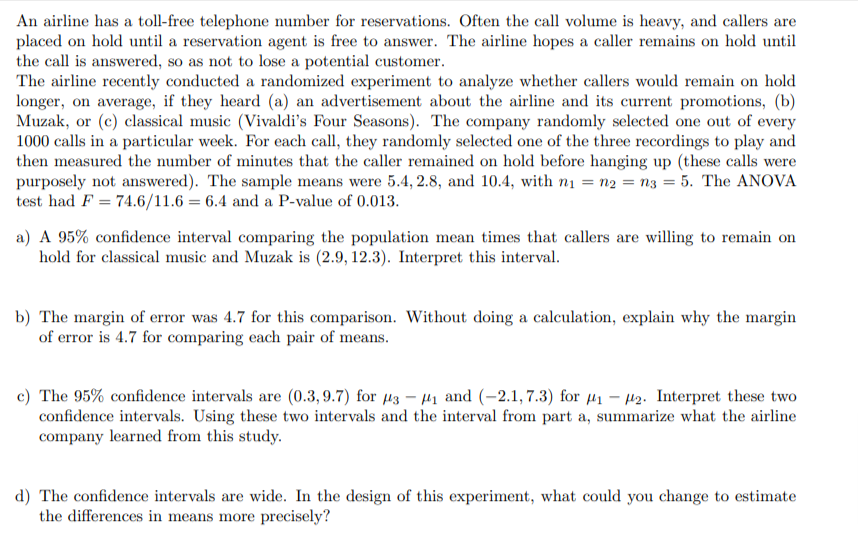
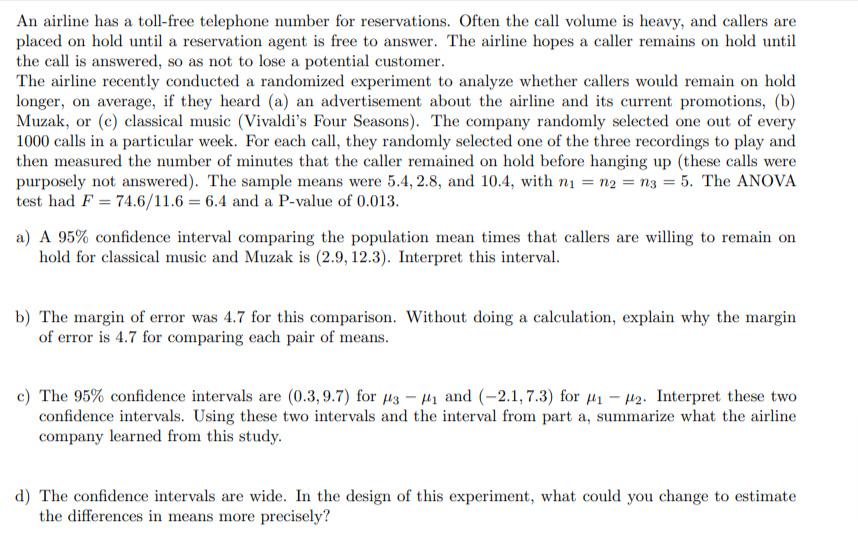
An airline has a toll-free telephone number for reservations. Often the call volume is heavy, and callers are placed on hold until a reservation agent is free to answer. The airline hopes a caller remains on hold until the call is answered, so as not to lose a potential customer. The airline recently conducted a randomized experiment to analyze whether callers would remain on hold longer, on average, if they heard (a) an advertisement about the airline and its current promotions, {b} Muzak, or (c) classical music {Vivaldi's Four Seasons). The company randomly selected one out of every 1000 calls in a particular week. For each call, they randomly selected one of the three recordings to play and then measured the number of minutes that the caller remained on hold before hanging up {these calls were purposely not answered). The sample means were 5.4, 2.3, and 10.4, with m = ns = m = 5. The ANOVA test had F : T4.f11. : 6.4 and a P-value of.{]13. a} A 95% condence interval comparing the population mean times that callers are willing to remain on hold for classical music and Muzak is {23,123}. Interpret this interval. In} The margin of error was 4.7 for this comparison. Without doing a calculation, explain why the margin of error is 4.7 for comparing each pair of means. c) The 95% condence intervals are {U.3,9.T) for #3 m and (2.1,T.3} for p; pg. Interpret these two condence intervals. Using these two intervals and the interval from part a, summarize what the airline company learned from this study. d} The condence intervals are wide. In the design of this experiment, what could you change to estimate the di'erences in means more precisely
Step by Step Solution
There are 3 Steps involved in it

Get step-by-step solutions from verified subject matter experts
 Study Help