







Question: please help for this question 2 Moral Hazard and Adverse Selection(50') We change the setting of question 1 slightly to discuss the effect of moral
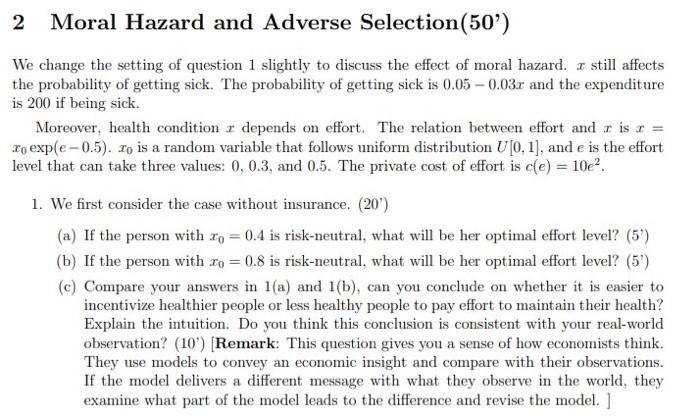
2 Moral Hazard and Adverse Selection(50') We change the setting of question 1 slightly to discuss the effect of moral hazard. I still affects the probability of getting sick. The probability of getting sick is 0.05 -0.03.r and the expenditure is 200 if being sick. Moreover, health condition r depends on effort. The relation between effort and r is r = To exp(e -0.5). To is a random variable that follows uniform distribution U[0,1], and e is the effort level that can take three values: 0,0.3, and 0.5. The private cost of effort is cle) = 10e. 1. We first consider the case without insurance. (20) (a) If the person with 19 = 0.4 is risk-neutral, what will be her optimal effort level? (5') (b) If the person with co = 0.8 is risk-neutral, what will be her optimal effort level? (5') (c) Compare your answers in 1a) and 1(b), can you conclude on whether it is easier to incentivize healthier people or less healthy people to pay effort to maintain their health? Explain the intuition. Do you think this conclusion is consistent with your real-world observation? (10) [Remark: This question gives you a sense of how economists think. They use models to convey an economic insight and compare with their observations. If the model delivers a different message with what they observe in the world, they examine what part of the model leads to the difference and revise the model. ] 2 Moral Hazard and Adverse Selection(50') We change the setting of question 1 slightly to discuss the effect of moral hazard. I still affects the probability of getting sick. The probability of getting sick is 0.05 -0.03.r and the expenditure is 200 if being sick. Moreover, health condition r depends on effort. The relation between effort and r is r = To exp(e -0.5). To is a random variable that follows uniform distribution U[0,1], and e is the effort level that can take three values: 0,0.3, and 0.5. The private cost of effort is cle) = 10e. 1. We first consider the case without insurance. (20) (a) If the person with 19 = 0.4 is risk-neutral, what will be her optimal effort level? (5') (b) If the person with co = 0.8 is risk-neutral, what will be her optimal effort level? (5') (c) Compare your answers in 1a) and 1(b), can you conclude on whether it is easier to incentivize healthier people or less healthy people to pay effort to maintain their health? Explain the intuition. Do you think this conclusion is consistent with your real-world observation? (10) [Remark: This question gives you a sense of how economists think. They use models to convey an economic insight and compare with their observations. If the model delivers a different message with what they observe in the world, they examine what part of the model leads to the difference and revise the model. ]
Step by Step Solution
There are 3 Steps involved in it

Get step-by-step solutions from verified subject matter experts
 Study Help