







Question: please help. I hope this information is clear enough, if you can't see it, or solve it, please leave it to others that can see
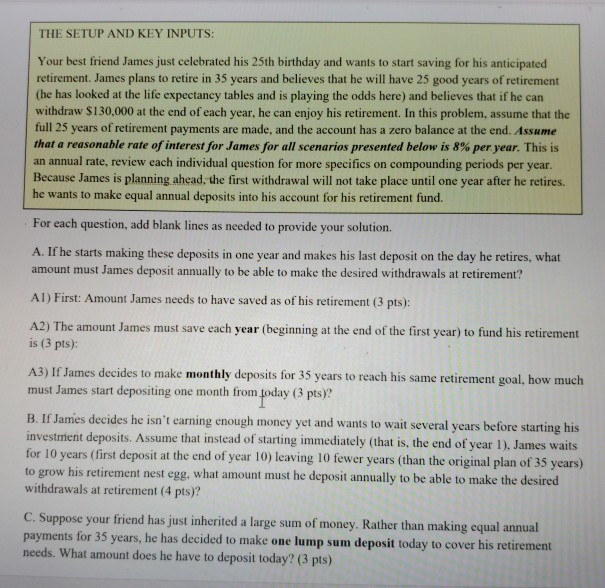
please help. I hope this information is clear enough, if you can't see it, or solve it, please leave it to others that can see or solve the problem. thanks to those that truly want to help.
THE SETUP AND KEY INPUTS: Your best friend James just celebrated his 25th birthday and wants to start saving for his anticipated retirement. James plans to retire in 35 years and believes that he will have 25 good years of retirement (he has looked at the life expectancy tables and is playing the odds here) and believes that if he can withdraw S130,000 at the end of each year, he can enjoy his retirement. In this problem, assume that the full 25 years of retirement payments are made, and the account has a zero balance at the end. Assume that a reasonable rate of interest for James for all scenarios presented below is 8% per year. This is an annual rate, review each individual question for more specifics on compounding periods per year. Because James is planning ahead, the first withdrawal will not take place until one year after he retires. he wants to make equal annual deposits into his account for his retirement fund. For each question, add blank lines as needed to provide your solution. A. If he starts making these deposits in one year and makes his last deposit on the day he retires, what amount must James deposit annually to be able to make the desired withdrawals at retirement? Al) First: Amount James needs to have saved as of his retirement (3 pts): A2) The amount James must save each year (beginning at the end of the first year) to fund his retirement is (3 pts): A3) If James decides to make monthly deposits for 35 years to reach his same retirement goal, how much must James start depositing one month from today (3 pts)? B. If James decides he isn't earning enough money yet and wants to wait several years before starting his investment deposits. Assume that instead of starting immediately (that is, the end of year 1). James waits for 10 years (first deposit at the end of year 10) leaving 10 fewer years (than the original plan of 35 years) to grow his retirement nest egg, what amount must be deposit annually to be able to make the desired withdrawals at retirement (4 pts)? C. Suppose your friend has just inherited a large sum of money. Rather than making equal annual payments for 35 years, he has decided to make one lump sum deposit today to cover his retirement needs. What amount does he have to deposit today? (3 pts)
Step by Step Solution
There are 3 Steps involved in it

Get step-by-step solutions from verified subject matter experts
 Study Help