







Question: PLEASE HELP I really need it will vote need the end of B all of C and D thank you in advance The Robotics Manufacturing
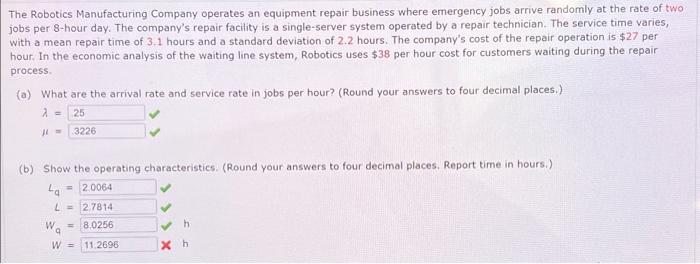
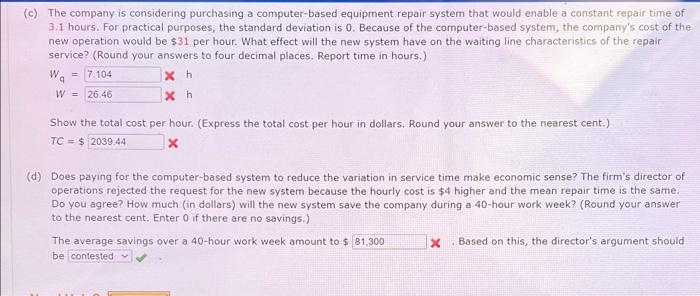
The Robotics Manufacturing Company operates an equipment repair business where emergency jobs arrive randomly at the rate of two jobs per 8-hour day. The company's repair facility is a single-server system operated by a repair technician. The service time varies, with a mean repair time of 3.1 hours and a standard deviation of 2.2 hours. The company's cost of the repair operation is $27 per hour. In the economic analysis of the waiting line system, Robotics uses $38 per hour cost for customers waiting during the repair process. (a) What are the arrival rate and service rate in jobs per hour? (Round your answers to four decimal places.) == (b) Show the operating characteristics. (Round your answers to four decimal places. Report time in hours.) Lq=L=Wq=hW=h (c) The company is considering purchasing a computer-based equipment repair system that would enable a constant repair time of 3.1 hours. For practical purposes, the standard deviation is 0 . Because of the computer-based system, the company's cost of the new operation would be $31 per hour. What effect will the new system have on the waiting line characteristics of the repair service? (Round your answers to four decimal places. Report time in hours.) wa=hW=h Show the total cost per hour. (Express the total cost per hour in dollars. Round your answer to the nearest cent.) TC=$ (d) Does paying for the computer-based system to reduce the variation in service time make economic sense? The firm's director of operations rejected the request for the new system because the hourly cost is $4 higher and the mean repair time is the same. Do you agree? How much (in dollars) will the new system save the company during a 40 -hour work week? (Round your answer to the nearest cent. Enter 0 if there are no savings.) The average savings over a 40 -hour work week amount to $ X.Based on this, the director's argument should be The Robotics Manufacturing Company operates an equipment repair business where emergency jobs arrive randomly at the rate of two jobs per 8-hour day. The company's repair facility is a single-server system operated by a repair technician. The service time varies, with a mean repair time of 3.1 hours and a standard deviation of 2.2 hours. The company's cost of the repair operation is $27 per hour. In the economic analysis of the waiting line system, Robotics uses $38 per hour cost for customers waiting during the repair process. (a) What are the arrival rate and service rate in jobs per hour? (Round your answers to four decimal places.) == (b) Show the operating characteristics. (Round your answers to four decimal places. Report time in hours.) Lq=L=Wq=hW=h (c) The company is considering purchasing a computer-based equipment repair system that would enable a constant repair time of 3.1 hours. For practical purposes, the standard deviation is 0 . Because of the computer-based system, the company's cost of the new operation would be $31 per hour. What effect will the new system have on the waiting line characteristics of the repair service? (Round your answers to four decimal places. Report time in hours.) wa=hW=h Show the total cost per hour. (Express the total cost per hour in dollars. Round your answer to the nearest cent.) TC=$ (d) Does paying for the computer-based system to reduce the variation in service time make economic sense? The firm's director of operations rejected the request for the new system because the hourly cost is $4 higher and the mean repair time is the same. Do you agree? How much (in dollars) will the new system save the company during a 40 -hour work week? (Round your answer to the nearest cent. Enter 0 if there are no savings.) The average savings over a 40 -hour work week amount to $ X.Based on this, the director's argument should be
Step by Step Solution
There are 3 Steps involved in it

Get step-by-step solutions from verified subject matter experts
 Study Help