







Question: please help me answer questions 1, 2, and 3 :) I quote with pride the nineteenth-century French politician, statesman, and sometime revolutionary Alexandre Auguste Ledru
please help me answer questions 1, 2, and 3 :) 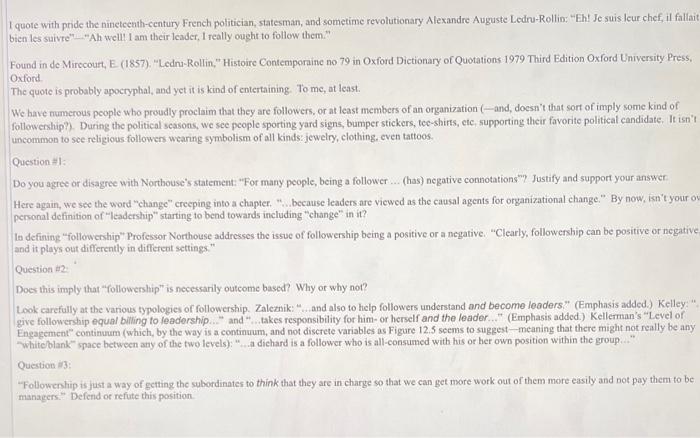
I quote with pride the nineteenth-century French politician, statesman, and sometime revolutionary Alexandre Auguste Ledru Rollio: "Eh! Je suis leur chef, il fallait bien les suivre". "Ah well! I am their leader. I really ought to follow them." Found in de Mirecourt, E (1857). "Ledni-Rollin," Histoire Contemporaine no 79 in Oxford Dictionary of Quotations 1979 Third Edition Oxford University Press, Oxford The quote is probably apocryphal, and yet it is kind of entertaining. To me, at least We have numerous people who proudly proclaim that they are followers, or at least members of an organization (and, doesn't that sort of imply some kind of followership?). During the political scasons, we see people sporting yard signs, bumper stickers, tee-shirts, etc, supporting their favorito political candidate. It isn't uncommon to see religious followers wearing symbolism of all kinds: jewelry, clothing, even tattoos, Question 1: Do you agree or disagree with Northouse's statement: "For many people, being a follower ... (has) negative connotations Justify and support your answer Here again, we see the word "change" creeping into a chapter....because leaders are viewed as the causal agents for organizational change." By now. isn't your ow personal definition of "leadership" starting to bend towards including change" in it? la defining "followership" Professor Northouse addresses the issue of followership being a positive or a negative. "Clearly, followership can be positive or negative and it plays out differently in different settings" Question #2 Does this imply that followership" is necessarily outcome based? Why or why not? Look carefully at the various typologies of followership. Zalemik" and also to help followers understand and become leaders." (Emphasis added.) Kelley give followership equal billing to leadership... and takes responsibility for him or herself and the leader. (Emphasis added.) Kellerman's "Level of Engagement continuum (which, by the way is a continuum, and not discrete variables as Figure 12.5 seems to suggest meaning that there might not really be any white/blank" space between any of the two levels):" a dichard is a follower who is all-consumed with his or her own position within the group." Question 3 "Followership is just a way of getting the subordinates to think that they are in charge so that we can get more work out of them more easily and not pay them to be managers. Defend or refute this position
Step by Step Solution
There are 3 Steps involved in it
1 Expert Approved Answer
Step: 1 Unlock

Question Has Been Solved by an Expert!
Get step-by-step solutions from verified subject matter experts
Step: 2 Unlock
Step: 3 Unlock
 Study Help