







Question: Please help me answer this question step by step, thanks so much. 4. Suppose voters A, B, and C have preferences in two dimensions, .1:
Please help me answer this question step by step, thanks so much.
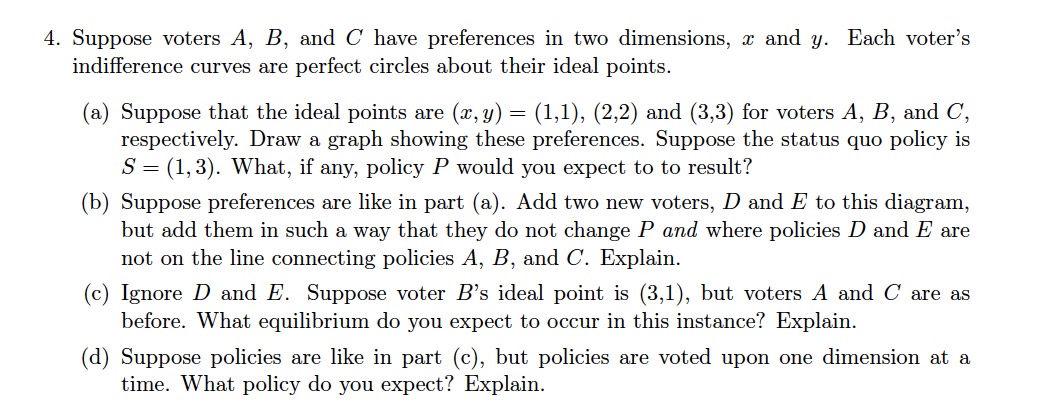
4. Suppose voters A, B, and C have preferences in two dimensions, .1: and 3;. Each voter's indierence curves are perfect circles about their ideal points. (a) Suppose that the ideal points are (23,59) = (1,1), (2,2) and (3,3) for voters A, B, and C, respectively. Draw a graph showing these preferences. Suppose the status quo policy is S = (1, 3). What, if any, policy P would you expect to to result? (b) Suppose preferences are like in part (a). Add two new voters, D and E to this diagram, but add them in such a way that they do not change P and where policies D and E are not on the line connecting policies A, B, and C. Explain. (c) Ignore D and E. Suppose voter B's ideal point is (3,1), but voters A and C are as before. What equilibrium do you expect to occur in this instance? Explain. (d) Suppose policies are like in part (c), but policies are voted upon one dimension at a time. What policy do you expect? Explain
Step by Step Solution
There are 3 Steps involved in it

Get step-by-step solutions from verified subject matter experts
 Study Help