







Question: PLEASE HELP ME , I ONLY HAVE 4 HOUR TO ANSWER THE QUESTION. THANK YOU QUESTION 3 (25 MARKS : 120 MINUTES) Khidmat Kewangan Sdn.
PLEASE HELP ME , I ONLY HAVE 4 HOUR TO ANSWER THE QUESTION. THANK YOU
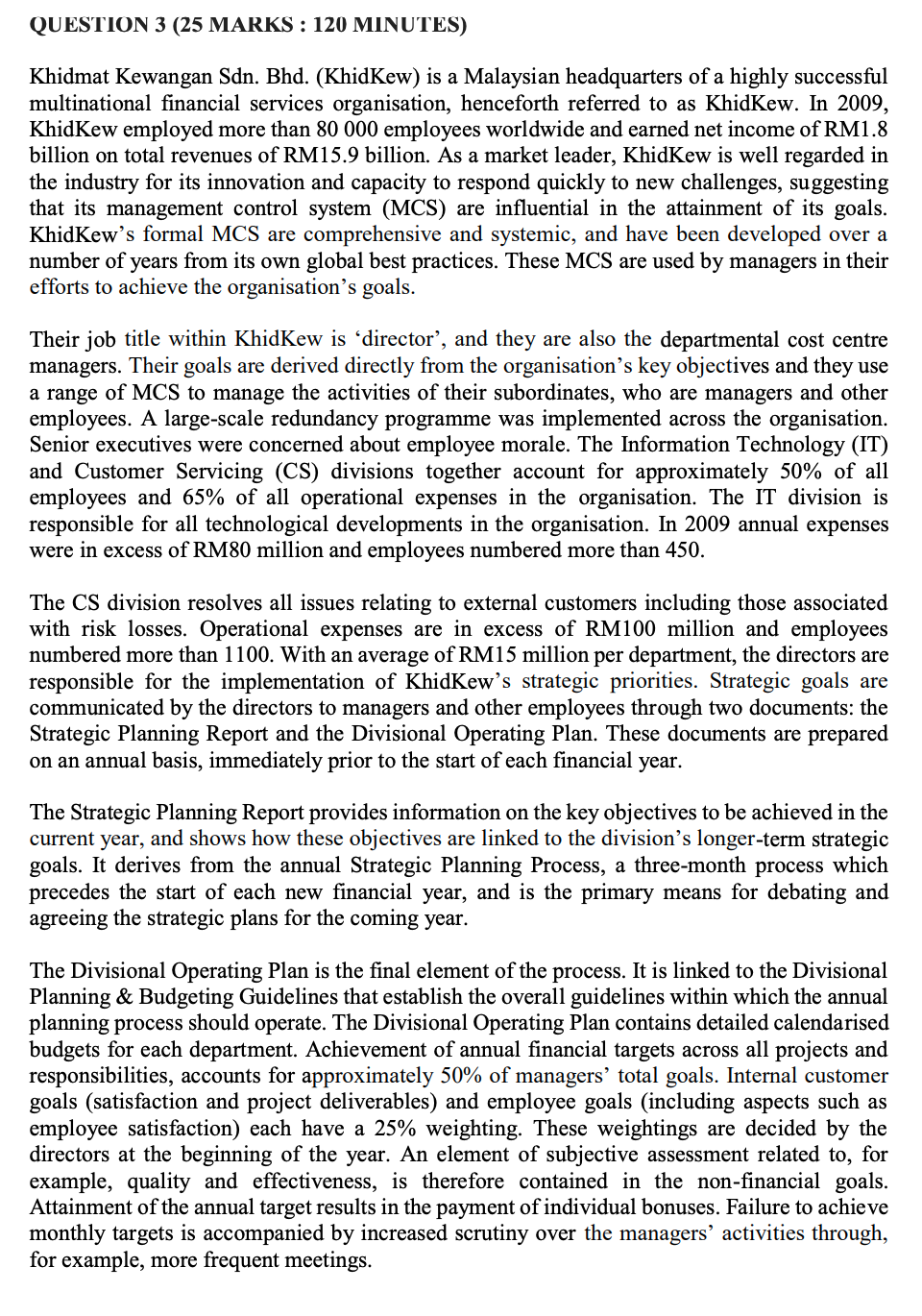
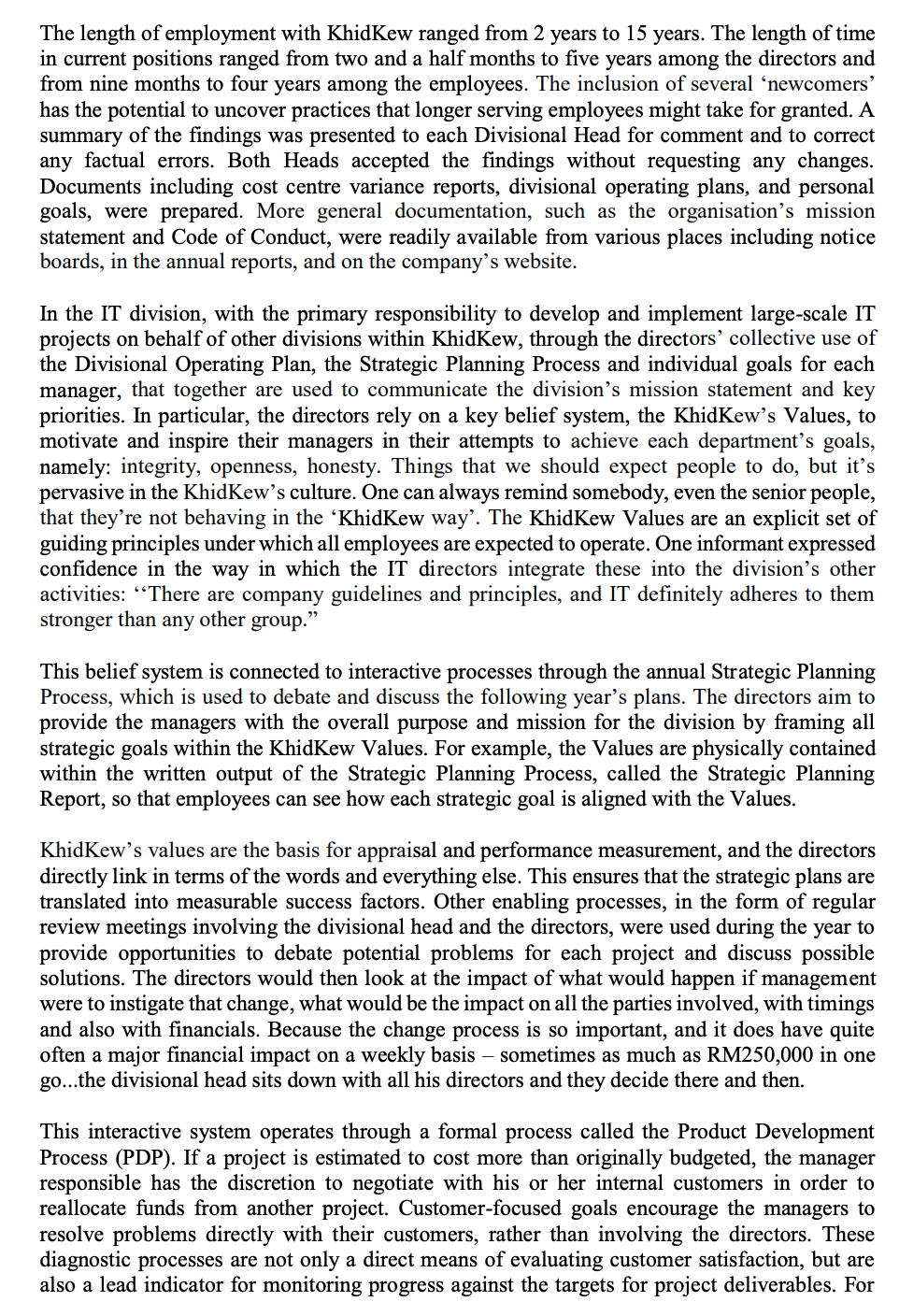
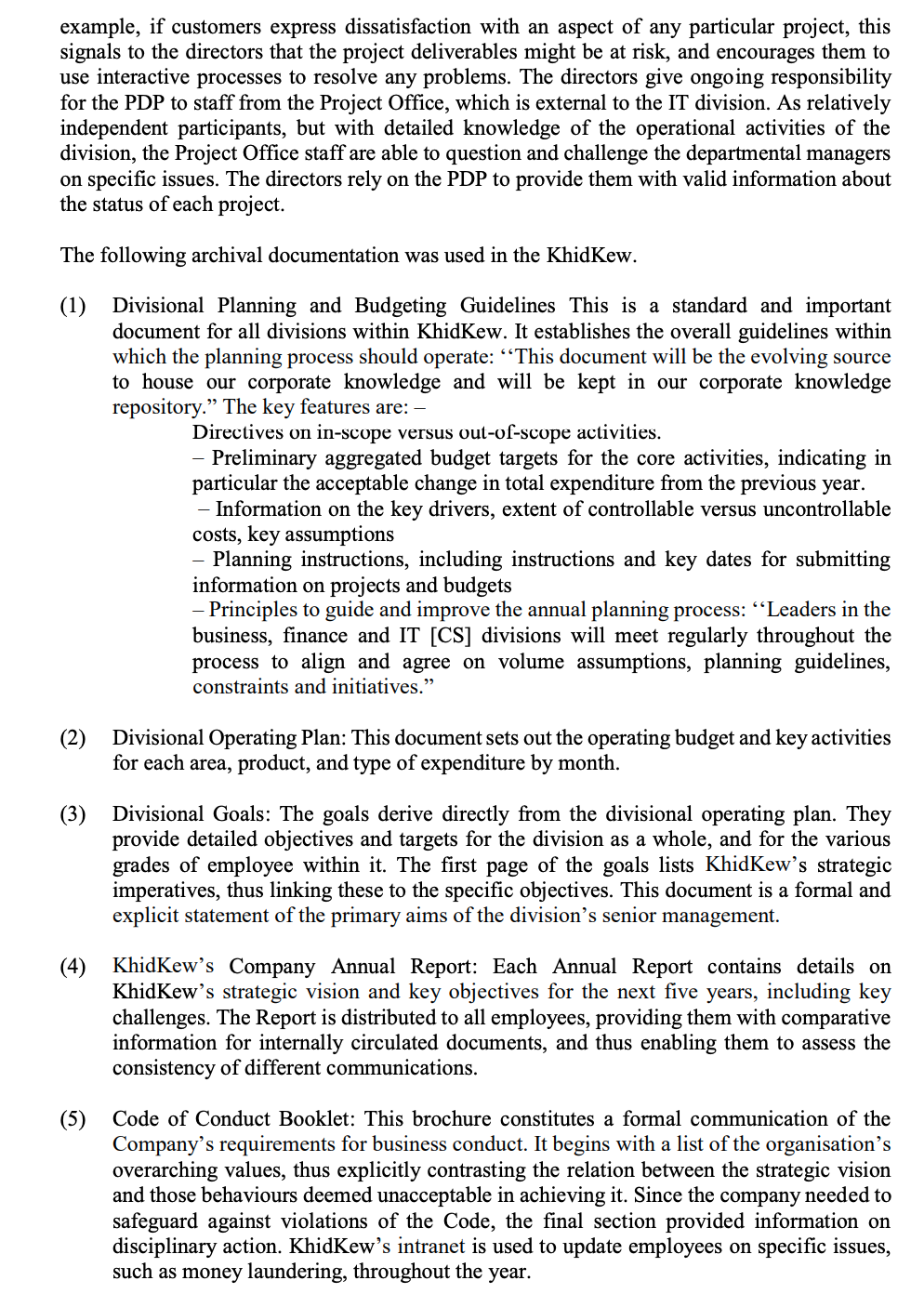
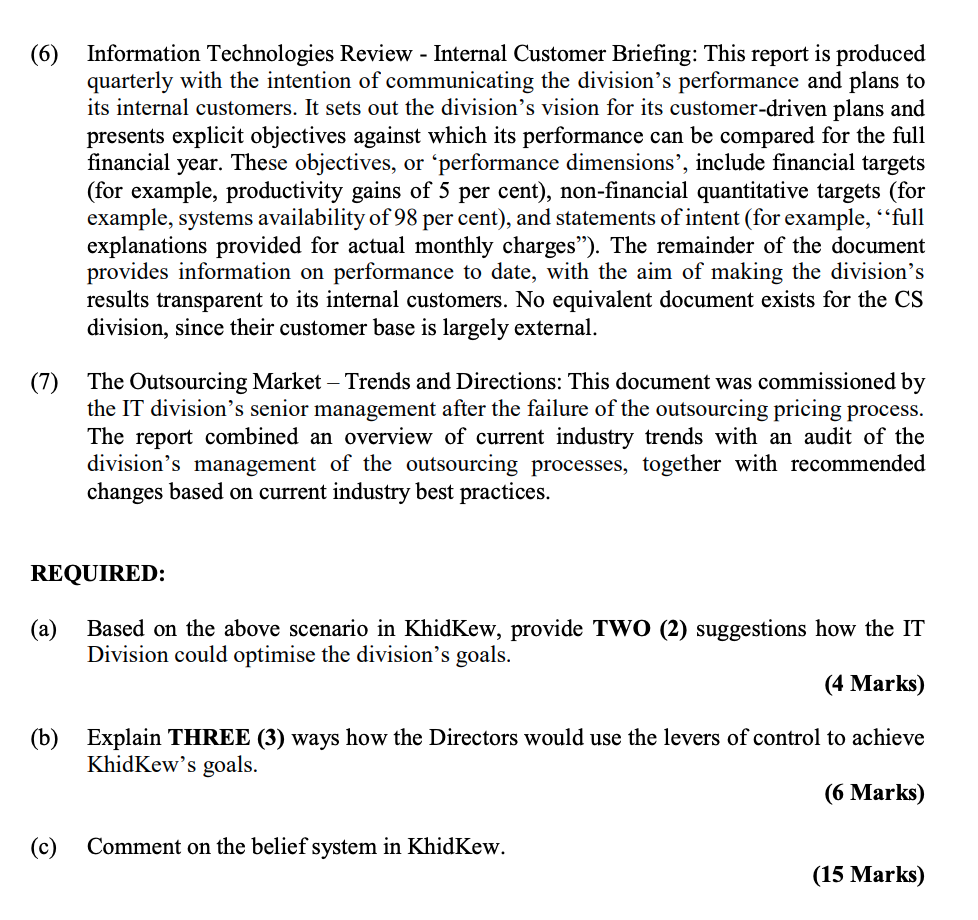
QUESTION 3 (25 MARKS : 120 MINUTES) Khidmat Kewangan Sdn. Bhd. (KhidKew) is a Malaysian headquarters of a highly successful multinational financial services organisation, henceforth referred to as KhidKew. In 2009, KhidKew employed more than 80 000 employees worldwide and earned net income of RM1.8 billion on total revenues of RM15.9 billion. As a market leader, KhidKew is well regarded in the industry for its innovation and capacity to respond quickly to new challenges, suggesting that its management control system (MCS) are influential in the attainment of its goals. KhidKew's formal MCS are comprehensive and systemic, and have been developed over a number of years from its own global best practices. These MCS are used by managers in their efforts to achieve the organisation's goals. Their job title within KhidKew is director', and they are also the departmental cost centre managers. Their goals are derived directly from the organisations key objectives and they use a range of MCS to manage the activities of their subordinates, who are managers and other employees. A large-scale redundancy programme was implemented across the organisation. Senior executives were concerned about employee morale. The Information Technology (IT) and Customer Servicing (CS) divisions together account for approximately 50% of all employees and 65% of all operational expenses in the organisation. The IT division is responsible for all technological developments in the organisation. In 2009 annual expenses were in excess of RM80 million and employees numbered more than 450. The CS division resolves all issues relating to external customers including those associated with risk losses. Operational expenses are in excess of RM100 million and employees numbered more than 1100. With an average of RM15 million per department, the directors are responsible for the implementation of KhidKew's strategic priorities. Strategic goals are communicated by the directors to managers and other employees through two documents: the Strategic Planning Report and the Divisional Operating Plan. These documents are prepared on an annual basis, immediately prior to the start of each financial year. The Strategic Planning Report provides information on the key objectives to be achieved in the current year, and shows how these objectives are linked to the division's longer-term strategic goals. It derives from the annual Strategic Planning Process, a three-month process which precedes the start of each new financial year, and is the primary means for debating and agreeing the strategic plans for the coming year. The Divisional Operating Plan is the final element of the process. It is linked to the Divisional Planning & Budgeting Guidelines that establish the overall guidelines within which the annual planning process should operate. The Divisional Operating Plan contains detailed calendarised budgets for each department. Achievement of annual financial targets across all projects and responsibilities, accounts for approximately 50% of managers' total goals. Internal customer goals (satisfaction and project deliverables) and employee goals (including aspects such as employee satisfaction) each have a 25% weighting. These weightings are decided by the directors at the beginning of the year. An element of subjective assessment related to, for example, quality and effectiveness, is therefore contained in the non-financial goals. Attainment of the annual target results in the payment of individual bonuses. Failure to achieve monthly targets is accompanied by increased scrutiny over the managers' activities through, for example, more frequent meetings. The length of employment with KhidKew ranged from 2 years to 15 years. The length of time in current positions ranged from two and a half months to five years among the directors and from nine months to four years among the employees. The inclusion of several newcomers' has the potential to uncover practices that longer serving employees might take for granted. A summary of the findings was presented to each Divisional Head for comment and to correct any factual errors. Both Heads accepted the findings without requesting any changes. Documents including cost centre variance reports, divisional operating plans, and personal goals, were prepared. More general documentation, such as the organisation's mission statement and Code of Conduct, were readily available from various places including notice boards, in the annual reports, and on the company's website. In the IT division, with the primary responsibility to develop and implement large-scale IT projects on behalf of other divisions within KhidKew, through the directors' collective use of the Divisional Operating Plan, the Strategic Planning Process and individual goals for each manager, that together are used to communicate the division's mission statement and key priorities. In particular, the directors rely on a key belief system, the KhidKew's Values, to motivate and inspire their managers in their attempts to achieve each department's goals, namely: integrity, openness, honesty. Things that we should expect people to do, but it's pervasive in the KhidKew's culture. One can always remind somebody, even the senior people, that they're not behaving in the KhidKew way'. The KhidKew Values are an explicit set of guiding principles under which all employees are expected to operate. One informant expressed confidence in the way in which the IT directors integrate these into the division's other activities: There are company guidelines and principles, and IT definitely adheres to them stronger than any other group. This belief system is connected to interactive processes through the annual Strategic Planning Process, which is used to debate and discuss the following year's plans. The directors aim to provide the managers with the overall purpose and mission for the division by framing all strategic goals within the KhidKew Values. For example, the Values are physically contained within the written output of the Strategic Planning Process, called the Strategic Planning Report, so that employees can see how each strategic goal is aligned with the Values. KhidKew's values are the basis for appraisal and performance measurement, and the directors directly link in terms of the words and everything else. This ensures that the strategic plans are translated into measurable success factors. Other enabling processes, in the form of regular review meetings involving the divisional head and the directors, were used during the year to provide opportunities to debate potential problems for each project and discuss possible solutions. The directors would then look at the impact of what would happen if management were to instigate that change, what would be the impact on all the parties involved, with timings and also with financials. Because the change process is so important, and it does have quite often a major financial impact on a weekly basis sometimes as much as RM250,000 in one go...the divisional head sits down with all his directors and they decide there and then. This interactive system operates through a formal process called the Product Development Process (PDP). If a project is estimated to cost more than originally budgeted, the manager responsible has the discretion to negotiate with his or her internal customers in order to reallocate funds from another project. Customer-focused goals encourage the managers to resolve problems directly with their customers, rather than involving the directors. These diagnostic processes are not only a direct means of evaluating customer satisfaction, but are also a lead indicator for monitoring progress against the targets for project deliverables. For example, if customers express dissatisfaction with an aspect of any particular project, this signals to the directors that the project deliverables might be at risk, and encourages them to use interactive processes to resolve any problems. The directors give ongoing responsibility for the PDP to staff from the Project Office, which is external to the IT division. As relatively independent participants, but with detailed knowledge of the operational activities of the division, the Project Office staff are able to question and challenge the departmental managers on specific issues. The directors rely on the PDP to provide them with valid information about the status of each project. The following archival documentation was used in the KhidKew. (1) Divisional Planning and Budgeting Guidelines This is a standard and important document for all divisions within KhidKew. It establishes the overall guidelines within which the planning process should operate: This document will be the evolving source to house our corporate knowledge and will be kept in our corporate knowledge repository. The key features are: - Directives on in-scope versus out-of-scope activities. Preliminary aggregated budget targets for the core activities, indicating in particular the acceptable change in total expenditure from the previous year. - Information on the key drivers, extent of controllable versus uncontrollable costs, key assumptions - Planning instructions, including instructions and key dates for submitting information on projects and budgets - Principles to guide and improve the annual planning process: Leaders in the business, finance and IT [CS] divisions will meet regularly throughout the process to align and agree on volume assumptions, planning guidelines, constraints and initiatives." (2) Divisional Operating Plan: This document sets out the operating budget and key activities for each area, product, and type of expenditure by month. (3) Divisional Goals: The goals derive directly from the divisional operating plan. They provide detailed objectives and targets for the division as a whole, and for the various grades of employee within it. The first page of the goals lists KhidKew's strategic imperatives, thus linking these to the specific objectives. This document is a formal and explicit statement of the primary aims of the division's senior management. (4) KhidKew's Company Annual Report: Each Annual Report contains details on KhidKew's strategic vision and key objectives for the next five years, including key challenges. The Report is distributed to all employees, providing them with comparative information for internally circulated documents, and thus enabling them to assess the consistency of different communications. (5) Code of Conduct Booklet: This brochure constitutes a formal communication of the Company's requirements for business conduct. It begins with a list of the organisation's overarching values, thus explicitly contrasting the relation between the strategic vision and those behaviours deemed unacceptable in achieving it. Since the company needed to safeguard against violations of the Code, the final section provided information on disciplinary action. KhidKew's intranet is used to update employees on specific issues, such as money laundering, throughout the year. (6) Information Technologies Review - Internal Customer Briefing: This report is produced quarterly with the intention of communicating the division's performance and plans to its internal customers. It sets out the division's vision for its customer-driven plans and presents explicit objectives against which its performance can be compared for the full financial year. These objectives, or performance dimensions', include financial targets (for example, productivity gains of 5 per cent), non-financial quantitative targets (for example, systems availability of 98 per cent), and statements of intent (for example, full explanations provided for actual monthly charges). The remainder of the document provides information on performance to date, with the aim of making the division's results transparent to its internal customers. No equivalent document exists for the CS division, since their customer base is largely external. (7) The Outsourcing Market Trends and Directions: This document was commissioned by the IT division's senior management after the failure of the outsourcing pricing process. The report combined an overview of current industry trends with an audit of the division's management the outsourcing processes, together with recommended changes based on current industry best practices. REQUIRED: (a) Based on the above scenario in KhidKew, provide TWO (2) suggestions how the IT Division could optimise the division's goals. (4 Marks) (b) Explain THREE (3) ways how the Directors would use the levers of control to achieve KhidKew's goals. (6 Marks) (c) Comment on the belief system in KhidKew. (15 Marks)
Step by Step Solution
There are 3 Steps involved in it
1 Expert Approved Answer
Step: 1 Unlock

Question Has Been Solved by an Expert!
Get step-by-step solutions from verified subject matter experts
Step: 2 Unlock
Step: 3 Unlock
 Study Help