







Question: Please help me on this question 2. Consider a low-income single mother named Jane. Jane has 2,000 hours that she can allocate to work (H)
Please help me on this question
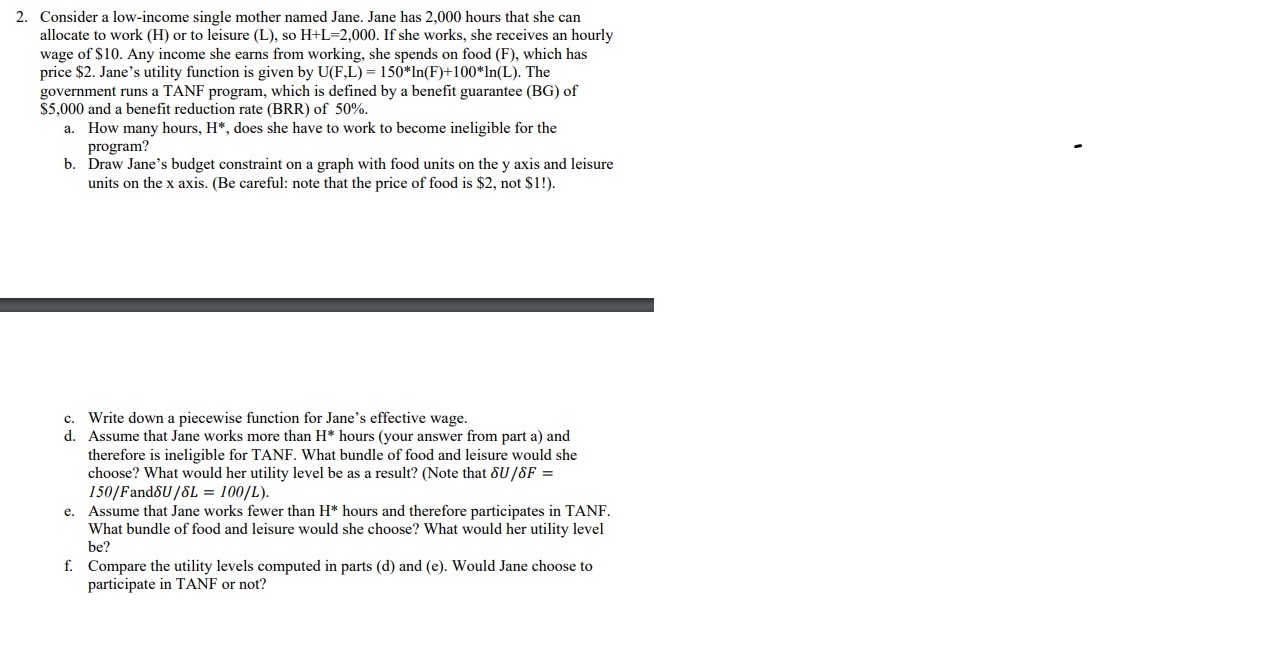
2. Consider a low-income single mother named Jane. Jane has 2,000 hours that she can allocate to work (H) or to leisure (L), so H+L=2,000. If she works, she receives an hourly wage of $10. Any income she earns from working, she spends on food (F), which has price $2. Jane's utility function is given by U(F,L) = 150*In(F)+100*In(L). The government runs a TANF program, which is defined by a benefit guarantee (BG) of $5,000 and a benefit reduction rate (BRR) of 50%. a. How many hours, H*, does she have to work to become ineligible for the program? b. Draw Jane's budget constraint on a graph with food units on the y axis and leisure units on the x axis. (Be careful: note that the price of food is $2, not $1!). c. Write down a piecewise function for Jane's effective wage. d. Assume that Jane works more than H* hours (your answer from part a) and therefore is ineligible for TANF. What bundle of food and leisure would she choose? What would her utility level be as a result? (Note that SU /8F = 150/FandSU /SL = 100/L). e. Assume that Jane works fewer than H* hours and therefore participates in TANF. What bundle of food and leisure would she choose? What would her utility level be ? f. Compare the utility levels computed in parts (d) and (e). Would Jane choose to participate in TANF or not
Step by Step Solution
There are 3 Steps involved in it

Get step-by-step solutions from verified subject matter experts
 Study Help