







Question: Please help me solve the report, given the value Th = 3.42 only. Experiment 1: Synthesis of Acetyloalicylic acid (Aspirin) Aspinin is a trade tsame
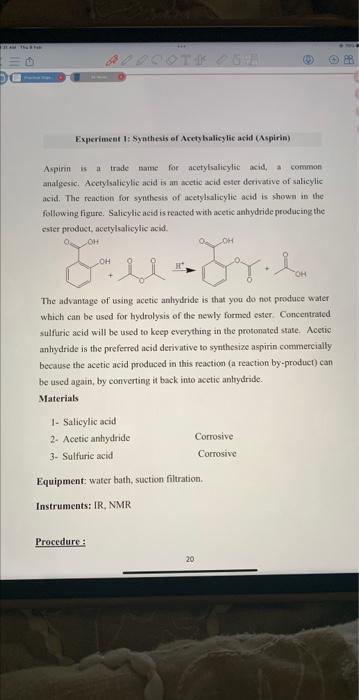
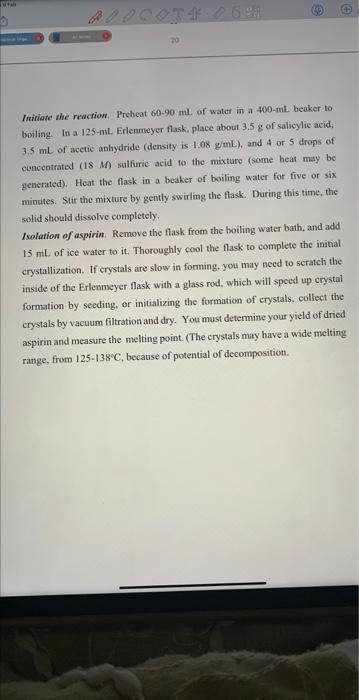
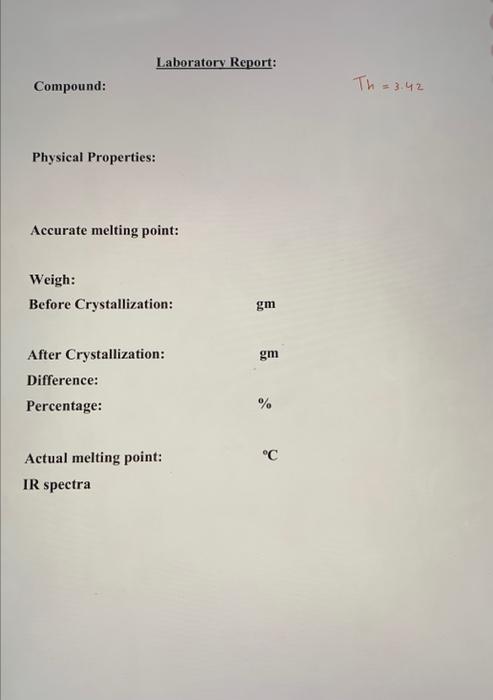
Experiment 1: Synthesis of Acetyloalicylic acid (Aspirin) Aspinin is a trade tsame for acetytsalicylic acid, a common analpesic. Acetylsalicylic acid is an acetic acid ester derivative of salicylic acid. The reaction for symbhesis of acetylkalicylic acid is-shown in the following figure. Salicylie acud is reacted with acetic anhydrideptoducing the ' esier product, acetylsalicylic acid. The advantage of using acetic anhydride is that you do not produce water which can be used for bydrolysis of the newly formed ester. Concentrated sulfuric acid will be used to keep everything in the protonated state. Acetic anhydride is the preferred acid derivative to synthesize aspirin conmercially because the acetic acid produced in this reaction (a reaction by-product) can be uscel again, by converting it back into acetic anbydride. Iniriate the reacrion. Preheat 6090ml of water in a 400 -mL beaker to boiling. In a 125-mL. Erlenmeyer flask, place about 3.5g of salicylic acid. 3.5 mL of acetie anhydride (density is 1.08gmL ), and 4 or 5 drops of concentrated (18 M) sulfuric acid to the mixture (some heat may be generated). Heat the flask in a beaker of boiling water for five or 31x minutes. Stir the mixture by gently swirling the ftask. During this time, the solid should dissolve completely. Isplatiors of aspirin. Remove the flask from the boiling water bath, and add 15mL of ice water to it. Thoroughly cool the flask to complete the initial crystallization. If crystals are slow in fomming, you may need to seratch the inside of the Erlemmeyer flask with a glass rod, which will speed up erystal formation by seeding, or initializing the formation of erystals, collect the crystals by vacuum filtration and dry. You must detemine your yield of dried aspirin and measure the melting point. (The crystals may have a wide melting range, from 125138, becatse of potential of decomposition. Laboratory Report: Compound: Th=3.42 Physical Properties: Accurate melting point: Experiment 1: Synthesis of Acetyloalicylic acid (Aspirin) Aspinin is a trade tsame for acetytsalicylic acid, a common analpesic. Acetylsalicylic acid is an acetic acid ester derivative of salicylic acid. The reaction for symbhesis of acetylkalicylic acid is-shown in the following figure. Salicylie acud is reacted with acetic anhydrideptoducing the ' esier product, acetylsalicylic acid. The advantage of using acetic anhydride is that you do not produce water which can be used for bydrolysis of the newly formed ester. Concentrated sulfuric acid will be used to keep everything in the protonated state. Acetic anhydride is the preferred acid derivative to synthesize aspirin conmercially because the acetic acid produced in this reaction (a reaction by-product) can be uscel again, by converting it back into acetic anbydride. Iniriate the reacrion. Preheat 6090ml of water in a 400 -mL beaker to boiling. In a 125-mL. Erlenmeyer flask, place about 3.5g of salicylic acid. 3.5 mL of acetie anhydride (density is 1.08gmL ), and 4 or 5 drops of concentrated (18 M) sulfuric acid to the mixture (some heat may be generated). Heat the flask in a beaker of boiling water for five or 31x minutes. Stir the mixture by gently swirling the ftask. During this time, the solid should dissolve completely. Isplatiors of aspirin. Remove the flask from the boiling water bath, and add 15mL of ice water to it. Thoroughly cool the flask to complete the initial crystallization. If crystals are slow in fomming, you may need to seratch the inside of the Erlemmeyer flask with a glass rod, which will speed up erystal formation by seeding, or initializing the formation of erystals, collect the crystals by vacuum filtration and dry. You must detemine your yield of dried aspirin and measure the melting point. (The crystals may have a wide melting range, from 125138, becatse of potential of decomposition. Laboratory Report: Compound: Th=3.42 Physical Properties: Accurate melting point
Step by Step Solution
There are 3 Steps involved in it

Get step-by-step solutions from verified subject matter experts
 Study Help