







Question: Please help me this lap https://phet.colorado.edu/sims/html/charges-and-fields/latest/charges-and-fields_en.html Instructional video: https://youtu.be/rASDNxwqkIA Physics 236: Using Spreadsheets to Calculate Electric Fields In this project, you will use a spreadsheet
Please help me this lap
https://phet.colorado.edu/sims/html/charges-and-fields/latest/charges-and-fields_en.html
Instructional video: https://youtu.be/rASDNxwqkIA
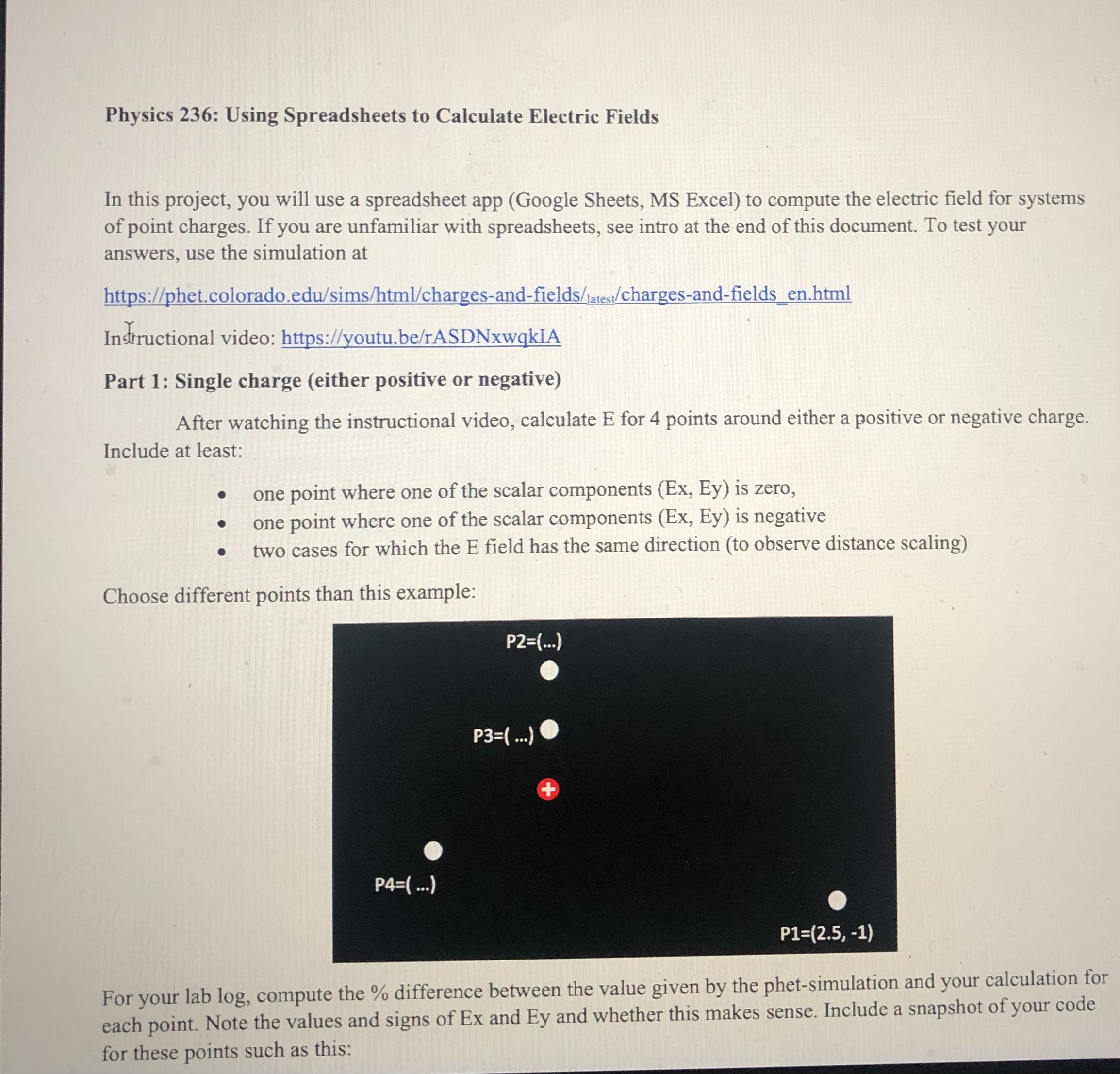
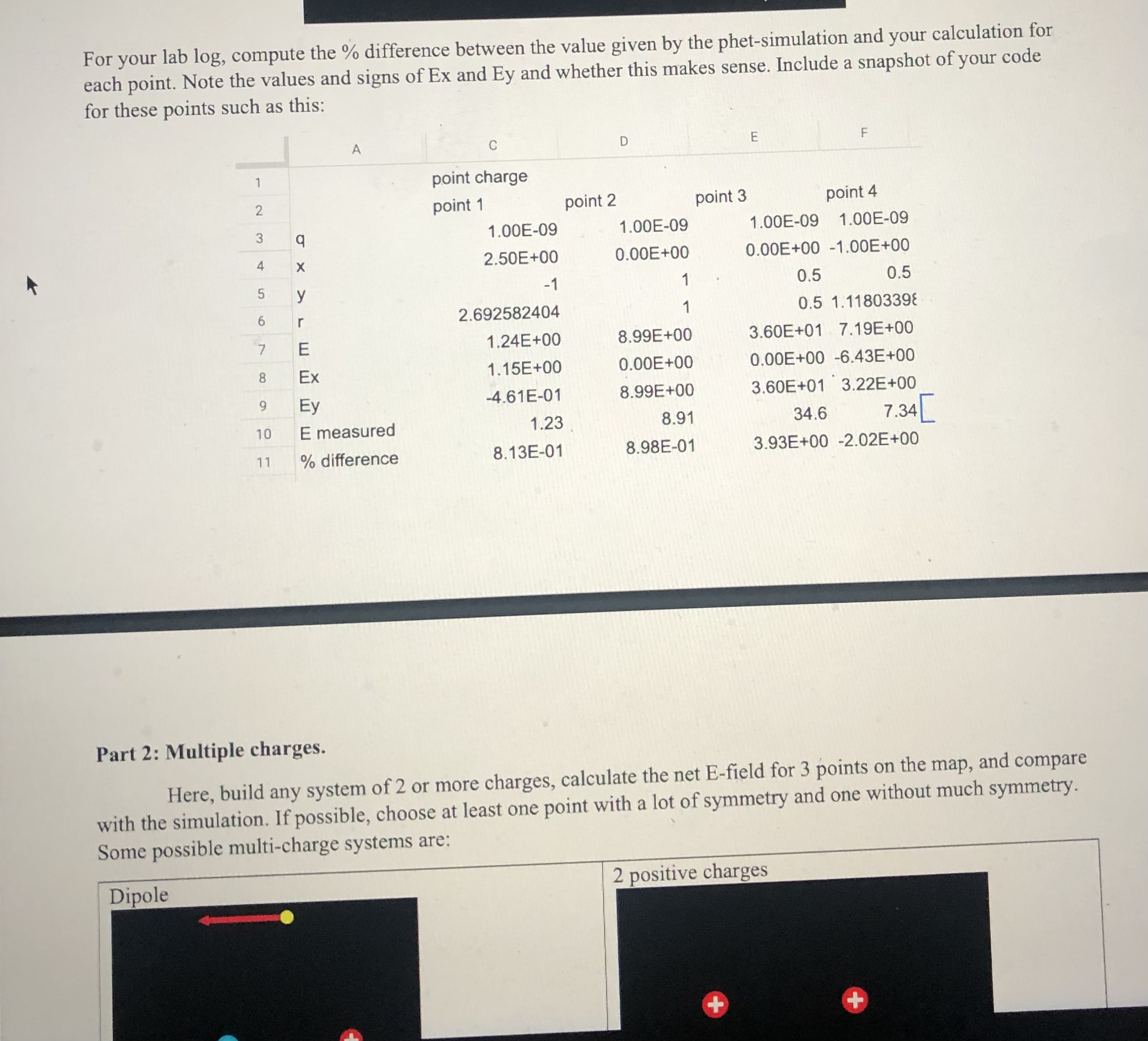
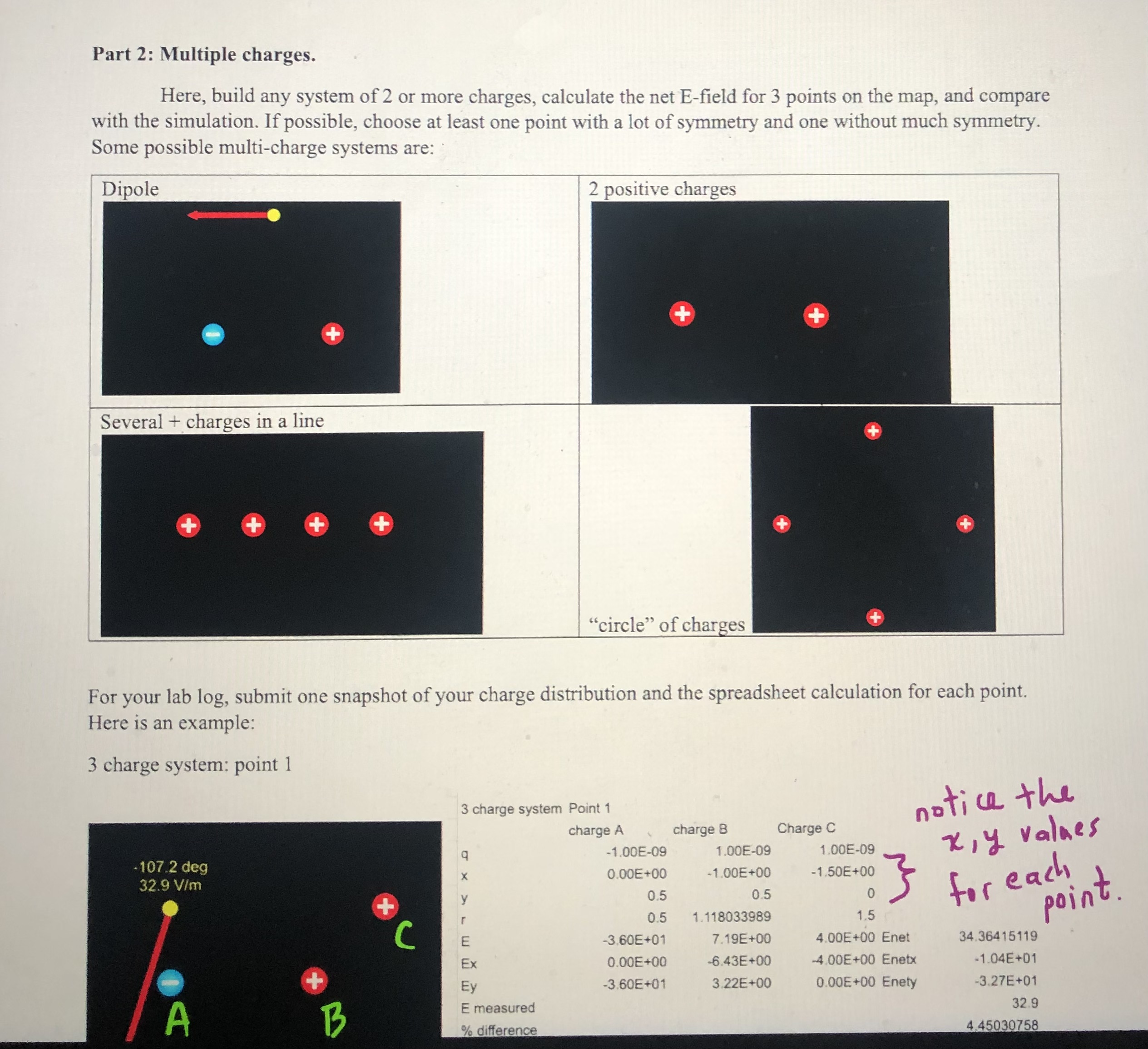
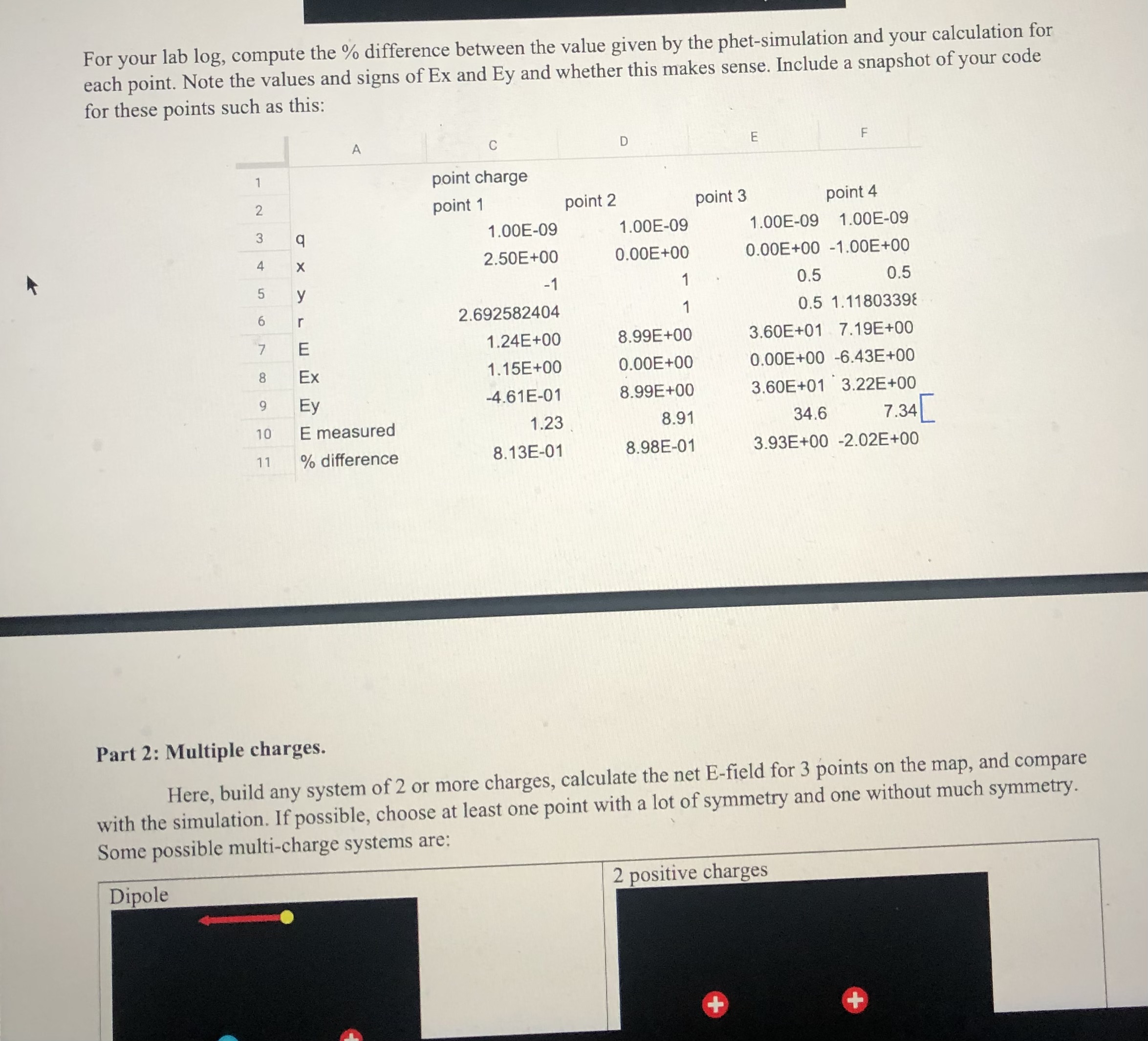
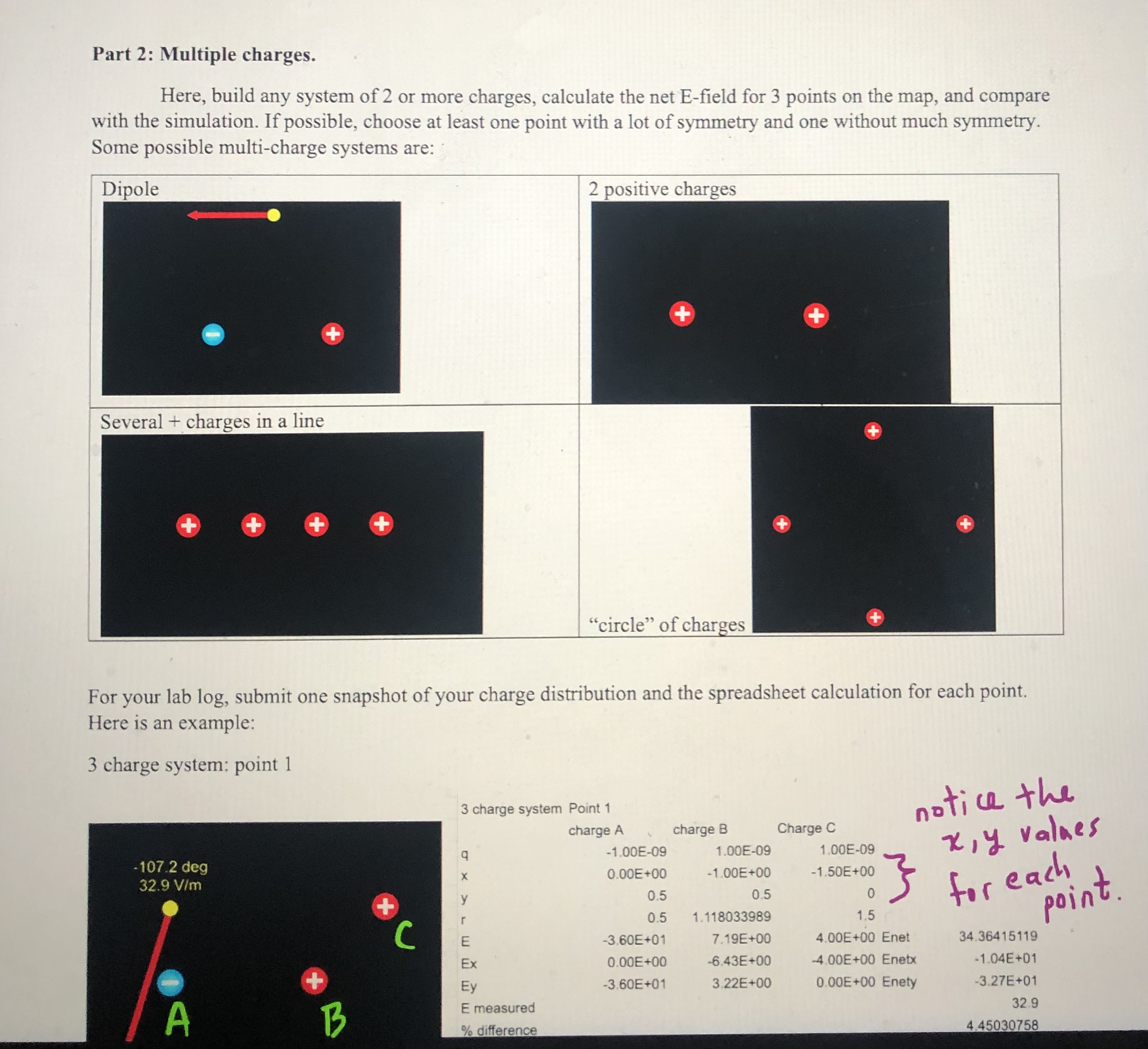
Physics 236: Using Spreadsheets to Calculate Electric Fields In this project, you will use a spreadsheet app (Google Sheets, MS Excel) to compute the electric field for systems of point charges. If you are unfamiliar with spreadsheets, see intro at the end of this document. To test your answers, use the simulation at https://phet.colorado.edu/sims/html/charges-and-fields/latest/charges-and-fields_en.html Instructional video: https://youtube/rASDNxwqkIA Part 1: Single charge (either positive or negative) After watching the instructional video, calculate E for 4 points around either a positive or negative charge. Include at least: one point where one of the scalar components (Ex, Ey) is zero, one point where one of the scalar components (Ex, Ey) is negative . . two cases for which the E field has the same direction (to observe distance scaling) Choose different points than this example: P2=(...) P3=( ...) + P4=( ...) P1=(2.5, -1) For your lab log, compute the % difference between the value given by the phet-simulation and your calculation for each point. Note the values and signs of Ex and Ey and whether this makes sense. Include a snapshot of your code for these points such as this:* For your lab log, compute the % difference between the value given by the phetsimulation and your calculation for each pomt. Note the values and signs of Ex and By and whether this makes sense. Include a snapshot ofyour code for these points such as this: 1 point charge point 1 point 2 point 3 point 4 q 1.00509 1.00509 1.00509 1.00509 x 2.505% 0.005+00 0005+00 1.005+00 4 y -1 1 0.5 0.5 1, r 2692582404 1 0.5 11180339: ' E 1.245+00 8.99E+00 3.60E+01 7.195+00 Ex 1,155+00 0005+00 0005+00 -6.43E+OO 1 Ey 451501 8.99E+00 3.60501 ' 322E+00 1: E measured 1.23 8.91 34.6 7.34[: .1 % difference 8.13E-01 8.98501 3.93500 2.02E+00 Part 2: Multiple charges. ate the net Eeld for 3 points on the map, and compare llcre, build any system of 2 or more charges, calcul h a lot of symmetry and one without much symmetry. with the simulation. If possible. choose at least one point wit Some possible multichargc systems are: ' 2 positive charges Dipole Part 2: Multiple charges. Here, build any system of 2 or more charges, calculate the net E-field for 3 points on the map, and compare with the simulation. If possible, choose at least one point with a lot of symmetry and one without much symmetry. Some possible multi-charge systems are: Dipole 2 positive charges + + Several + charges in a line + + + + + + "circle" of charges + For your lab log, submit one snapshot of your charge distribution and the spreadsheet calculation for each point. Here is an example: 3 charge system: point 1 3 charge system Point 1 notice the charge A charge B Charge C -1.00E-09 1.00E-09 1.00E-09 x,y values -107.2 deg 0.00E+00 -1.00E+00 -1.50E+00 32.9 V/m 0.5 0.5 0 for each + point 0.5 1.118033989 15 E 3.60E+01 7.19E+00 4.00E+00 Enet 34.36415119 EX 0.00E+00 -6.43E+00 -4.00E+00 Enetx -1.04E+01 + EV -3.60E+01 3.22E+00 0.00E+00 Enety -3.27E+01 32.9 A B E measured % difference 4.45030758
Step by Step Solution
There are 3 Steps involved in it

Get step-by-step solutions from verified subject matter experts
 Study Help