







Question: Please help me to answer below questions Professor require to answer those questions below. Case Study: Damon White Party Promotions The Problem The telephone rang.
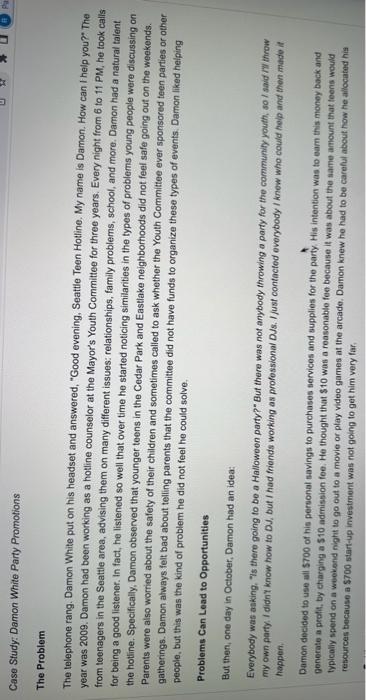
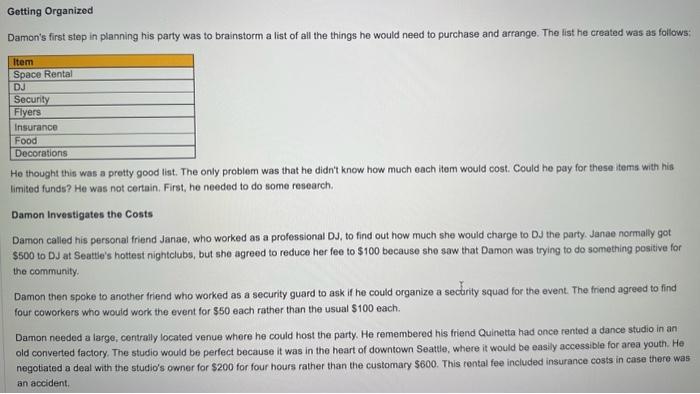
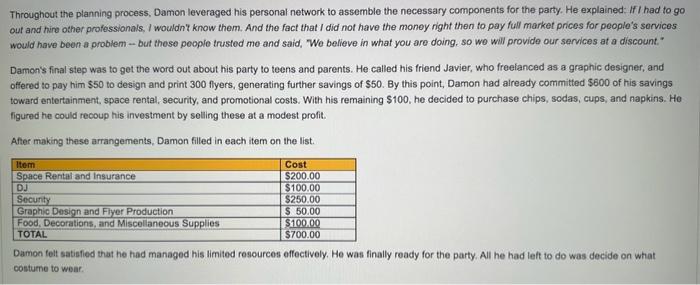
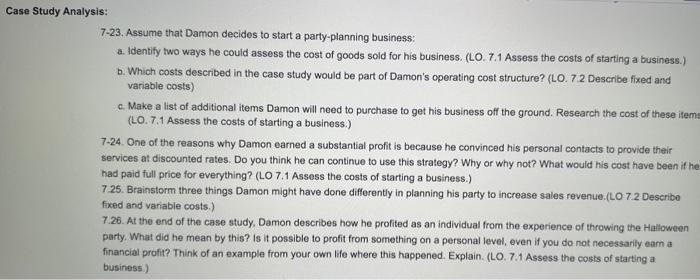
Case Study: Damon White Party Promotions The Problem The telephone rang. Damon White put on his headset and answered, "Good evening, Seattle Teen Hotline, My name is Damon. How can I help you?* The year was 2009. Damon had been working as a hotline counselor at the Mayor's Youth Committee for three years. Every night from 6 to 11 PM, he took call from teonagers in the Seattle area, advising them on many different issues: relationships, family problems, school, and more. Damon had a natural talent for being a good listener. In fact, he listened so well that over time he started noticing similarities in the types of problems young people were discussing on the hotline. Specifically, Damon observed that younger teens in the Cedar Park and Eastlake neighborhoods did not feel safe going out on the weekends. Parents were also worried about the safety of their children and sometimes called to ask whether the Youth Committee ever sponsored teen parties or other gatherings. Damon always felt bad about telling parents that the committee did not have funds to organize these types of events. Damon liked helping people, but this was the kind of problem he did not feel he could solve. Problems Can Lead to Opportunities But then, one day in October, Damon had an idea: Everybody was anking, "is there going to be a Halloween party? " But there was not anybody throwing a party for the communily youth, so l said I I throw my own party. I didny know how to DJ, but I had friends working as profossional DJs. I fust contacted everybody I knew who coudd help and then made it happen. Damon decided to use all $700 of his personal savings to purchases services and supplies for the party. His intention was to eam this money bock and ponerate a peofit, by charging a $10 admission fee. He thought that $10 was a reasonable fee because it was about the same amount that teens would typically spend on a weokend night to go out to a movie or play video games at the arcade. Damon knew he had to be careful about how he allocated his resources because a $700 start-up investment was not going to get him very far. Damon's first step in planning his party was to brainstorm a list of all the things he would need to purchase and arrange. The list he created was as follows: He thought this was a protty good list. The only problem was that he didn't know how much each item would cost. Could he pay for these items with his limited funds? He was not certain. First, he needed to do some research. Damon Investigates the Costs Damon called his personal friend Jariae, who worked as a professional DJ, to find out how much she wouid charge to DJ the party. Janae normally got $500 to DJ at Seattle's hottest nightclubs, but she agreed to reduce her fee to $100 because she saw that Damon was trying to do something positive for the community. Damon then spoke to another friend who worked as a security guard to ask if he could organize a secturity squad for the event. The fnend agreed to find four coworkers who would work the event for $50 each rather than the usual $100 each. Damon needed a large, centrally located venue where he could host the party. He remembered his friend Quinetta had once rented a dance studio in an old converted factory. The studio would be perfect because it was in the heart of downtown Seattle, where it would be easily accessible for area youth. He negotiated a deal with the studio's owner for $200 for four hours rather than the customary $600. This rental fee included insurance costs in case there was an accident. Throughout the planning process, Damon leveraged his personal network to assemble the necessary components for the party. He explained: If I had to go out and hire other professionals, I wouldn't know them. And the fact that I did not have the money right then to pay full market prices for peoplo's services . would have beon a problem - but these pooplo trusted me and said, "We believe in what you are doing. so wo will provide our services at a discount." Damon's final step was to get the word out about his party to teens and parents. He called his friend Javier, who freelanced as a graphic designer, and offered to pay him $50 to design and print 300 flyers, generating further savings of $50. By this point, Damon had already committed $600 of his savings toward entertainment, space rental, security, and promotional costs. With his remaining $100, he decided to purchase chips, sodas, cups, and napkins. He figured he could recoup his investment by selling these at a modest profit. After making these arrangements, Damon filled in each item on the list. Damon felt satiafied that he had managed his limited resources effectively. He was finally ready for the party. All he had left to do was decide on what costume to wear. 7-23. Assume that Damon decides to start a party-planning business: a. Identify two ways he could assess the cost of goods sold for his business. (LO. 7.1 Assess the costs of starting a business.) b. Which costs described in the case study would be part of Damon's operating cost structure? (LO. 7.2 Describe fixed and variable costs) c. Make a list of additional items Damon will need to purchase to get his business off the ground. Research the cost of these item (LO.7.1 Assess the costs of starting a business.) 7-24. One of the reasons why Damon earned a substantial profit is because he convinced his personal contacts to provide their services at discounted rates. Do you think he can continue to use this strategy? Why or why not? What would his cost have been if he had paid full price for everything? (LO 7.1 Assess the costs of starting a business.) 7.25. Brainstorm three things Damon might have done differently in planning his party to increase sales revenue.(LO 7.2 Describe fixed and variable costs.) 7.26. At the end of the case study, Damon describes how he profited as an individual from the experience of throwing the Halloween party. What did he mean by this? is it possible to profit from something on a personal level, even if you do not necessarily eam a financial profit? Think of an example from your own life where this happened. Explain. (LO. 7.1 Assess the costs of starting a business.)
Step by Step Solution
There are 3 Steps involved in it

Get step-by-step solutions from verified subject matter experts
 Study Help