Question: Please help me to answer this question!!!! your help is much appreicated as this will be my revison. Overview of clothing manufacturing in Europe Since
Please help me to answer this question!!!! your help is much appreicated as this will be my revison.
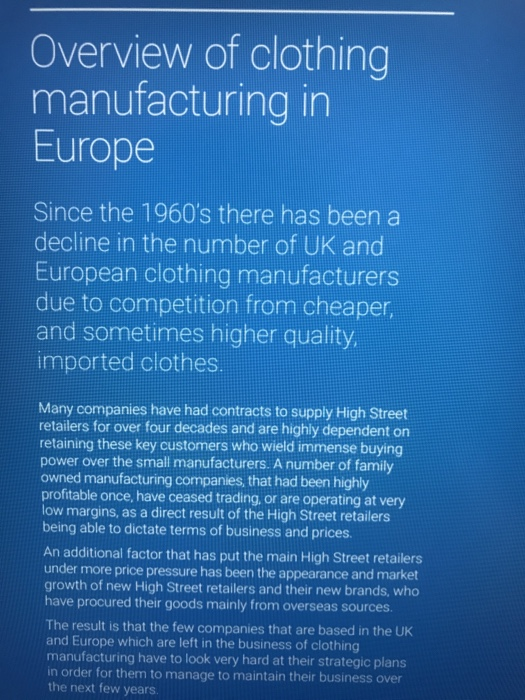
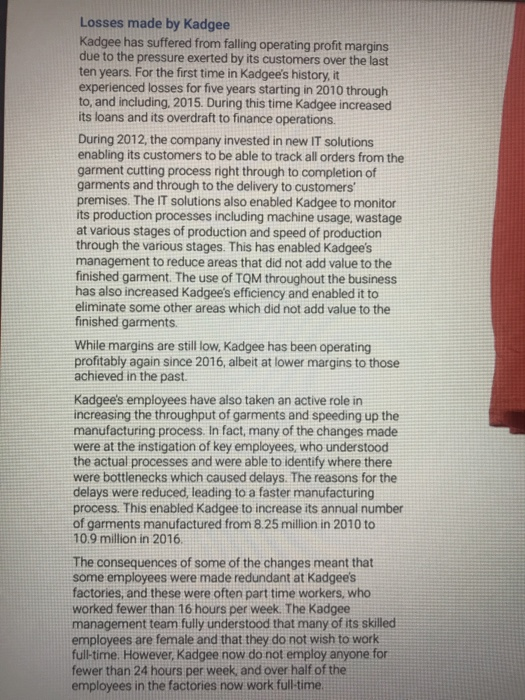
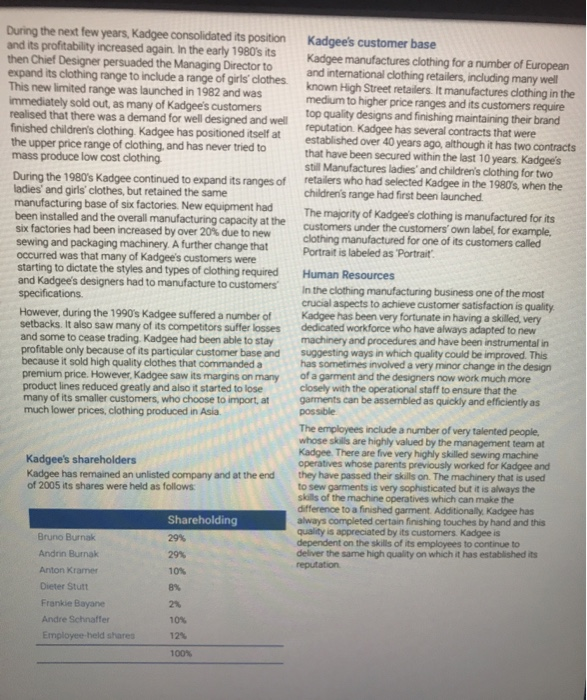
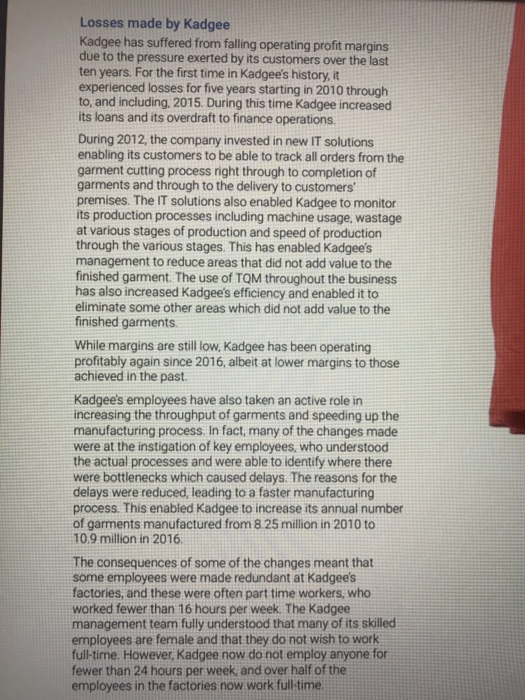
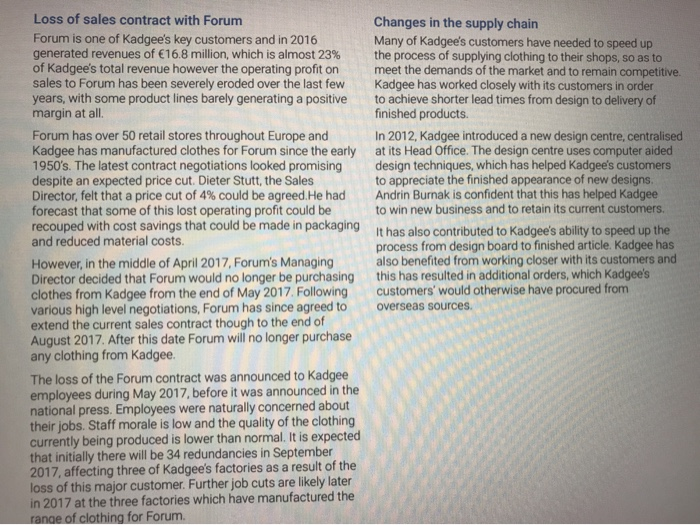
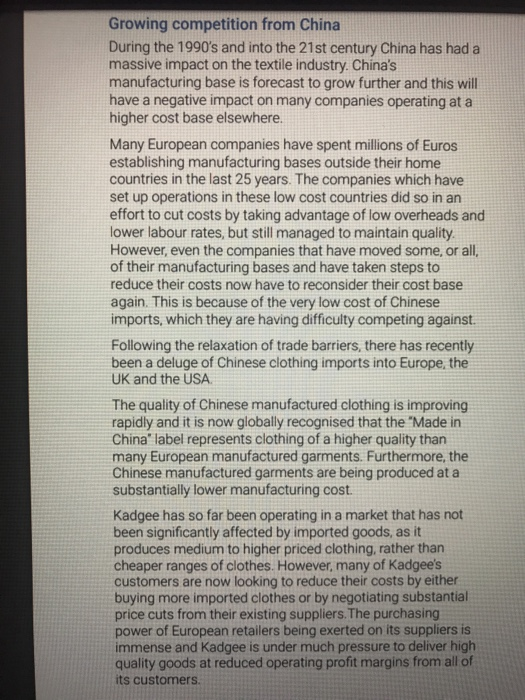
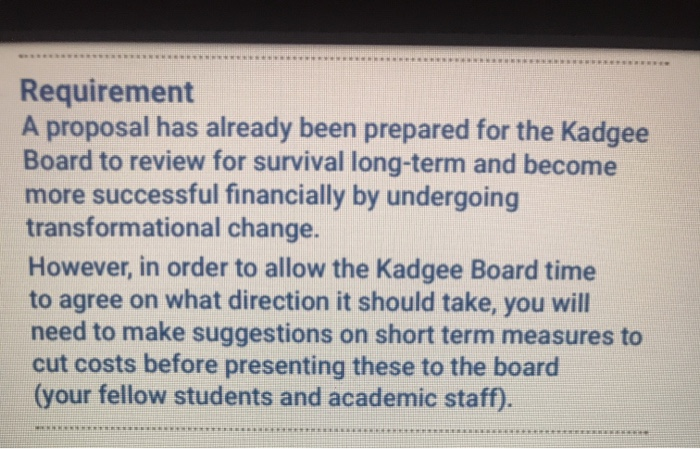
Overview of clothing manufacturing in Europe Since the 1960's there has been a decline in the number of UK and European clothing manufacturers due to competition from cheaper, and sometimes higher quality, imported clothes. Many companies have had contracts to supply High Street retailers for over four decades and are highly dependent on retaining these key customers who wield immense buying power over the small manufacturers. A number of family owned manufacturing companies that had been highly profitable once, have ceased trading or are operating at very low margins, as a direct result of the High Street retailers being able to dictate terms of business and prices. An additional factor that has put the main High Street retailers under more price pressure has been the appearance and market growth of new High Street retailers and their new brands, who have procured their goods mainly from overseas sources. The result is that the few companies that are based in the UK and Europe which are left in the business of clothing manufacturing have to look very hard at their strategic plans in order for them to manage to maintain their business over the next few years Losses made by Kadgee Kadgee has suffered from falling operating profit margins due to the pressure exerted by its customers over the last ten years. For the first time in Kadgee's history, it experienced losses for five years starting in 2010 through to, and including, 2015. During this time Kadgee increased its loans and its overdraft to finance operations. During 2012, the company invested in new IT solutions enabling its customers to be able to track all orders from the garment cutting process right through to completion of garments and through to the delivery to customers' premises. The IT solutions also enabled Kadgee to monitor its production processes including machine usage, wastage at various stages of production and speed of production through the various stages. This has enabled Kadgee's management to reduce areas that did not add value to the finished garment. The use of TQM throughout the business has also increased Kadgee's efficiency and enabled it to eliminate some other areas which did not add value to the finished garments. While margins are still low, Kadgee has been operating profitably again since 2016, albeit at lower margins to those achieved in the past Kadgee's employees have also taken an active role in increasing the throughput of garments and speeding up the manufacturing process. In fact, many of the changes made were at the instigation of key employees, who understood the actual processes and were able to identify where there were bottlenecks which caused delays. The reasons for the delays were reduced, leading to a faster manufacturing process. This enabled Kadgee to increase its annual number of garments manufactured from 8.25 million in 2010 to 10.9 million in 2016 The consequences of some of the changes meant that some employees were made redundant at Kadgee's factories, and these were often part time workers, who worked fewer than 16 hours per week. The Kadgee management team fully understood that many of its skilled employees are female and that they do not wish to work full-time. However, Kadgee now do not employ anyone for fewer than 24 hours per week, and over half of the employees in the factories now work full-time, During the next few years, Kadgee consolidated its position and its profitability increased again. In the early 1980's its Kadgee's customer base then Chief Designer persuaded the Managing Director to Kadgee manufactures clothing for a number of European expand its clothing range to include a range of girls clothes and international clothing retailers, including many well This new limited range was launched in 1982 and was known High Street retailers. It manufactures clothing in the immediately sold out, as many of Kadgee's customers medium to higher price ranges and its customers require realised that there was a demand for well designed and well top quality designs and finishing maintaining their brand finished children's clothing, Kadgee has positioned itself at reputation Kadgee has several contracts that were the upper price range of clothing, and has never tried to established over 40 years ago, although it has two contracts mass produce low cost clothing that have been secured within the last 10 years. Kadgee's still Manufactures ladies and children's clothing for two During the 1980's Kadgee continued to expand its ranges of retailers who had selected Kadgee in the 1980s, when the ladies' and girls clothes, but retained the same children's range had first been launched. manufacturing base of six factories. New equipment had been installed and the overall manufacturing capacity at the The majority of Kadgee's clothing is manufactured for its six factories had been increased by over 20% due to new customers under the customers' own label, for example, sewing and packaging machinery. A further change that clothing manufactured for one of its customers called occurred was that many of Kadgee's customers were Portrait is labeled as "Portrait starting to dictate the styles and types of clothing required Human Resources and Kadgee's designers had to manufacture to customers In the clothing manufacturing business one of the most specifications crucial aspects to achieve customer satisfaction is quality However, during the 1990's Kadgee suffered a number of Kadgee has been very fortunate in having a skilled, very setbacks. It also saw many of its competitors suffer losses dedicated workforce who have always adapted to new and some to cease trading. Kadgee had been able to stay machinery and procedures and have been instrumental in profitable only because of its particular customer base and suggesting ways in which quality could be improved. This because it sold high quality clothes that commanded a has sometimes involved a very minor change in the design premium price. However, Kadgee saw its margins on many of a garment and the designers now work much more product lines reduced greatly and also it started to lose closely with the operational staff to ensure that the many of its smaller customers, who choose to import, at garments can be assembled as quickly and efficiently as much lower prices, clothing produced in Asia. possible The employees include a number of very talented people. whose skills are highly valued by the management team at Kadgee. There are five very highly skilled sewing machine Kadgee's shareholders operatives whose parents previously worked for Kadgee and Kadgee has remained an unlisted company and at the end they have passed their skills on. The machinery that is used of 2005 its shares were held as follows: to sew garments is very sophisticated but it is always the skills of the machine operatives which can make the difference to a finished garment. Additionally, Kadgee has Shareholding always completed certain finishing touches by hand and this quality is appreciated by its customers. Kadgee is Bruno Burak 29% dependent on the skills of its employees to continue to Andrin Burak 29% deliver the same high quality on which it has established its reputation Anton Kramer 10% Dieter Stutt 8% Frankie Bayane 2 Andre Schnaller 10% Employee held shares 12% 100% Loss of sales contract with Forum Changes in the supply chain Forum is one of Kadgee's key customers and in 2016 Many of Kadgee's customers have needed to speed up generated revenues of 16.8 million, which is almost 23% the process of supplying clothing to their shops, so as to of Kadgee's total revenue however the operating profit on meet the demands of the market and to remain competitive. sales to Forum has been severely eroded over the last few Kadgee has worked closely with its customers in order years, with some product lines barely generating a positive to achieve shorter lead times from design to delivery of margin at all finished products. Forum has over 50 retail stores throughout Europe and In 2012, Kadgee introduced a new design centre, centralised Kadgee has manufactured clothes for Forum since the early at its Head Office. The design centre uses computer aided 1950's. The latest contract negotiations looked promising design techniques, which has helped Kadgee's customers despite an expected price cut. Dieter Stutt, the Sales to appreciate the finished appearance of new designs. Director, felt that a price cut of 4% could be agreed. He had Andrin Burnak is confident that this has helped Kadgee forecast that some of this lost operating profit could be to win new business and to retain its current customers. recouped with cost savings that could be made in packaging it has also contributed to Kadgee's ability to speed up the and reduced material costs. process from design board to finished article. Kadgee has However, in the middle of April 2017, Forum's Managing also benefited from working closer with its customers and Director decided that Forum would no longer be purchasing this has resulted in additional orders, which Kadgee's clothes from Kadgee from the end of May 2017. Following customers' would otherwise have procured from various high level negotiations, Forum has since agreed to overseas sources extend the current sales contract though to the end of August 2017. After this date Forum will no longer purchase any clothing from Kadgee. The loss of the Forum contract was announced to Kadgee employees during May 2017, before it was announced in the national press. Employees were naturally concerned about their jobs. Staff morale is low and the quality of the clothing currently being produced is lower than normal. It is expected that initially there will be 34 redundancies in September 2017, affecting three of Kadgee's factories as a result of the loss of this major customer. Further job cuts are likely later in 2017 at the three factories which have manufactured the range of clothing for Forum Growing competition from China During the 1990's and into the 21st century China has had a massive impact on the textile industry. China's manufacturing base is forecast to grow further and this will have a negative impact on many companies operating at a higher cost base elsewhere. Many European companies have spent millions of Euros establishing manufacturing bases outside their home countries in the last 25 years. The companies which have set up operations in these low cost countries did so in an effort to cut costs by taking advantage of low overheads and lower labour rates, but still managed to maintain quality. However, even the companies that have moved some, or all, of their manufacturing bases and have taken steps to reduce their costs now have to reconsider their cost base again. This is because of the very low cost of Chinese imports, which they are having difficulty competing against. Following the relaxation of trade barriers, there has recently been a deluge of Chinese clothing imports into Europe, the UK and the USA The quality of Chinese manufactured clothing is improving rapidly and it is now globally recognised that the "Made in China" label represents clothing of a higher quality than many European manufactured garments. Furthermore, the Chinese manufactured garments are being produced at a substantially lower manufacturing cost. Kadgee has so far been operating in a market that has not been significantly affected by imported goods, as it produces medium to higher priced clothing, rather than cheaper ranges of clothes. However, many of Kadgee's customers are now looking to reduce their costs by either buying more imported clothes or by negotiating substantial price cuts from their existing suppliers. The purchasing power of European retailers being exerted on its suppliers is immense and Kadgee is under much pressure to deliver high quality goods at reduced operating profit margins from all of its customers Requirement A proposal has already been prepared for the Kadgee Board to review for survival long-term and become more successful financially by undergoing transformational change. However, in order to allow the Kadgee Board time to agree on what direction it should take, you will need to make suggestions on short term measures to cut costs before presenting these to the board (your fellow students and academic staff)









 Study Help