







Question: PLEASE HELP ME TO COMPLETE MY C++ CODE FOR THIS FUNCTION IN THE // function to be implemented by you #include #include #include using namespace
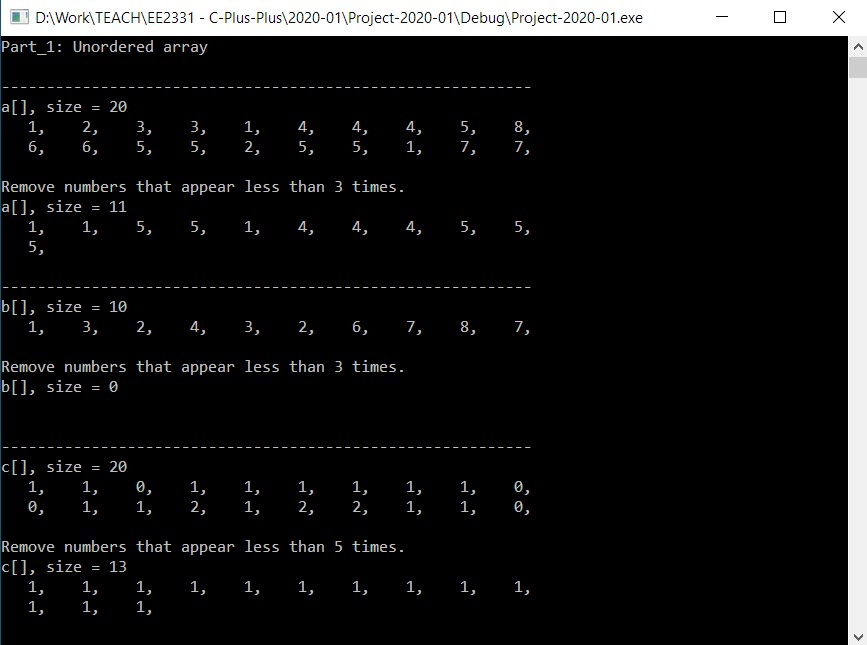
PLEASE HELP ME TO COMPLETE MY C++ CODE FOR THIS FUNCTION IN THE "// function to be implemented by you"
#include
#include
#include
using namespace std;
// -------------------------------------------- functions to be implemented by you
void filter_1(int *a, int& n, int countThreshold)
{
// Input array a[] is not ordered.
// Remove numbers in a[] that appear less than countThreshold number of times.
// Relative order of elements retained in the array need not be preserved.
// Do NOT sort the array a[] in your answer.
}
void filter_2(int *a, int& n, int countThreshold)
{
// Input array a[] is sorted in ascending order.
// Remove numbers in a[] that appear less than countThreshold number of times.
// Relative order of elements retained in the array should be preserved.
}
// ------------------------------------------- functions given to you
void printArray(const char *header, int* a, int n)
{
cout
for (int i = 0; i
{
if (i > 0 && i % 10 == 0)
cout
cout
}
cout
}
void test_1(const char *header, int *a, int& n, int threshold)
{
cout
printArray(header, a, n);
cout
filter_1(a, n, threshold);
printArray(header, a, n);
}
void part_1()
{
cout
int a[] = {1, 2, 3, 3, 1, 4, 4, 4, 5, 8, 6, 6, 5, 5, 2, 5, 5, 1, 7, 7};
int n = 20;
test_1("a[]", a, n, 3);
int b[] = {1, 3, 2, 4, 3, 2, 6, 7, 8, 7};
int m = 10;
test_1("b[]", b, m, 3);
int c[] = {1, 1, 0, 1, 1, 1, 1, 1, 1, 0, 0, 1, 1, 2, 1, 2, 2, 1, 1, 0};
int r = 20;
test_1("c[]", c, r, 5);
}
void test_2(const char *header, int *a, int& n, int threshold)
{
cout
printArray(header, a, n);
cout
filter_2(a, n, threshold);
printArray(header, a, n);
}
void part_2()
{
cout
cout
int a[] = {1, 1, 2, 2, 2, 2, 5, 5, 6, 6, 7, 7, 7, 9, 9, 9, 10, 12, 13, 13};
int n = 20;
test_2("a[]", a, n, 3);
int b[] = {1, 1, 2, 2, 3, 4, 6, 7, 7, 8};
int m = 10;
test_2("b[]", b, m, 3);
int c[] = {0, 0, 0, 0, 0, 0, 0, 1, 1, 1, 1, 1, 1, 1, 1, 2, 2, 2, 2, 2};
int r = 20;
test_2("c[]", c, r, 5);
}
int main()
{
part_1();
part_2();
system("pause");
return 0;
}
-ox ID: Work\TEACH\EE2331 - C-Plus-Plus 2020-01\Project-2020-01\Debug Project-2020-01.exe Part_1: Unordered array a[], size = 20 1, 2, 6, 6, 3, 5, 3, 5. 1, 2. 4, 5, 4, 5, 4, 1. 5, 7. 8, 7. Remove numbers that appear less than 3 times. a[], size = 11 1, 1, 5, 5, 1, 4, 4, 4, 5, 5, 5, - , 8, 7, b[], size = 10 1, 3, 2, 4, 3, 2, 6, 7, Remove numbers that appear less than 3 times. b[l, size = 0 C[], size = 20 0, 1, 1, 2, 1, 2, 2, 1, 1, 0, Remove numbers that appear less than 5 times. c[], size = 13 1, 1, 1, 1, 1, 1, 1, 1, 1, 1, 1, 1
Step by Step Solution
There are 3 Steps involved in it

Get step-by-step solutions from verified subject matter experts
 Study Help