







Question: Please help me to solve question b BMW's Supply Chain Makes a Quantum Leap An artificial intelligence (AI) partnership is helping BMW trial methods of
Please help me to solve question b
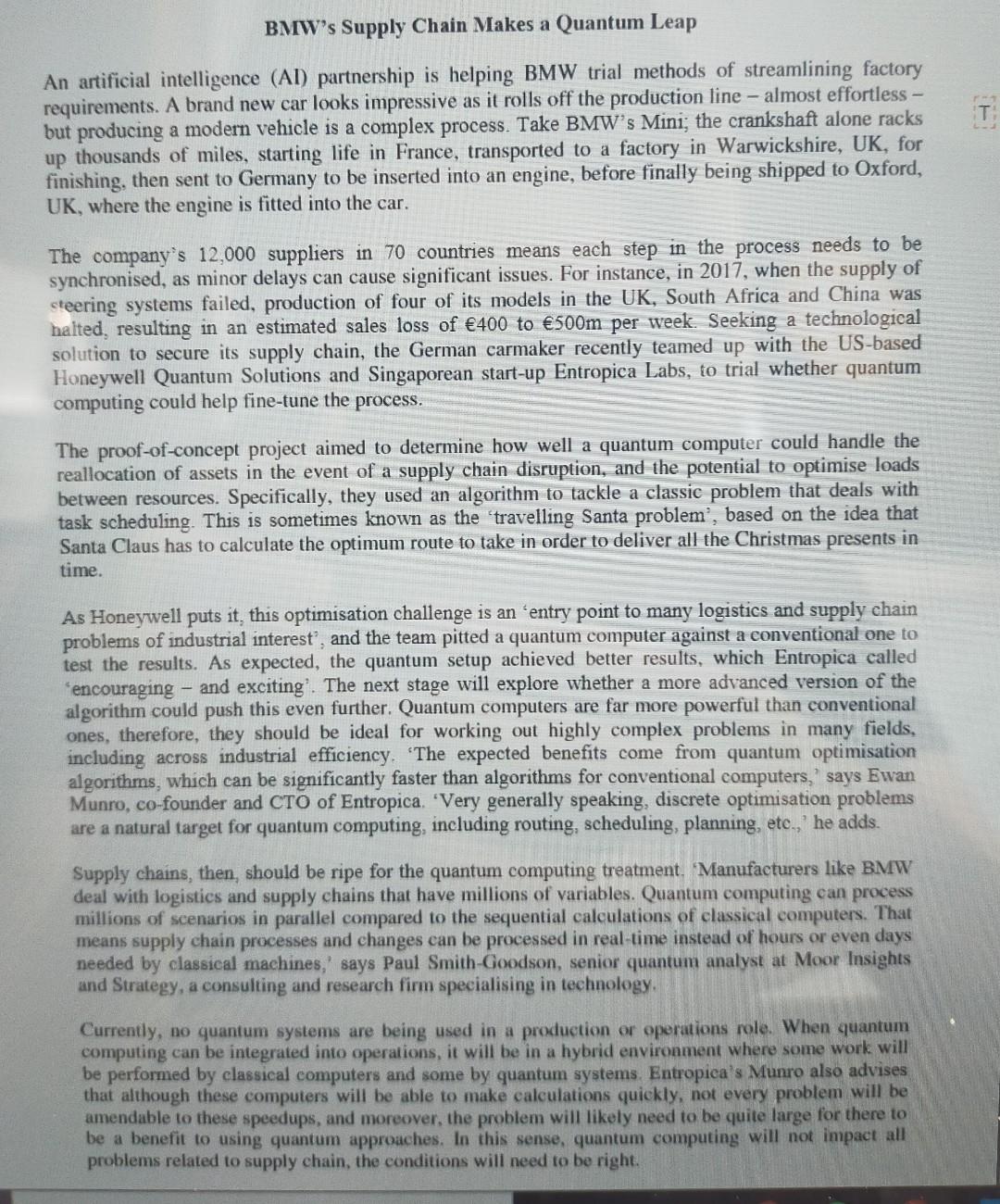
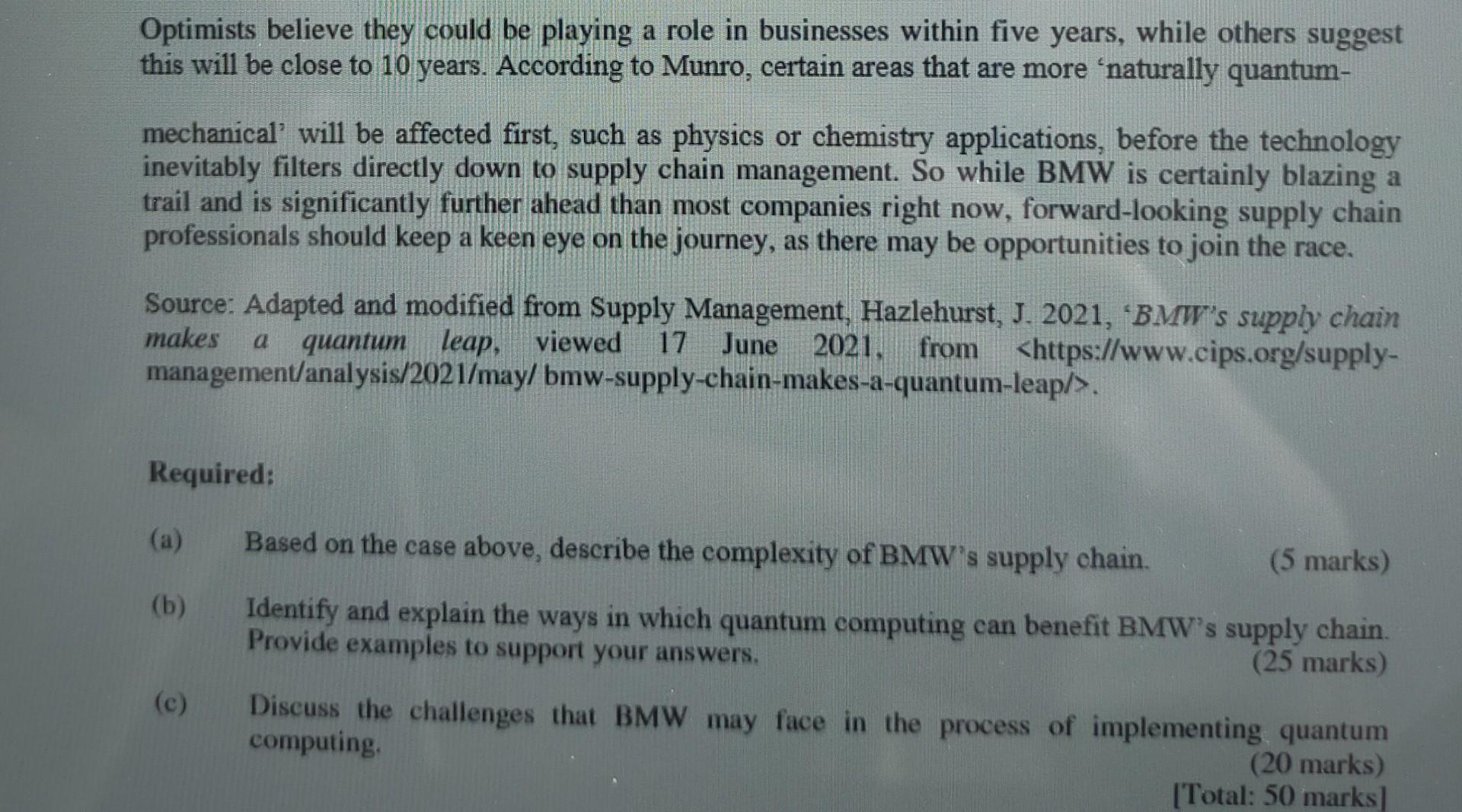
BMW's Supply Chain Makes a Quantum Leap An artificial intelligence (AI) partnership is helping BMW trial methods of streamlining factory requirements. A brand new car looks impressive as it rolls off the production line - almost effortless - but producing a modern vehicle is a complex process. Take BMW's Mini; the crankshaft alone racks up thousands of miles, starting life in France, transported to a factory in Warwickshire, UK, for finishing, then sent to Germany to be inserted into an engine, before finally being shipped to Oxford, UK, where the engine is fitted into the car. The company's 12,000 suppliers in 70 countries means each step in the process needs to be synchronised, as minor delays can cause significant issues. For instance, in 2017, when the supply of steering systems failed, production of four of its models in the UK, South Africa and China was haited, resulting in an estimated sales loss of 400 to 500m per week. Seeking a technological solution to secure its supply chain, the German carmaker recently teamed up with the US-based Honeywell Quantum Solutions and Singaporean start-up Entropica Labs, to trial whether quantum computing could help fine-tune the process. The proof-of-concept project aimed to determine how well a quantum computer could handle the reallocation of assets in the event of a supply chain disruption, and the potential to optimise loads between resources. Specifically, they used an algorithm to tackle a classic problem that deals with task scheduling. This is sometimes known as the travelling Santa problem', based on the idea that Santa Claus has to calculate the optimum route to take in order to deliver all the Christmas presents in time. As Honeywell puts it, this optimisation challenge is an entry point to many logistics and supply chain problems of industrial interest', and the team pitted a quantum computer against a conventional one to test the results. As expected, the quantum setup achieved better results, which Entropica called encouraging - and exciting. The next stage will explore whether a more advanced version of the algorithm could push this even further. Quantum computers are far more powerful than conventional ones, therefore, they should be ideal for working out highly complex problems in many fields, including across industrial efficiency. The expected benefits come from quantum optimisation algorithms, which can be significantly faster than algorithms for conventional computers, says Ewan Munro, co-founder and CTO of Entropica. 'Very generally speaking, discrete optimisation problems are a natural target for quantum computing, including routing, scheduling, planning, etc.,' he adds. Supply chains, then, should be ripe for the quantum computing treatment Manufacturers like BMW deal with logistics and supply chains that have millions of variables. Quantum computing can process millions of scenarios in parallel compared to the sequential calculations of classical computers. That means supply chain processes and changes can be processed in real-time instead of hours or even days needed by classical machines,' says Paul Smith-Goodson, senior quantum analyst at Moor Insights and Strategy, a consulting and research firm specialising in technology. Currently, no quantum systems are being used in a production or operations role. When quantum computing can be integrated into operations, it will be in a hybrid environment where some work will be performed by classical computers and some by quantum systems. Entropica's Munro also advises that although these computers will be able to make calculations quickly, not every problem will be amendable to these speedups, and moreover, the problem will likely need to be quite large for there to be a benefit to using quantum approaches. In this sense, quantum computing will not impact all problems related to supply chain, the conditions will need to be right. Optimists believe they could be playing a role in businesses within five years, while others suggest this will be close to 10 years. According to Munro, certain areas that are more 'naturally quantum- mechanical' will be affected first, such as physics or chemistry applications, before the technology inevitably filters directly down to supply chain management. So while BMW is certainly blazing a trail and is significantly further ahead than most companies right now, forward-looking supply chain professionals should keep a keen eye on the journey, as there may be opportunities to join the race. Source: Adapted and modified from Supply Management, Hazlehurst, J. 2021, 'BMW's supply chain makes quantum leap, viewed 17 June 17 June 2021. fromStep by Step Solution
There are 3 Steps involved in it
1 Expert Approved Answer
Step: 1 Unlock

Question Has Been Solved by an Expert!
Get step-by-step solutions from verified subject matter experts
Step: 2 Unlock
Step: 3 Unlock
 Study Help