







Question: Please help me to solve this problem step by step. ---------------------------------------------------------------------- The generalized definition of interactive proofs is it was just a simplified version of
Please help me to solve this problem step by step.
----------------------------------------------------------------------
The generalized definition of interactive proofs is
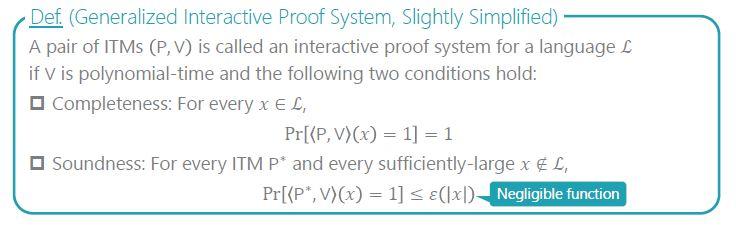
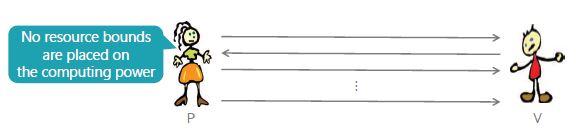
it was just a simplified version of generalized IPs.
----------------------------------------------------------------------------------
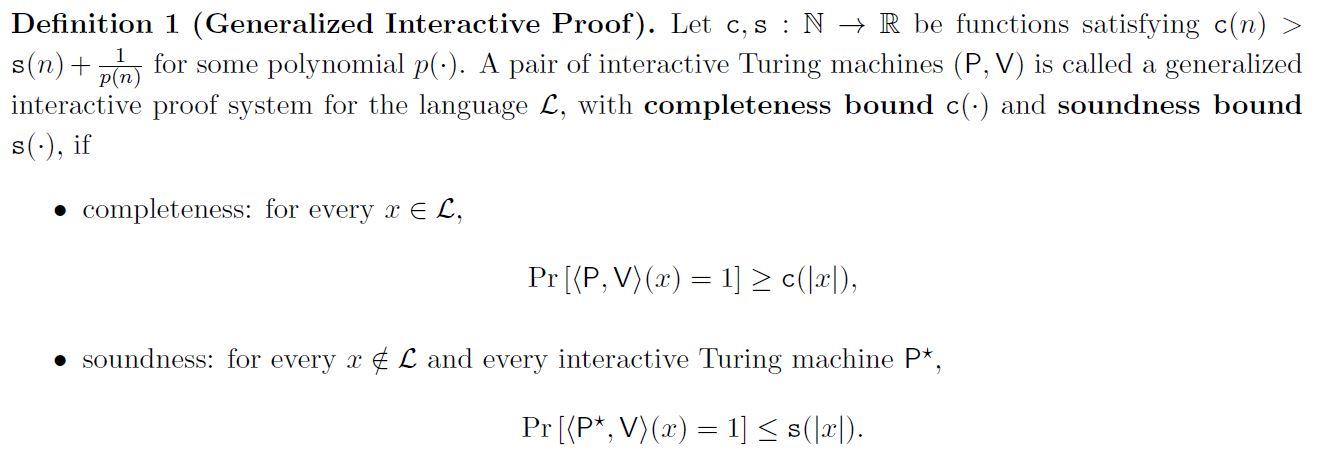
But, the (truly) generalized definition of IPs is given as follows:
Question :
1. Why can the above Definition 1 be seen as the generalized version of the IP definition on definitions on the simplified version above? please describe the reason.
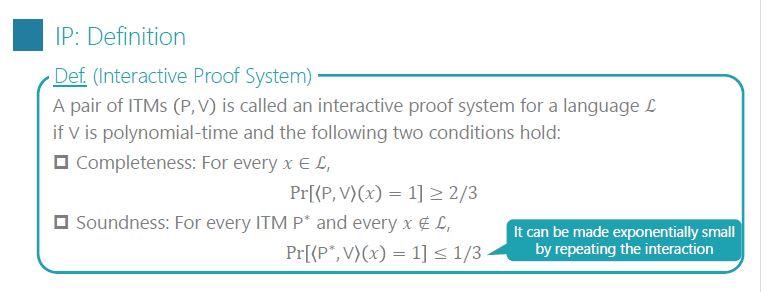
2. Check that the above Definition 1 implies the IP definition below, and please namely, check that the IP definition below is a special case of the above definition given in Definition 1 above.
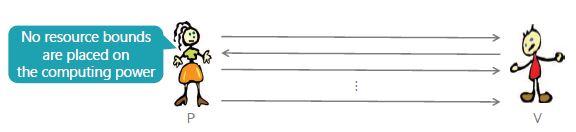
-----------------------------------------------------------------------------------------------------------
For any explanations given, I would very much appreciate it, thank you very much for your help.
Def. (Generalized Interactive Proof System, Slightly Simplified) A pair of ITMs (P,V) is called an interactive proof system for a language L V is polynomial-time and the following two conditions hold: Completeness: For every xLr Pr[P,V(x)=1]=1 Soundness: For every ITM P and every sufficiently-large x/Lt Pr[P,V(x)=1](x) Definition 1 (Generalized Interactive Proof). Let c,s:NR be functions satisfying c(n)> s(n)+p(n)1 for some polynomial p(). A pair of interactive Turing machines (P,V) is called a generalized interactive proof system for the language L, with completeness bound c() and soundness bound s(), if - completeness: for every xL, Pr[P,V(x)=1]c(x), - soundness: for every x/L and every interactive Turing machine P, Pr[P,V(x)=1]s(x) IP: Definition Def. (Interactive Proof System) A pair of ITMS (P,V) is called an interactive proof system for a language L if V is polynomial-time and the following two conditions hold: Completeness: For every xL, Pr[P,V(x)=1]2/3 Soundness: For every ITM P and every x/L, Pr[P,V(x)=1]1/3
Step by Step Solution
There are 3 Steps involved in it

Get step-by-step solutions from verified subject matter experts
 Study Help