Question: please help me witb this WHAT IS A DEPRESSION? In 2009 with the stock market falling, banks failing, and unemployment soaring, many people wondered if
please help me witb this
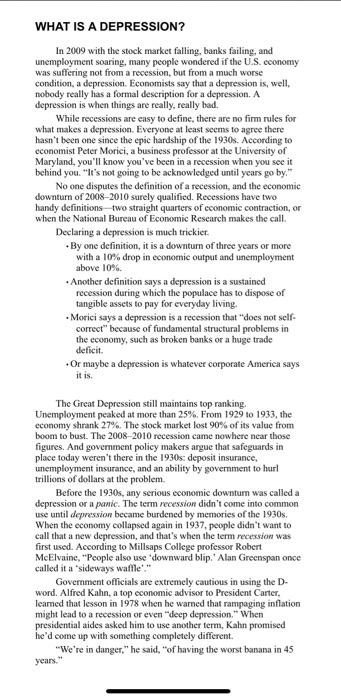
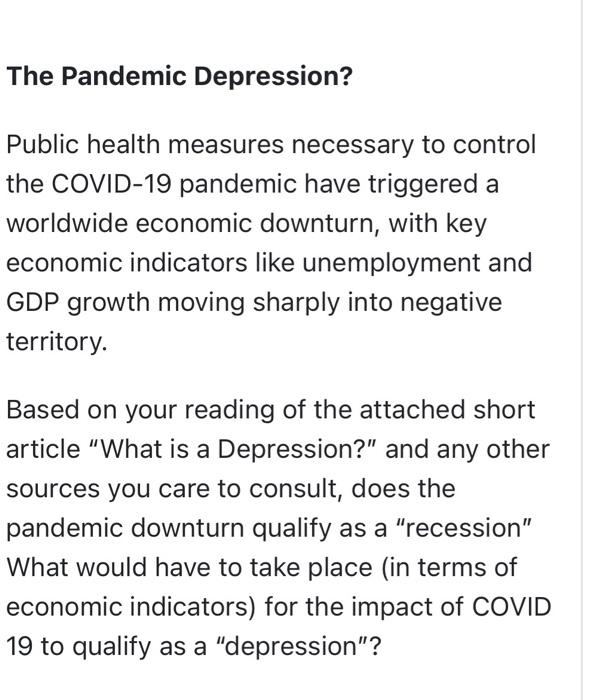
WHAT IS A DEPRESSION? In 2009 with the stock market falling, banks failing, and unemployment soaring, many people wondered if the U.S.cconomy was suffering not from a recession, but from a much worse condition, a depression. Economists say that a depression is, well, nobody really has a formal description for a depression. A depression is when things are really, really bad. While recessions are easy to define there are no fimm rules for what makes a depression. Everyone at least seems to agree there hasn't been one since the epic hardship of the 1930s. According to economist Peter Morici, a business professor at the University of Maryland, you'll know you've been in a recession when you see it behind you. "It's not going to be acknowledged until years go by." No one disputes the definition of a recession, and the economic downturn of 2008-2010 surely qualified. Recessions have two handy definitions two straight quarters of economic contraction, or when the National Bureau of Economic Research makes the call. Declaring a depression is much trickier. -By one definition, it is a downturn of three years or more with a 10% drop in economic output and unemployment above 10%. Another definition says a depression is a sustained recession during which the populace has to dispose of tangible assets to pay for everyday living. - Morici says a depression is a recession that does not self- correct" because of fundamental structural problems in the economy, such as broken banks or a huge trade deficit Or maybe a depression is whatever corporate America says it is The Great Depression still maintains top ranking. Unemployment peaked at more than 25%. From 1929 to 1933, the economy shrank 27%. The stock market lost 90% of its value from boom to bust. The 2008-2010 recession came nowhere near those figures. And government policy makers argue that safeguards in place today weren't there in the 1930s: deposit insurance, unemployment insurance, and an ability by government to hurl trillions of dollars at the problem. Before the 1930s, any serious cconomic downturn was called a depression or a panic. The term recession didn't come into common use until depression became burdened by memories of the 1930s. When the economy collapsed again in 1937, people didn't want to call that a new depression, and that's when the term recession was first used. According to Millsaps College professor Robert McElvaine, "People also use 'downward blip. Alan Greenspan once called it a sideways waffle Government officials are extremely cautious in using the D- word. Alfred Kahn, a top economic advisor to President Carter, leamed that lesson in 1978 when he warned that rampaging inflation might lead to a recession or even "deep depression. When presidential aides asked him to use another term, Kahn promised he'd come up with something completely different. "We're in danger," he said, "of having the worst banana in 45 years. The Pandemic Depression? Public health measures necessary to control the COVID-19 pandemic have triggered a worldwide economic downturn, with key economic indicators like unemployment and GDP growth moving sharply into negative territory. Based on your reading of the attached short article "What is a Depression?" and any other sources you care to consult, does the pandemic downturn qualify as a "recession" What would have to take place in terms of economic indicators) for the impact of COVID 19 to qualify as a "depression









 Study Help