



Question: please help me with the question below. thank you very much. 2. The following data set (only first few rows shown) refers to the number
please help me with the question below. thank you very much.
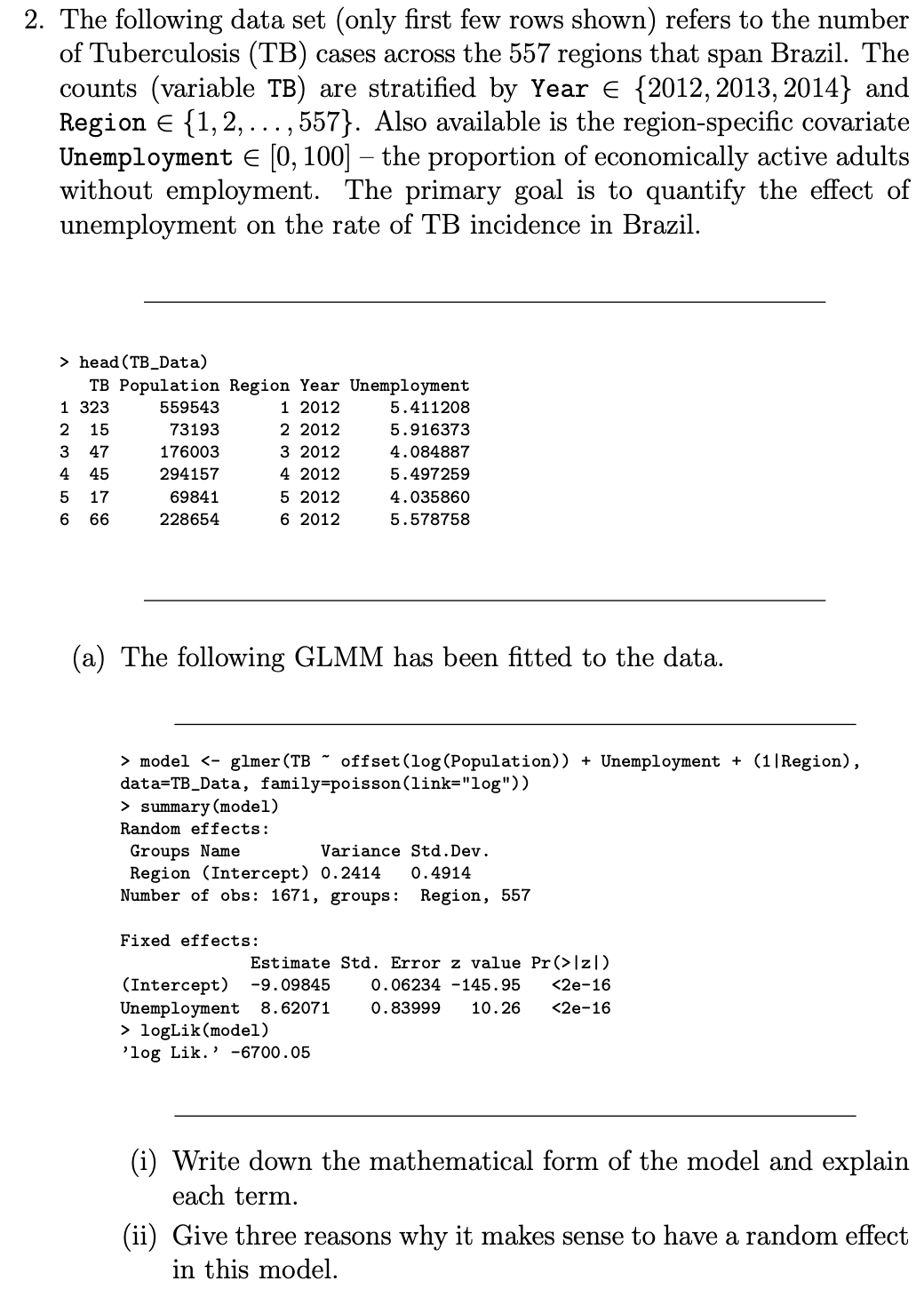
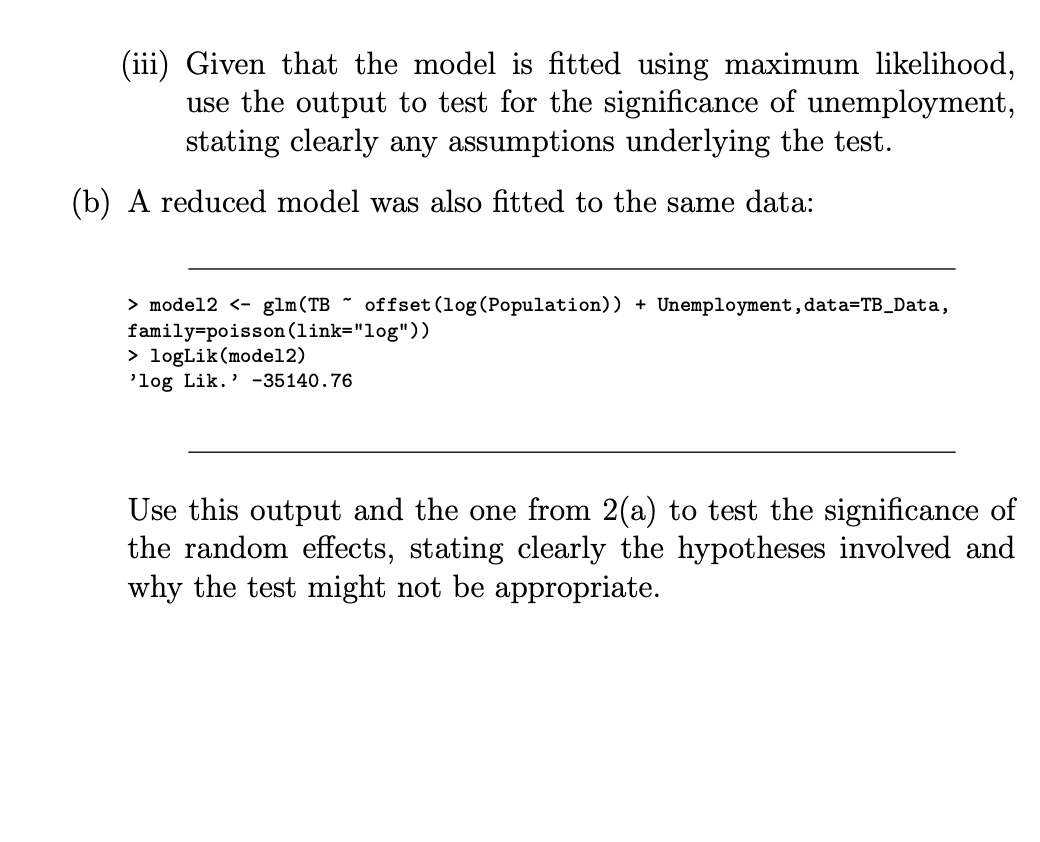
2. The following data set (only first few rows shown) refers to the number of Tuberculosis (TB) cases across the 557 regions that span Brazil. The counts (variable TB) are stratified by Year E {2012, 2013, 2014} and Region E {1, 2, ...,557}. Also available is the region-specific covariate Unemployment E [0, 100] - the proportion of economically active adults without employment. The primary goal is to quantify the effect of unemployment on the rate of TB incidence in Brazil. > head (TB_Data) TB Population Region Year Unemployment 323 559543 1 2012 5. 411208 2 15 73193 2 2012 5.916373 3 47 176003 3 2012 4. 084887 4 45 294157 4 2012 5. 497259 5 17 69841 5 2012 4. 035860 6 66 228654 6 2012 5.578758 (a) The following GLMM has been fitted to the data. > model summary (model) Random effects: Groups Name Variance Std. Dev. Region (Intercept) 0. 2414 0. 4914 Number of obs: 1671, groups: Region, 557 Fixed effects: Estimate Std. Error z value Pr (> |z|) (Intercept) -9. 09845 0. 06234 -145.95 logLik (model) 'log Lik. ' -6700.05 (i) Write down the mathematical form of the model and explain each term. (ii) Give three reasons why it makes sense to have a random effect in this model.(iii) Given that the model is fitted using maximum likelihood, use the output to test for the significance of unemployment, stating clearly any assumptions underlying the test. (b) A reduced model was also fitted to the same data: > model2 logLik (mode12) 'log Lik. ' -35140.76 Use this output and the one from 2(a) to test the significance of the random effects, stating clearly the hypotheses involved and why the test might not be appropriate
Step by Step Solution
There are 3 Steps involved in it

Get step-by-step solutions from verified subject matter experts