







Question: Please help me with these. I do give likes. Basics of Data Collection & Sampling Homework PROBLEM: Determine if each of the following is a
Please help me with these. I do give likes.
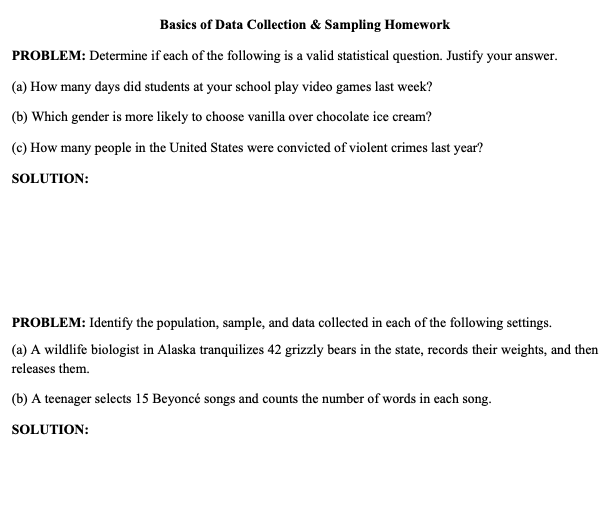
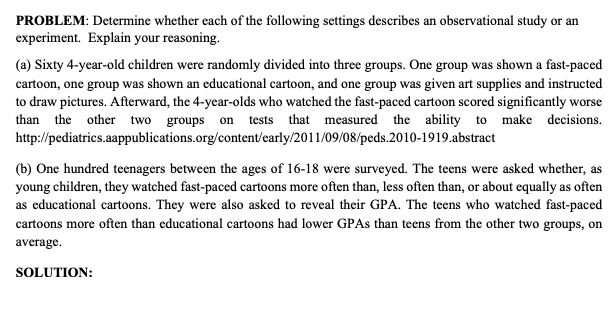
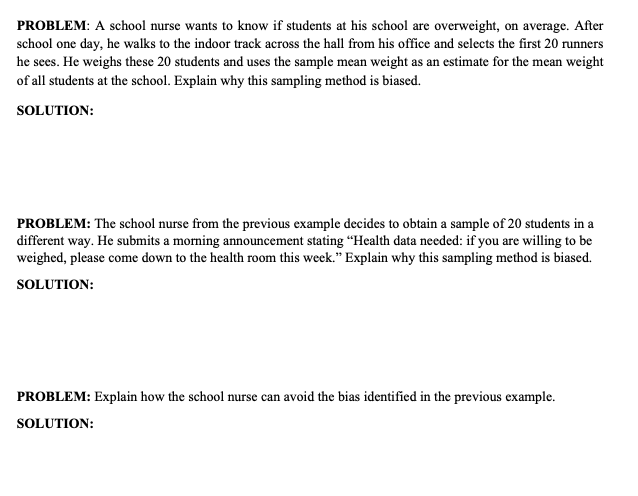
Basics of Data Collection & Sampling Homework PROBLEM: Determine if each of the following is a valid statistical question. Justify your answer. (a) How many days did students at your school play video games last week? (b) Which gender is more likely to choose vanilla over chocolate ice cream? (c) How many people in the United States were convicted of violent crimes last year? SOLUTION: PROBLEM: Identify the population, sample, and data collected in each of the following settings. (a) A wildlife biologist in Alaska tranquilizes 42 grizzly bears in the state, records their weights, and then releases them. (b) A teenager selects 15 Beyonc songs and counts the number of words in each song. SOLUTION: PROBLEM: Determine whether each of the following settings describes an observational study or an experiment. Explain your reasoning. (a) Sixty 4-year-old children were randomly divided into three groups. One group was shown a fast-paced cartoon, one group was shown an educational cartoon, and one group was given art supplies and instructed to draw pictures. Afterward, the 4-year-olds who watched the fast-paced cartoon scored significantly worse than the other two groups on tests that measured the ability to make decisions. http://pediatrics.aappublications.org/content/early/2011/09/08/peds.2010-1919.abstract (b) One hundred teenagers between the ages of 16-18 were surveyed. The teens were asked whether, as young children, they watched fast-paced cartoons more often than, less often than, or about equally as often as educational cartoons. They were also asked to reveal their GPA. The teens who watched fast-paced cartoons more often than educational cartoons had lower GPAs than teens from the other two groups, on average. SOLUTION: PROBLEM: A school nurse wants to know if students at his school are overweight, on average. After school one day, he walks to the indoor track across the hall from his office and selects the first 20 runners he sees. He weighs these 20 students and uses the sample mean weight as an estimate for the mean weight of all students at the school. Explain why this sampling method is biased. SOLUTION: PROBLEM: The school nurse from the previous example decides to obtain a sample of 20 students in a different way. He submits a morning announcement stating "Health data needed: if you are willing to be weighed, please come down to the health room this week. Explain why this sampling method is biased. SOLUTION: PROBLEM: Explain how the school nurse can avoid the bias identified in the previous example. SOLUTION: Basics of Data Collection & Sampling Homework PROBLEM: Determine if each of the following is a valid statistical question. Justify your answer. (a) How many days did students at your school play video games last week? (b) Which gender is more likely to choose vanilla over chocolate ice cream? (c) How many people in the United States were convicted of violent crimes last year? SOLUTION: PROBLEM: Identify the population, sample, and data collected in each of the following settings. (a) A wildlife biologist in Alaska tranquilizes 42 grizzly bears in the state, records their weights, and then releases them. (b) A teenager selects 15 Beyonc songs and counts the number of words in each song. SOLUTION: PROBLEM: Determine whether each of the following settings describes an observational study or an experiment. Explain your reasoning. (a) Sixty 4-year-old children were randomly divided into three groups. One group was shown a fast-paced cartoon, one group was shown an educational cartoon, and one group was given art supplies and instructed to draw pictures. Afterward, the 4-year-olds who watched the fast-paced cartoon scored significantly worse than the other two groups on tests that measured the ability to make decisions. http://pediatrics.aappublications.org/content/early/2011/09/08/peds.2010-1919.abstract (b) One hundred teenagers between the ages of 16-18 were surveyed. The teens were asked whether, as young children, they watched fast-paced cartoons more often than, less often than, or about equally as often as educational cartoons. They were also asked to reveal their GPA. The teens who watched fast-paced cartoons more often than educational cartoons had lower GPAs than teens from the other two groups, on average. SOLUTION: PROBLEM: A school nurse wants to know if students at his school are overweight, on average. After school one day, he walks to the indoor track across the hall from his office and selects the first 20 runners he sees. He weighs these 20 students and uses the sample mean weight as an estimate for the mean weight of all students at the school. Explain why this sampling method is biased. SOLUTION: PROBLEM: The school nurse from the previous example decides to obtain a sample of 20 students in a different way. He submits a morning announcement stating "Health data needed: if you are willing to be weighed, please come down to the health room this week. Explain why this sampling method is biased. SOLUTION: PROBLEM: Explain how the school nurse can avoid the bias identified in the previous example. SOLUTIONStep by Step Solution
There are 3 Steps involved in it
1 Expert Approved Answer
Step: 1 Unlock

Question Has Been Solved by an Expert!
Get step-by-step solutions from verified subject matter experts
Step: 2 Unlock
Step: 3 Unlock
 Study Help