







Question: Please help me with this assignment. I posted it this earlier but the answer that was provided did not compile with the test code and
Please help me with this assignment. I posted it this earlier but the answer that was provided did not compile with the test code and I saw that there are similar problems already posted but I could not get it to work correctly. Thank you!!
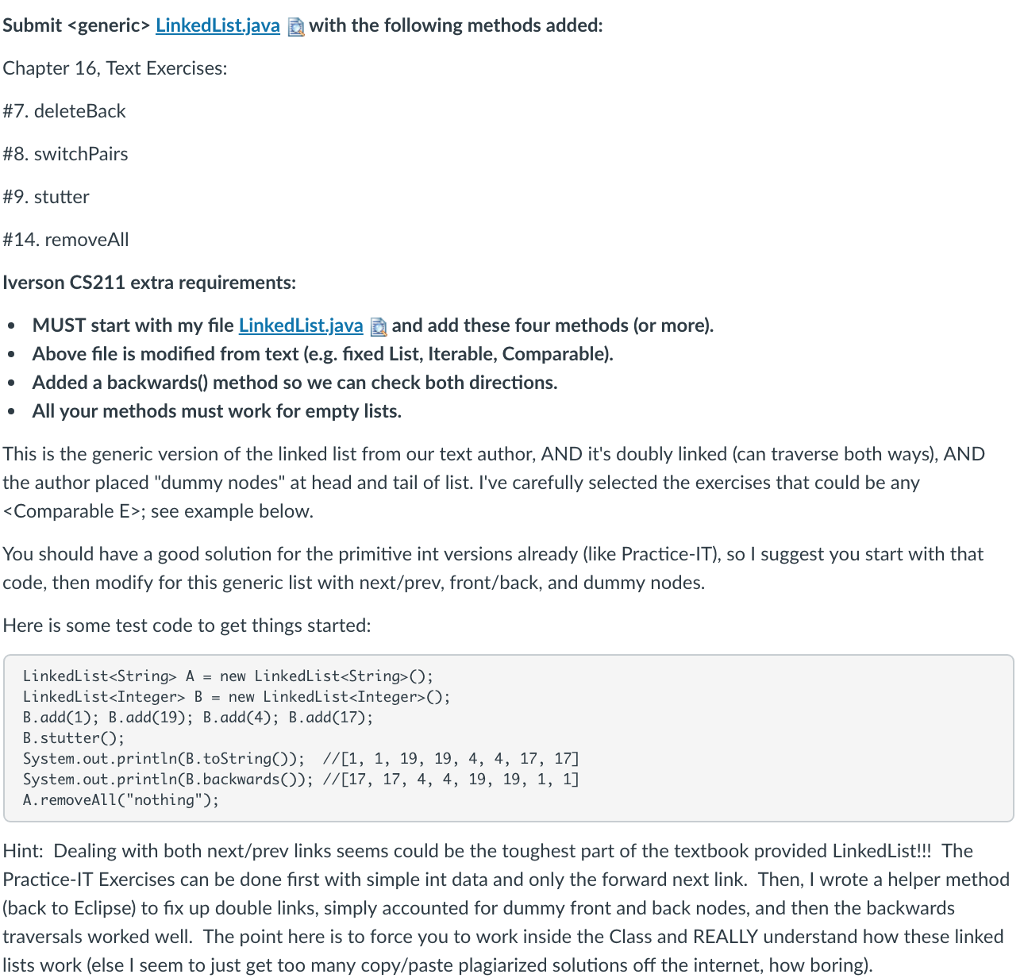
//LinkedList.java file
import java.util.*;
// Class LinkedList can be used to store a list of values of type E.
// from Buildingjavaprograms.com
// modified by W.P. Iverson, Bellevue College, January 2017
// added backwards() to check list in backwards order
public class LinkedList> implements Iterable{
// removed implements List due to version differences of List
private ListNode front; // first value in the list
private ListNode back; // last value in the list
private int size; // current number of elements
// post: constructs an empty list
public LinkedList() {
front = new ListNode(null);
back = new ListNode(null);
clear();
}
// ADD MORE METHODS HERE (like for assigned CS211 work):
// post: returns the current number of elements in the list
public int size() {
return size;
}
// pre : 0
// post: returns the value at the given index in the list
public E get(int index) {
checkIndex(index);
ListNode current = nodeAt(index);
return current.data;
}
// post: creates a comma-separated, bracketed version of the list
public String toString() {
if (size == 0) {
return "[]";
} else {
String result = "[" + front.next.data;
ListNode current = front.next.next;
while (current != back) {
result += ", " + current.data;
current = current.next;
}
result += "]";
return result;
}
}
// post: creates a comma-separated, bracketed version of the list
// Iverson creation
public String backwards() {
if (size == 0) {
return "[]";
} else {
String result = "[" + back.prev.data;
ListNode current = back.prev.prev;
while (current != front) {
result += ", " + current.data;
current = current.prev;
}
result += "]";
return result;
}
}
// post : returns the position of the first occurrence of the given
// value (-1 if not found)
public int indexOf(E value) {
int index = 0;
ListNode current = front.next;
while (current != back) {
if (current.data.equals(value)) {
return index;
}
index++;
current = current.next;
}
return -1;
}
// post: returns true if list is empty, false otherwise
public boolean isEmpty() {
return size == 0;
}
// post: returns true if the given value is contained in the list,
// false otherwise
public boolean contains(E value) {
return indexOf(value) >= 0;
}
// post: appends the given value to the end of the list
public void add(E value) {
add(size, value);
}
// pre: 0
// post: inserts the given value at the given index, shifting subsequent
// values right
public void add(int index, E value) {
if (index size) {
throw new IndexOutOfBoundsException("index: " + index);
}
ListNode current = nodeAt(index - 1);
ListNode newNode = new ListNode(value, current.next, current);
current.next = newNode;
newNode.next.prev = newNode;
size++;
}
// post: appends all values in the given list to the end of this list
public void addAll(List other) {
for (E value: other) {
add(value);
}
}
// pre : 0
// post: removes value at the given index, shifting subsequent values left
public void remove(int index) {
checkIndex(index);
ListNode current = nodeAt(index - 1);
current.next = current.next.next;
current.next.prev = current;
size--;
}
// pre : 0
// post: replaces the value at the given index with the given value
//public void set(int index, E value) {
// checkIndex(index);
// ListNode current = nodeAt(index);
// current.data = value;
//}
// post: list is empty
public void clear() {
front.next = back;
back.prev = front;
size = 0;
}
// post: returns an iterator for this list
public Iterator iterator() {
return new LinkedIterator();
}
// pre : 0
// post: returns the node at a specific index. Uses the fact that the list
// is doubly-linked to start from the front or the back, whichever
// is closer.
private ListNode nodeAt(int index) {
ListNode current;
if (index
current = front;
for (int i = 0; i
current = current.next;
}
} else {
current = back;
for (int i = size; i >= index + 1; i--) {
current = current.prev;
}
}
return current;
}
// post: throws an IndexOutOfBoundsException if the given index is
// not a legal index of the current list
private void checkIndex(int index) {
if (index = size()) {
throw new IndexOutOfBoundsException("index: " + index);
}
}
private static class ListNode {
public E data; // data stored in this node
public ListNode next; // link to next node in the list
public ListNode prev; // link to previous node in the list
// post: constructs a node with given data and null links
public ListNode(E data) {
this(data, null, null);
}
// post: constructs a node with given data and given links
public ListNode(E data, ListNode next, ListNode prev) {
this.data = data;
this.next = next;
this.prev = prev;
}
}
private class LinkedIterator implements Iterator {
private ListNode current; // location of next value to return
private boolean removeOK; // whether it's okay to remove now
// post: constructs an iterator for the given list
public LinkedIterator() {
current = front.next;
removeOK = false;
}
// post: returns true if there are more elements left, false otherwise
public boolean hasNext() {
return current != back;
}
// pre : hasNext()
// post: returns the next element in the iteration
public E next() {
if (!hasNext()) {
throw new NoSuchElementException();
}
E result = current.data;
current = current.next;
removeOK = true;
return result;
}
// pre : next() has been called without a call on remove (i.e., at most
// one call per call on next)
// post: removes the last element returned by the iterator
public void remove() {
if (!removeOK) {
throw new IllegalStateException();
}
ListNode prev2 = current.prev.prev;
prev2.next = current;
current.prev = prev2;
size--;
removeOK = false;
}
}
}
Some helpful solutions for these exercises that are from the Practice-It.
#7. deleteBack
public int deleteBack() {
if(front == null)
throw new NoSuchElementException();
int data;
if(front.next == null) {
data = front.data;
front = null;
return data;
}
ListNode n = front;
while(n.next.next != null)
n = n.next;
data = n.next.data;
n.next = null;
return data;
}
#8. switchPairs
public void switchPairs() {
if(front == null || front.next == null)
return;
ListNode first = front;
ListNode second = first.next;
first.next = second.next;
second.next = first;
front = second;
ListNode n = first;
while(n.next != null) {
first = n.next;
second = first.next;
if(second == null)
return;
first.next = second.next;
second.next = first;
n.next = second;
n = first;
}
}
#9. stutter
| public void stutter() { if(front == null) return; ListNode current = front; while(current != null) { ListNode n = new ListNode(current.data); n.next = current.next; current.next = n; current = n.next; } } |
#14. removeAll
| public void removeAll(int val) { ListNode prev = null; ListNode current = front;
while(current != null) { if(current.data == val) { if(prev == null) { front = current.next; } else { prev.next = current.next; } current = current.next; } else { prev = current; current = prev.next; } } }
Lastly, the test code to make sure it is correct.
public class Test {
public static void main(String[] args) {
LinkedList LinkedList B.add(1); B.add(19); B.add(4); B.add(17); System.out.println(B.toString()); //[1, 19, 4, 17]
B.stutter(); System.out.println(B.toString()); //[1, 1, 19, 19, 4, 4, 17, 17] B.deleteBack(); System.out.println(B.toString()); B.switchPairs(); System.out.println(B.toString()); System.out.println(B.backwards()); B.removeAll(1); System.out.println(B.toString());
}
} |
Step by Step Solution
There are 3 Steps involved in it

Get step-by-step solutions from verified subject matter experts
 Study Help