







Question: Please help me with this difficult problem question, thank you so much in advance! Problem Question: Please consider opposite sides (i.e., one answer
Please help me with this difficult problem question, thank you so much in advance!
Problem Question:
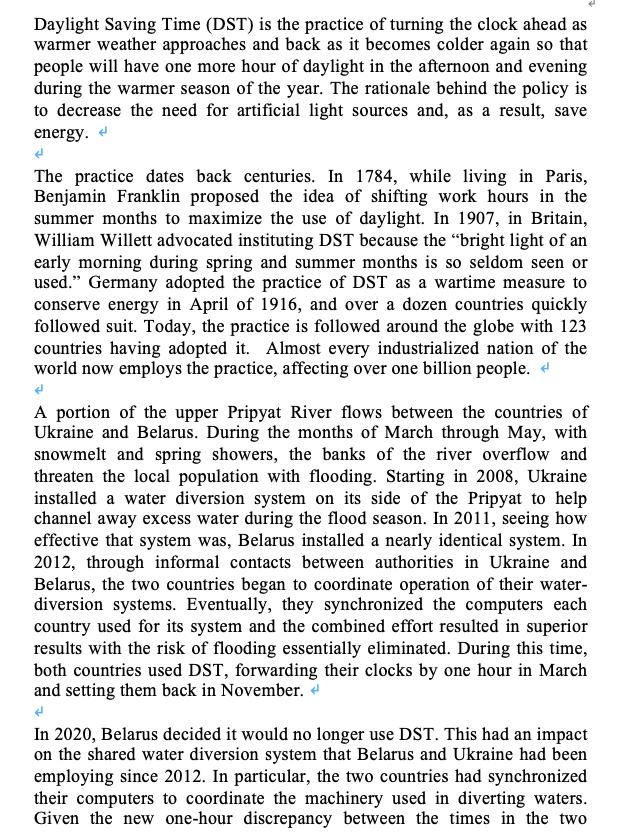
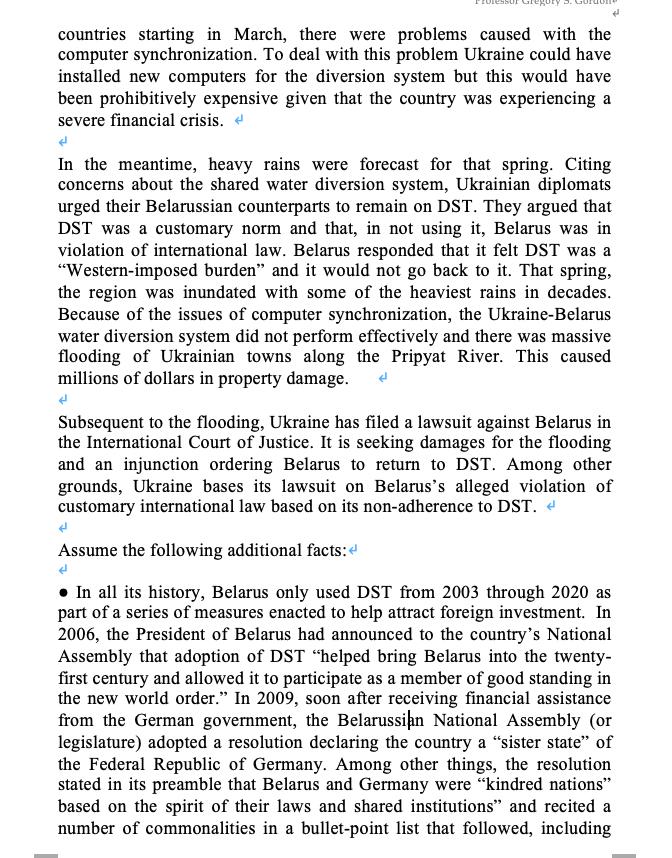
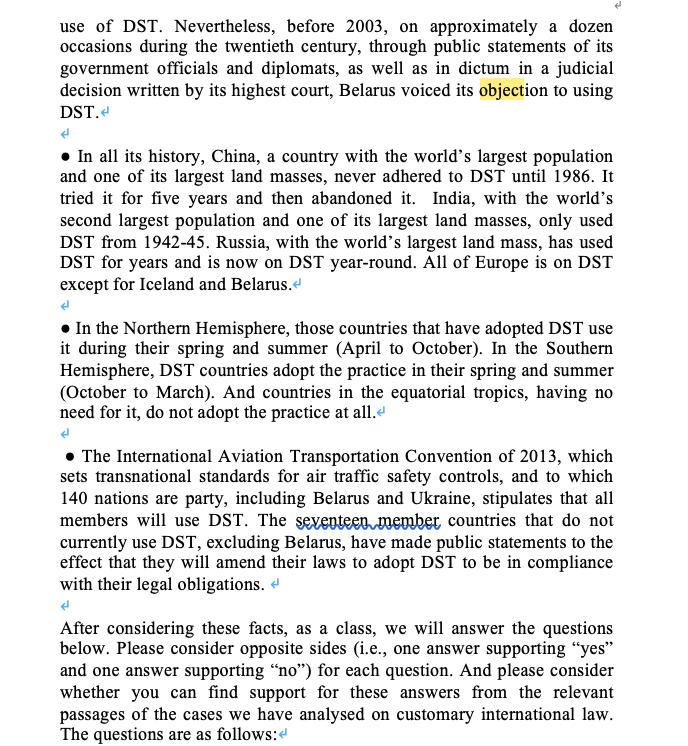
Please consider opposite sides (i.e., one answer supporting "yes" and one answer supporting "no") for each question. And please consider whether you can find support for these answers from the relevant passages of the cases we have analysed on customary international law. The questions are as follows:
1. Will the International Court of Justice find that adherence to DST as customary international law is supported by state practice?
2. Will the International Court of Justice find that adherence to DST as customary international law is supported by sufficient evidence of opinion juris?
3. In deciding whether Belarus is obligated by customary international law to use DST, will the International Court of Justice specifically take into account the adherence of European countries to DST?
4. Regardless of whether the International Court of Justice finds that use of DST is a rule of customary international law, will it conclude that Belarus is exempt from that rule?
reference: https://www.studocu.com/hk/document/university-of-the-witwatersrand-johannesburg/public-international-law/book-summary-dugards-international-law/6100306
Daylight Saving Time (DST) is the practice of turning the clock ahead as warmer weather approaches and back as it becomes colder again so that people will have one more hour of daylight in the afternoon and evening during the warmer season of the year. The rationale behind the policy is to decrease the need for artificial light sources and, as a result, save energy. The practice dates back centuries. In 1784, while living in Paris, Benjamin Franklin proposed the idea of shifting work hours in the summer months to maximize the use of daylight. In 1907, in Britain, William Willett advocated instituting DST because the "bright light of an early morning during spring and summer months is so seldom seen or used." Germany adopted the practice of DST as a wartime measure to conserve energy in April of 1916, and over a dozen countries quickly followed suit. Today, the practice is followed around the globe with 123 countries having adopted it. Almost every industrialized nation of the world now employs the practice, affecting over one billion people. < A portion of the upper Pripyat River flows between the countries of Ukraine and Belarus. During the months of March through May, with snowmelt and spring showers, the banks of the river overflow and threaten the local population with flooding. Starting in 2008, Ukraine installed a water diversion system on its side of the Pripyat to help channel away excess water during the flood season. In 2011, seeing how effective that system was, Belarus installed a nearly identical system. In 2012, through informal contacts between authorities in Ukraine and Belarus, the two countries began to coordinate operation of their water- diversion systems. Eventually, they synchronized the computers each country used for its system and the combined effort resulted in superior results with the risk of flooding essentially eliminated. During this time, both countries used DST, forwarding their clocks by one hour in March and setting them back in November. In 2020, Belarus decided it would no longer use DST. This had an impact on the shared water diversion system that Belarus and Ukraine had been employing since 2012. In particular, the two countries had synchronized their computers to coordinate the machinery used in diverting waters. Given the new one-hour discrepancy between the times in the two
Step by Step Solution
There are 3 Steps involved in it

Get step-by-step solutions from verified subject matter experts
 Study Help