







Question: Please help me with this problem, I have no background in this subject so I ' d appreciate it if you can explain each step
Please help me with this problem, I have no background in this subject so Id appreciate it if you can explain each step in detail. Thank you!
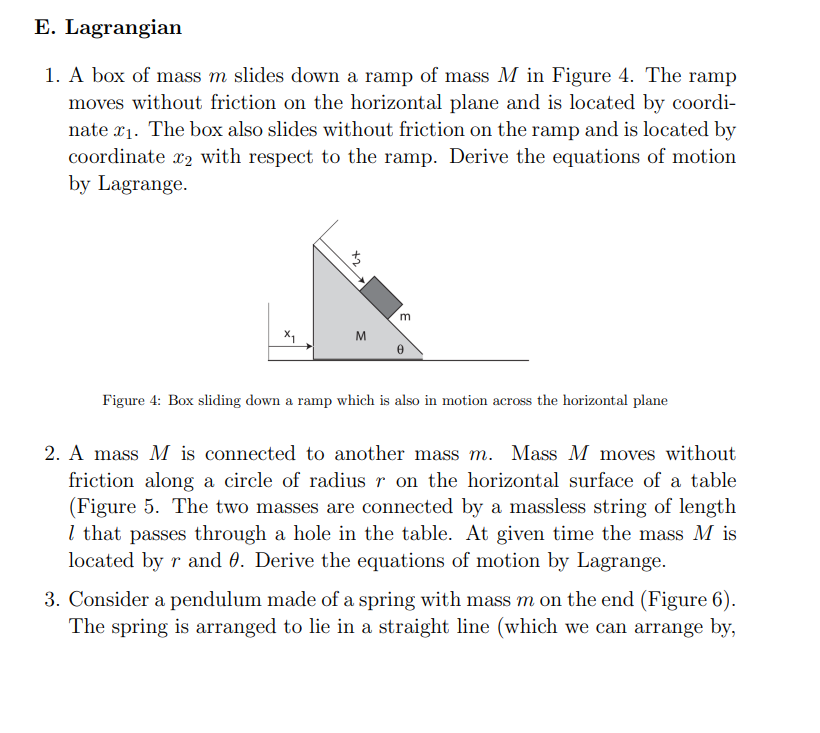
A mass M is connected to another mass m Mass M moves without
friction along a circle of radius r on the horizontal surface of a table
Figure The two masses are connected by a massless string of length
l that passes through a hole in the table. At given time the mass M is
located by r and theta. Derive the equations of motion by Lagrange.
Consider a pendulum made of a spring with mass m on the end Figure
The spring is arranged to lie in a straight line which we can arrange by
Figure : A mass m attached to a string which is threaded through a table with another mass M attached at the other end
say, wrapping the spring around a rigid massless rod The equilibrium length of the spring is l Let the spring has length lxt and let its angle with the vertical be thetat Assuming that the motion takes place in a vertical plane, find the equations of motion for x and theta using the Lagrangian.
Figure : A mass m attached to a pendulum made of a spring
A cart and pendulum, shown in Figure consists of a cart of mass, m moving on a horizontal surface, acted upon by a spring with spring constant k From the cart is suspended a pendulum consisting of a uniform rod of length, l and mass, m pivoting about point A Derive the equations of motion by Lagrange.
Step by Step Solution
There are 3 Steps involved in it
1 Expert Approved Answer
Step: 1 Unlock

Question Has Been Solved by an Expert!
Get step-by-step solutions from verified subject matter experts
Step: 2 Unlock
Step: 3 Unlock
 Study Help