







Question: Please help me with those 4 questions. This case study is on page C-11 (521/632) of Management book (author: Schermerhorn), twelfth edition Case Study 5
Please help me with those 4 questions. This case study is on page C-11 (521/632) of "Management" book (author: Schermerhorn), twelfth edition
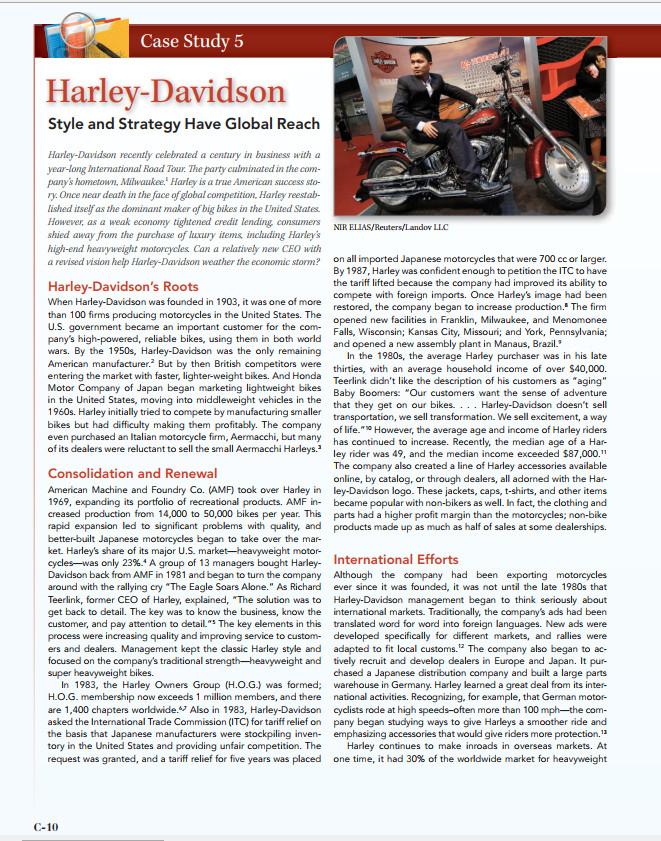
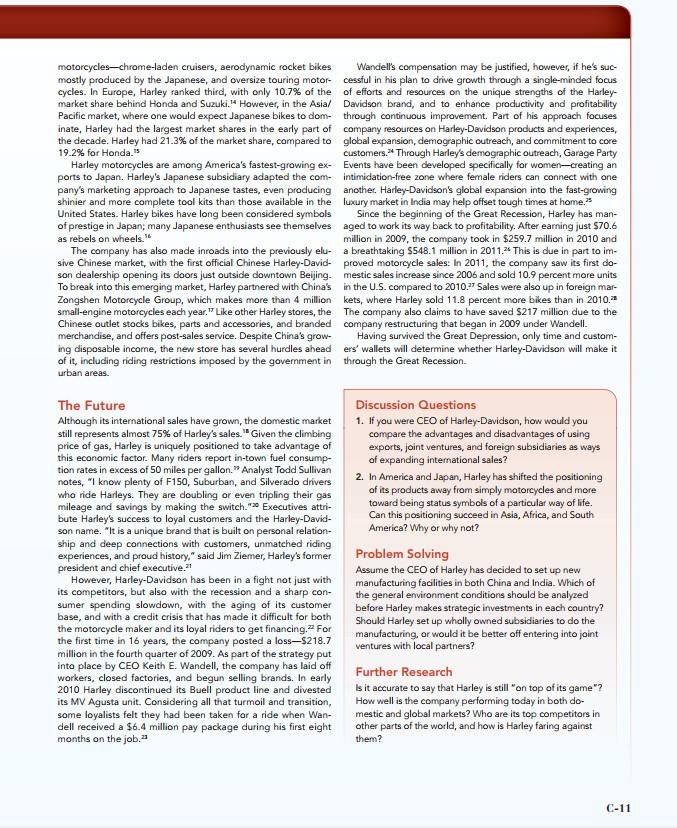
Case Study 5 Harley-Davidson Style and Strategy Have Global Reach Harley-Davidson recently celebrated a century in business with a year-long International Road Tour. The party culminated in the com- pany's hometown. Milwaukee." Harley is a true American success sto- ry. Once near death in the face of global competition. Harley reestals- lished itself as the dominant maker of big bikes in the United States However, as a weak economy tightened credit lending consumers NIR ELIAS/Reuters/Landov LLC shied away from the purchase of luxury items including Harley's high-end heavyweight motorcycles Can a relatively new CEO with a revised Vision helps Harley-Davidson weather the economic storm? on all imported Japanese motorcycles that were 700 cc or larger. By 1987, Harley was confident enough to petition the ITC to have Harley-Davidson's Roots the tariff lifted because the company had improved its ability to When Harley-Davidson was founded in 1903, it was one of more restored, the company began to increase production. The firm compete with foreign imports. Once Harley's image had been than 100 firms producing motorcycles in the United States. The opened new facilities in Franklin, Milwaukee, and Menomonee U.S. government became an important customer for the com. Falls, Wisconsin; Kansas City, Missouri, and York, Pennsylvania; pany's high-powered, reliable bikes, using them in both world and opened a new assembly plant in Manaus, Brazil." wars. By the 1950s, Harley-Davidson was the only remaining In the 1980s, the average Harley purchaser was in his late American manufacturer. But by then British competitors were thirties, with an average household income of over $40,000. entering the market with faster, lighter-weight bikes. And Honda Teerlink didn't like the description of his customers as "aging" Motor Company of Japan began marketing lightweight bikes Baby Boomers: "Our customers want the sense of adventure in the United States, moving into middleweight vehicles in the that they get on our bikes.... Harley-Davidson doesn't sell 1960s. Harley initially tried to compete by manufacturing smaller transportation, we sell transformation. We sell excitement , a way bikes but had difficulty making them profitably. The company of life. However, the average age and income of Harley riders even purchased an Italian motorcycle firm, Aermacchi, but many has continued to increase. Recently, the median age of a Har- of its dealers were reluctant to sell the small Aermacchi Harleys. ley rider was 49, and the median income exceeded $87,000." The company also created a line of Harley accessories available Consolidation and Renewal online, by catalog, or through dealers, all adorned with the Har- American Machine and Foundry Co. (AMF) took over Harley in ley-Davidson logo. These jackets, caps, t-shirts, and other items 1969, expanding its portfolio of recreational products, AMF in became popular with non-bikers as well . In fact, the clothing and creased production from 14,000 to 50,000 bikes per year. This parts had a higher profit margin than the motorcycles, non-bike rapid expansion led to significant problems with quality, and products made up as much as half of sales at some dealerships. better-built Japanese motorcycles began to take over the mar- ket. Harley's share of its major U.S. market-heavyweight motor- cycles-was only 23%. A group of 13 managers bought Harley International Efforts Davidson back from AMF in 1981 and began to turn the company Although the company had been exporting motorcycles around with the rallying cry "The Eagle Soars Alone." As Richard ever since it was founded, it was not until the late 1980s that Teerlink, former CEO of Harley, explained, "The solution was to Harley-Davidson management began to think seriously about get back to detail. The key was to know the business, know the international markets. Traditionally, the company's ads had been customer, and pay attention to detail." The key elements in this translated word for word into foreign languages. New ads were process were increasing quality and improving service to custom- developed specifically for different markets, and rallies were ers and dealers. Management kept the classic Harley style and adapted to fit local customs." The company also began to ac- focused on the company's traditional strength-heavyweight and tively recruit and develop dealers in Europe and Japan. It pur- super heavyweight bikes. chased a Japanese distribution company and built a large parts In 1983, the Harley Owners Group (H.O.G.) was formed warehouse in Germany. Harley leamed a great deal from its inter- H.O.G. membership now exceeds 1 million members, and there national activities. Recognizing, for example, that German motor- are 1,400 chapters worldwide. Also in 1983, Harley-Davidson cyclists rode at high speeds-often more than 100 mphthe com- asked the International Trade Commission (ITC) for tariff relief on pany began studying ways to give Harleys a smoother ride and the basis that Japanese manufacturers were stockpiling inven- emphasizing accessories that would give riders more protection." tory in the United States and providing unfair competition. The Harley continues to make inroads in overseas markets. At request was granted, and a tariff relief for five years was placed one time, it had 30% of the worldwide market for heavyweight C-10 motorcycles-chrome-laden cruisers, aerodynamic rocket bikes Wandell's compensation may be justified, however, if he's suc mostly produced by the Japanese, and oversize touring motor- cessful in his plan to drive growth through a single-minded focus cycles. In Europe, Harley ranked third, with only 10.7% of the of efforts and resources on the unique strengths of the Harley- market share behind Honda and Suzuki." However, in the Asia/ Davidson brand, and to enhance productivity and profitability Pacific market, where one would expect Japanese bikes to dom- through continuous improvement. Part of his approach focuses inate, Harley had the largest market shares in the early part of company resources on Harley-Davidson products and experiences, the decade. Harley had 21.3% of the market share, compared to global expansion, demographic Outreach, and commitment to core 19.2% for Honda. customers. Through Harley's demographic outreach, Garage Party Harley motorcycles are among America's fastest-growing ex- Events have been developed specifically for women-creating an ports to Japan. Harley's Japanese subsidiary adapted the com- intimidation-free zone where female niders can connect with one pany's marketing approach to Japanese tastes, even producing another. Harley-Davidson's global expansion into the fast-growing shinier and more complete tool kits than those available in the luxury market in India may help offset tough times at home. United States. Harley bikes have long been considered symbols Since the beginning of the Great Recession, Harley has man- of prestige in Japan, many Japanese enthusiasts see themselves aged to work its way back to profitability. After earning just $70.6 as rebels on wheels. million in 2009, the company took in $259.7 million in 2010 and The company has also made inroads into the previously elu- a breathtaking $548.1 million in 2011.* This is due in part to im- sive Chinese market, with the first official Chinese Harley-David- proved motorcycle sales: In 2011, the company saw its first do- son dealership opening its doors just outside downtown Beijing.mestic sales increase since 2006 and sold 10.9 percent more units To break into this emerging market, Harley partnered with China's in the U.S.compared to 2010. Sales were also up in foreign mar- Zongshen Motorcycle Group, which makes more than 4 million kets, where Harley sold 11.8 percent more bikes than in 2010. small-engine motorcycles each year." Like other Harley stores, the The company also claims to have saved $217 million due to the Chinese outlet stocks bikes, parts and accessories, and branded company restructuring that began in 2009 under Wandell. merchandise, and offers post-sales service. Despite China's grow- Having survived the Great Depression, only time and custom- ing disposable income, the new store has several hurdles aheaders' wallets will determine whether Harley-Davidson will make it of it, including riding restrictions imposed by the government in through the Great Recession urban areas. The Future Although its international sales have grown, the domestic market still represents almost 75% of Harley's sales. "Given the climbing price of gas, Harley is uniquely positioned to take advantage of this economic factor. Many riders report in-town fuel consump- tion rates in excess of 50 miles per gallon." Analyst Todd Sullivan notes, "I know plenty of F150, Suburban, and Silverado drivers who ride Harleys. They are doubling or even tripling their gas mileage and savings by making the switch.*** Executives attri- bute Harley's success to loyal customers and the Harley-David- son name. "It is a unique brand that is built on personal relation- ship and deep connections with customers, unmatched riding experiences, and proud history," said Jim Ziemer, Harley's former president and chief executive. However, Harley-Davidson has been in a fight not just with its competitors, but also with the recession and a sharp con- sumer spending slowdown, with the aging of its customer base, and with a credit crisis that has made it difficult for both the motorcycle maker and its loyal riders to get financing. For the first time in 16 years, the company posted a loss-S218.7 million in the fourth quarter of 2009. As part of the strategy put into place by CEO Keith E. Wandell, the company has laid off workers, closed factories, and begun selling brands. In early 2010 Harley discontinued its Buell product line and divested its MV Agusta unit. Considering all that turmoil and transition, some loyalists felt they had been taken for a ride when Wan- dell received a $6.4 million pay package during his first eight months on the job. Discussion Questions 1. If you were CEO of Harley-Davidson, how would you compare the advantages and disadvantages of using exports, joint ventures, and foreign subsidiaries as ways of expanding international sales? 2. In America and Japan, Harley has shifted the positioning of its products away from simply motorcycles and more toward being status symbols of a particular way of life. Can this positioning succeed in Asia, Africa, and South America? Why or why not? Problem Solving Assume the CEO of Harley has decided to set up new manufacturing facilities in both China and India. Which of the general environment conditions should be analyzed before Harley makes strategic investments in each country? Should Harley set up wholly owned subsidiaries to do the manufacturing, or would it be better off entering into joint ventures with local partners? Further Research Is it accurate to say that Harley is still on top of its game"? How well is the company performing today in both do- mestic and global markets? Who are its top competitors in other parts of the world, and how is Harley faring against them? C-11Step by Step Solution
There are 3 Steps involved in it
1 Expert Approved Answer
Step: 1 Unlock

Question Has Been Solved by an Expert!
Get step-by-step solutions from verified subject matter experts
Step: 2 Unlock
Step: 3 Unlock
 Study Help