







Question: PLEASE HELP!!!! Please use the pseudocode above! Code must be written in java You are provided one skeleton program named Graph.java Please modify the skeleton
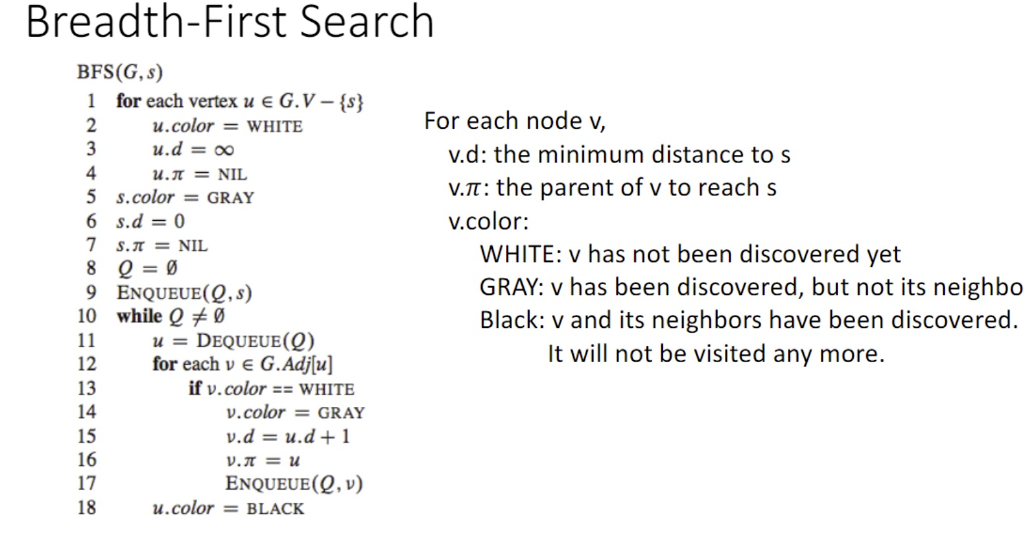
PLEASE HELP!!!! Please use the pseudocode above! Code must be written in java
You are provided one skeleton program named Graph.java
Please modify the skeleton code to solve the following tasks.
Task 1: .Implement the bfs(int s) function:
Note: You should return an integer array that records the minimum distance between every node to the sources.
Hint 1:The colors have been defined in the class for you to use.
Hint 2:In the matrix-adjacency representation, each node is just an integer. So you cannot do this u.color = WHITE
for a node u. Instead, I suggest you to create an integer array to represent the colors of the nodes, another array to represent the distance
d for the nodes.
Hint 3: You can ignore the parent in your code.
Hint 4:To use the Enqueue and Dequeue function, use
your previous implementation of Queue in HW3. Or you can use the add() and remove()
function of Java LinkedList.
Task 2 (Extra Credit 100 pts). Implement the DFS() and DFS Visit() function.
----------------------------------------------------------------
Here's skeleton code
-------------------------------------------------------------------
package graph;
import ds.Queue;
public class Graph {
public int n; /umber of vertice
public int[][] A;//the adjacency matrix
private final int WHITE = 2;
private final int GRAY = 3;
private final int BLACK = 4;
public Graph () {
n = 0;
A = null;
}
public Graph (int _n, int[][] _A) {
this.n = _n;
this.A = _A;
}
/*
* Input: s denotes the index of the source node
* Output: the array dist, where dist[i] is the distance between the
i-th node to s
*/
public int[] bfs (int s) {
----code goes here!----
}
public void print_array (int[] array) {
for (int i = 0; i
System.out.println(i + ": " + array[i]);
}
/**
* @param args
*/
public static void main(String[] args) {
// TODO Auto-generated method stub
int n = 8;
int[][] A =
{{0, 1, 0, 0, 1, 0, 0, 0},
{1, 0, 0, 0, 0, 1, 0, 0},
{0, 0, 0, 1, 0, 1, 1, 0},
{0, 0, 1, 0, 0, 0, 1, 1},
{1, 0, 0, 0, 0, 0, 0, 0},
{0, 1, 1, 0, 0, 0, 1, 0},
{0, 0, 1, 1, 0, 1, 0, 1},
{0, 0, 0, 1, 0, 0, 1, 0}};
Graph g = new Graph(n, A);
g.print_array(g.bfs(1));
}
}
Breadth-First Search BFS(G,s) 1 for each vertex u e G.V - {s) For each node v, u.colorWHITE u.d =00 u. = NIL 4 5 s.color=GRAY 6 s.d=0 7 s.=NIL v.d: the minimum distance to s v.Tt: the parent of v to reach s v.color: WHITE: v has not been discovered yet GRAY: v has been discovered, but not its neighbo Black: v and its neighbors have been discovered. 9 ENQUEUE(Q,s) 10 while 0 u = DEQUEUE(Q) for each v E G.Adj[u] It will not be visited any more. 12 13 if v. color == WHITE v,color = GRAY 15 16 17 ENQUEUE(Q, v) 18 ucolor = BLACK Breadth-First Search BFS(G,s) 1 for each vertex u e G.V - {s) For each node v, u.colorWHITE u.d =00 u. = NIL 4 5 s.color=GRAY 6 s.d=0 7 s.=NIL v.d: the minimum distance to s v.Tt: the parent of v to reach s v.color: WHITE: v has not been discovered yet GRAY: v has been discovered, but not its neighbo Black: v and its neighbors have been discovered. 9 ENQUEUE(Q,s) 10 while 0 u = DEQUEUE(Q) for each v E G.Adj[u] It will not be visited any more. 12 13 if v. color == WHITE v,color = GRAY 15 16 17 ENQUEUE(Q, v) 18 ucolor = BLACK
Step by Step Solution
There are 3 Steps involved in it

Get step-by-step solutions from verified subject matter experts
 Study Help