







Question: Please Help Read the Case excerpt, Sutton v. Warner. See above. Answer the three Case Questions at the end of the excerpt. Critical Legal Thinking:
Please Help
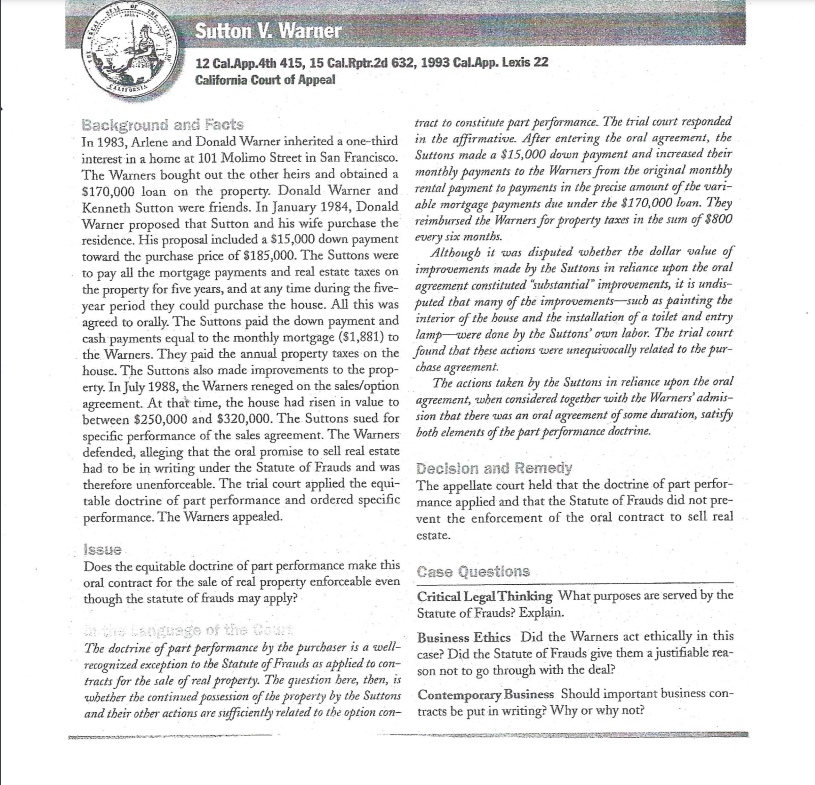
Read the Case excerpt, Sutton v. Warner. See above. Answer the three Case Questions at the end of the excerpt.
Critical Legal Thinking: What purposes are served by the Statute of Frauds? Explain.
Business Ethics: Did the Warners act ethically in this case? Did the Statute of Frauds give them a justifiable reason not to go through with the deal?
Contemporary Business: Should important business contracts be put into writing? Why or why not?
12 Cal.App.4th 415, 15 Cal.Rptr.2d 632, 1993 Cal.App. Lexis 22 California Court of Appeal Background and pacts In 1983, Arlene and Donald Warner inherited a one-third interest in a home at 101 Molimo Street in San Francisco. The Warners bought out the other heirs and obtained a $170,000 loan on the property. Donald Warner and Kenneth Sutton were friends. In January 1984, Donald Warner proposed that Sutton and his wife purchase the residence. His proposal included a $15,000 down payment toward the purchase price of $185,000. The Suttons were to pay all the mortgage payments and real estate taxes on the property for five years, and at any time during the fiveyear period they could purchase the house. All this was agreed to orally. The Suttons paid the down payment and cash payments equal to the monthly mortgage ($1,881) to the Warners. They paid the annual property taxes on the house. The Suttons also made improvements to the property. In July 1988, the Warners reneged on the sales/option agreement. At that time, the house had risen in value to between $250,000 and $320,000. The Suttons sued for specific performance of the sales agreement. The Warners defended, alleging that the oral promise to sell real estate had to be in writing under the Statute of Frauds and was therefore unenforceable. The trial court applied the equitable doctrine of part performance and ordered specific performance. The Warners appealed. Issue Does the equitable doctrine of part performance make this oral contract for the sale of rcal property enforceable even though the statute of frauds may apply? The doctrine of part performance by the purchaser is a wellrecognized exception to the Statute of Frauds as applied to contracts for the sale of real property. The question bere, then, is whether the continued possession of lbe property by the Suttons and their other actions are sufficiently related to the option con- tract to constitute part performance. The trial court responded in the affirmative. After entering the oral agreement, the Suttons made a $15,000 down payment and increased their montbly payments to the Warners from the original montbly rental payment to payments in the precise amount of tbe variable mortgage payments due under the $170,000 loan. They reimbursed the Warners for property taxes in the sum of $800 every six months. Altbough it was disputed whether the dollar value of improvements made by the Suttons in reliance upon the oral agreement constituted "substantial" improvements, it is undisputed that many of the improvements - such as painting the interior of the house and the installation of a toilet and entry lamp-were done by the Suttons' own labor. The trial court found that these actions were unequivocally related to the purchase agreement. The actions taken by the Suttons in reliance upon the oral agreement, when considered together with the Warners' admission that there was an oral agreement of some duration, satisfy both elements of the part performance doctrine. Decision and Remedy The appellate court held that the doctrine of part performance applied and that the Statute of Frauds did not prevent the enforcement of the oral contract to sell real estate. Case Questions Critical Legal Thinking What purposes are served by the Statute of Frauds? Explain. Business Ethics Did the Warners act ethically in this case? Did the Statute of Frauds give them a justifiable reason not to go through with the deal? Contemporary Business Should important business contracts be put in writing? Why or why not
Step by Step Solution
There are 3 Steps involved in it

Get step-by-step solutions from verified subject matter experts
 Study Help