







Question: Please help solve question 3 (multiple part question). I will provide thumbs up if answer is correct. Thank you! Harnett Corporation has two manufacturing departments--Molding
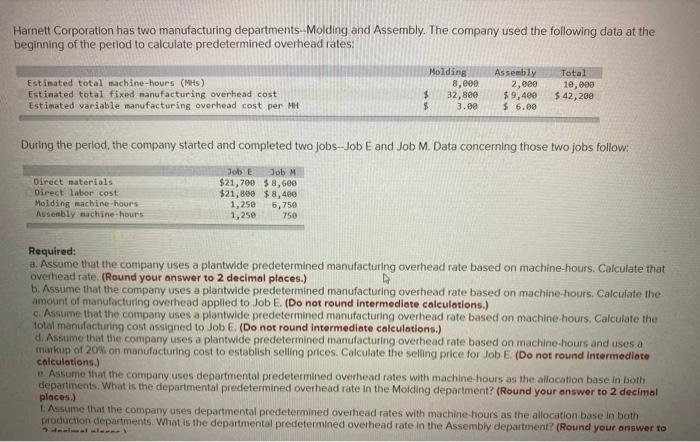
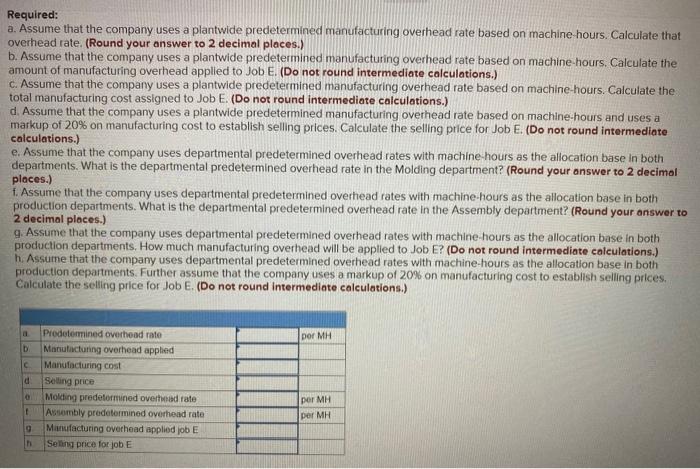
Harnett Corporation has two manufacturing departments--Molding and Assembly. The company used the following data at the beginning of the period to calculate predetermined overhead rates: Estimated total machine-hours (MHS) Estimated total fixed manufacturing overhead cost Estimated variable manufacturing overhead cost per MH Molding 8,000 $ 32,800 $ 3.00 Assembly 2,000 $ 9,400 $ 6.00 Total 10,000 $ 42,200 During the period, the company started and completed two Jobs - Job E and Job M. Data concerning those two jobs follow: Direct materials Direct labor cost Molding machine-hours Assembly machine-hours Job JobM $21,700 $8,6ee $21,800 $8,400 1,25e 6,750 1,250 750 Required: a. Assume that the company uses a plantwide predetermined manufacturing overhead rate based on machine hours. Calculate that overhead rate (Round your answer to 2 decimal places.) b. Assume that the company uses a plantwide predetermined manufacturing overhead rate based on machine hours. Calculate the amount of manufacturing overhead applied to Job E. (Do not round intermediate calculations.) c. Assume that the company uses a plantwide predetermined manufacturing overhead rate based on machine hours. Calculate the total manufacturing cost assigned to Job E. (Do not round Intermediate calculations.) d. Assume that the company uses a plantwide predetermined manufacturing overhead rate based on machine hours and uses a markup of 20% on manufacturing cost to establish selling prices. Calculate the selling price for Job E. (Do not round intermediate calculations.) Assume that the company uses departmental predetermined overhead rates with machine hours as the allocation base in both departments. What is the departmental predetermined overhead rate in the Molding department? (Round your answer to 2 decimal places.) Assume that the company uses departmental predetermined overhead rates with machine hours as the allocation base in both production departments. What is the departmental predetermined overhead rate in the Assembly department? (Round your answer to Required: a. Assume that the company uses a plantwide predetermined manufacturing overhead rate based on machine hours. Calculate that overhead rate. (Round your answer to 2 decimal places.) b. Assume that the company uses a plantwide predetermined manufacturing overhead rate based on machine hours. Calculate the amount of manufacturing overhead applied to Job E. (Do not round intermediate calculations.) c. Assume that the company uses a plantwide predetermined manufacturing overhead rate based on machine-hours. Calculate the total manufacturing cost assigned to Job E. (Do not round intermediate calculations.) d. Assume that the company uses a plantwide predetermined manufacturing overhead rate based on machine hours and uses a markup of 20% on manufacturing cost to establish selling prices. Calculate the selling price for Job E. (Do not round intermediate calculations.) e. Assume that the company uses departmental predetermined overhead rates with machine hours as the allocation base in both departments. What is the departmental predetermined overhead rate in the Molding department? (Round your answer to 2 decimal places.) 1. Assume that the company uses departmental predetermined overhead rates with machine-hours as the allocation base in both production departments. What is the departmental predetermined overhead rate in the Assembly department? (Round your answer to 2 decimal places.) g. Assume that the company uses departmental predetermined overhead rates with machine hours as the allocation base in both production departments. How much manufacturing overhead will be applied to Job E? (Do not round intermediate calculations.) h. Assume that the company uses departmental predetermined overhead rates with machine hours as the allocation base in both production departments. Further assume that the company uses a markup of 20% on manufacturing cost to establish seling prices. Calculate the selling price for Job E. (Do not round Intermediate calculations.) por MH D C d Predetermined overhead rate Manufacturing overhead applied Manufacturing cost Selling price Molding predetermined overhead rate Assembly predetermined overhead rate Manufacturing overhead applied job E Selling price for job E por MH per MH 19
Step by Step Solution
There are 3 Steps involved in it

Get step-by-step solutions from verified subject matter experts
 Study Help