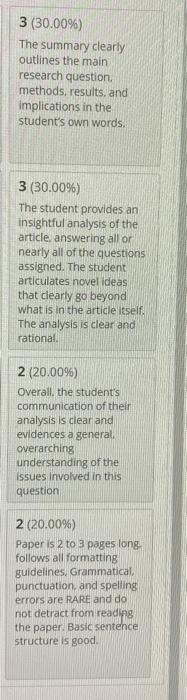
Question: please help summarise and anlyse the article based on the rubrics in 2 to 3 pages analysis report about the most important Ideas in the
please help
summarise and anlyse the article based on the rubrics in 2 to 3 pages analysis report about the most important Ideas in the research paper
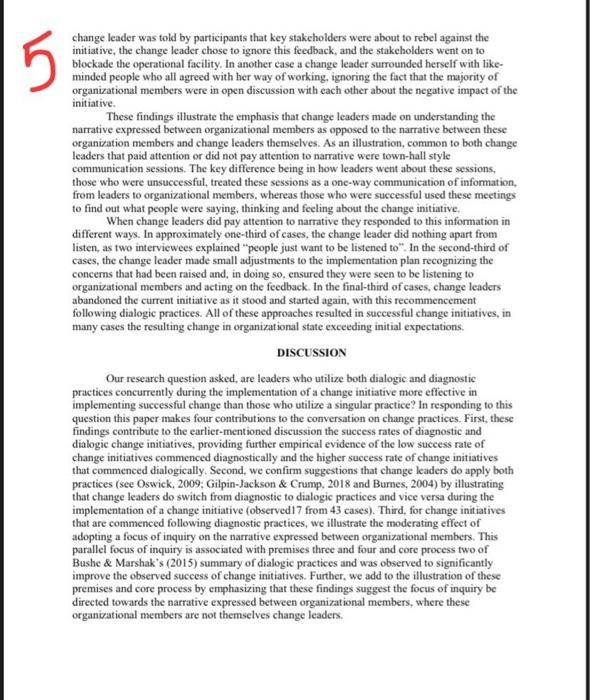
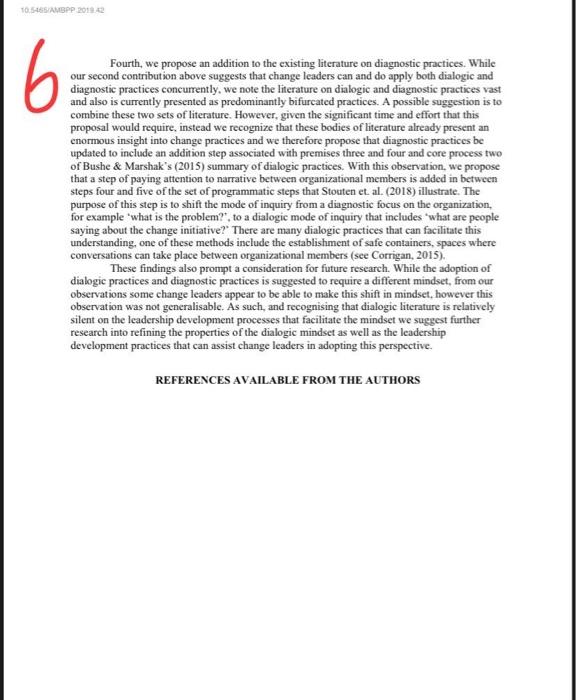
1 DIAGNOSTIC AND DIALOGIC ORGANIZATION DEVELOPMENT: COMPETITIVE OR COLLABORATIVE FOCUSES OF INQUIRY? BRADLEY HASTINGS UNSW Business School University of New South Wales Sydney, NSW 2052, Australia GAVIN SCHWARZ UNSW Business School INTRODUCTION Successful organizational change initiatives result in a sustained positive difference in the form or quality of an organizational state (Van de Ven & Poole, 1995, p. xi). A body of organization development (OD) literature suggests practices targeted towards achieving successful change and this literature has recently been summarized into two practices, diagnostic and dialogic OD, each following different philosophical perspectives with respect to organizations and basic change processes (Bushe & Marshak, 2009, Cummings & Cummings, 2014; Bartunek & Jones, 2017). With diagnostic practices, change is suggested to follow a set of planed and programmatic steps, typically commencing with a focus of inquiry on the organization itself, followed by the setting of a vision or defined end-state for the change initiative, and then the building and following of a plan to achieve that vision (see Stouten Rousseau, & De Cremer, 2018 for a summary of popular planned and programmatic processes). In contrast, dialogic practices suggest a focus of inquiry on the narrative expressed between organizational members, meaning the written or verbal storylines expressed between organizational members that are used to make sense of events (Marshak, Grant, & Floris, 2015), It is a change in this narrative that facilitates new possibilities and guides the actions of change initiatives (Ford & Ford, 1995). In contrast to diagnostic initiatives, with a dialogic perspective. end-states are seen as unpredictable (Burnes, 2004; Weick, 2000) and as such, less emphasis is placed on planned and programmatic steps and more emphasis on facilitating the conversations that lead to the development of new narratives (Bushe & Marshak, 2015). Studies suggest that only 20-30% of planned and programmatic change initiatives are successful (see Holbeche, 2006; Hughes, 2011: Keller & Aiken, 2009: Kotter, 1995; Meaney & Pung, 2008). However, often overlooked in this debate is that a separate body of research suggests that adopting dialogic practices correlates with far higher probabilities (greater than 80%) of success (see Beer, Eisenstat, & Spector, 1990; Bushe & Kassam, 2005; Collins & Hansen, 2011; Higgs & Rowland, 2005, 2011). For a change leader, defined as any person who steps forwards to take a leadership role during the course of change (Ford & Ford, 2012: Kotter, 1996), choosing the practice that will most likely lead to achieve successful change is difficult (Stouten et al. 2018). Taken together, the bifurcated nature of this empirical and theoretical discussion and the reported higher success rates of dialogic practices, could be taken to suggest that change leaders should adopt purely-dialogic practices. However, this choice overlooks suggestions that the two practices should be applied concurrently as complimentary forms of engagement (Cummings & Cummings, 2014: Gilpin, 2013; Burnes, 2004: Oswick, 2009; Marshak & Bushe, 2009). Despite these suggestions that change leaders should adopt both 2 practices, empirical evidence of this concurrent practice is limited to a few case studies (see Bumnes, 2004: Gilpin- Jackson & Crump, 2018). In this study we seek to expand this empirical base, investigating change initiatives from multiple contexts, asking the question: are leaders who utilize both dialogic and diagnostic practices concurrently during the implementation of change more effective in implementing successful change than those who utilize a singular practice? DIALOGIC AND DIAGNOSTIC PRACTICES Both dialogic and diagnostic practices share a tacit assumption that organizations can always be improved, a common purpose of a sustained change an organizational state for the better, and a common value of appreciating human potential (Bushe & Marshak, 2015; Cummings & Cummings, 2014, Schein, 2015). However, despite these commonalities the practices follow different philosophical perspectives. Diagnostic OD practices adopt the perspective that organizational reality, both the organization and the people within it, is a tangible entity that can be understood through objective analysis using rational and analytical processes (Cummings & Cummings, 2014). Alternatively, dialogic OD practices follow the perspective that organizations are socially constructed meaning making systems, with multiple realities expressed through the organizational discourse expressed between organizational members (Bushe & Marshak, 2009). Given these different philosophical foundations it is not surprising that the two practices are illustrated by separate bodies of literature. Below we briefly summarise recent literature of both perspectives. Diagnostic organization development Diagnostic change literature presents many expert opinions of change processes from popular change scholars (see Stouten et al., 2018). These suggestions are consistent with the philosophical perspective that an organization can be objectively analyzed and change processes are typically suggested to follow a set of planned and programmatic steps, for instance Lewin's three steps (Lewin, 1947) or Kotter's eight steps (Kotter, 1995). Over time, scholars have added additional steps and considerations and Stouten et al. (2018) summarize seven popular diagnostic processes into ten summary steps. Briefly these steps are: (1) assess the opportunity or problem motivating the change. (2) select and support a guiding change coalition, (3) formulate a clear compelling vision, (4) communicate the vision. (5) mobilize energy for change, (6) empower others to act. (7) develop and promote change-related knowledge and ability. (8) identify short-term wins and use as reinforcement of change progress. (9) monitor and strengthen the change process, and (10) institutionalize change in company culture, practices, and management succession Dialogic organization development Applying dialogic practices during change initiatives is suggested to require a different mindset (Weick & Quinn, 1999), meaning the fundamental beliefs, theories and attitudes that shape how a change leader sees and engages with organizations (Bushe & Marshak, 2015). A such, some change processes are suggested to be used either dialogically, meaning following a process, or diagnostically, meaning a focus on shifting mindsets. As an example, appreciative 3 inquiry is suggested in both dialogic and diagnostic literature (see Stouten et al. 2018; Bushe & Marshak, 2015). For dialogic practices, consistent with the perspective that change outcomes are a product of the mindset of the change leader, these practices are not presented as a series of steps, rather this literature illustrates the eight premises that shape this mindset (Bushe & Marshak 2015 p. 17-24). Briefly these premises are: (1) reality and relationships are social constructed, (2) organizations are meaning making systems. (3) language, broadly defined, matters, (4) creating change requires changing the conversations, (5) structure participative inquiry to increase differentiation before seeking coherence. (6) groups and organizations are continually self- organizing. (7) transformational change is more emergent than planned, and (8) consultants are part of the process, not apart from the process. Consistent with these premises, Bushe & Marshak (2105) suggest that at least one of the following three conditions should be met to facilitate success: (1) a disruption in the ongoing social construction of reality is stimulated or engaged in a way that leads to a more complex reorganization, (2) a change to one or more core narratives takes place, and (3) a generative image is introduced or surfaced that provides new and compelling alternatives for thinking and acting and focusses on the generative nature of inquiry. METHODOLOGY The predominant methodology for exploring concepts of change practices and success is qualitative (see Bushe & Kassam, 2005: Collins & Hansen, 2011; Higgs & Rowland, 2005, 2011; Lawrence, 2015). We adopted a similar qualitative methodology, collecting data from narrative interviews where participants were asked to recall their experiences with successful and unsuccessful change interviews. An often-utilized approach for such interviews is to study change leaders (see Higgs & Rowland, 2005, 2011: Lawrence, 2015), however given the emphasis on the narrative expressed between organizational members that dialogic practices suggest, together with research indicating that leaders may not have the organizational awareness to understand this narrative (Mabe & West, 1982; Smith-Doerr, Manev, & Rizova, 2004: Tsui & Ohlott, 1988), we therefore chose to interview both leaders and participants of change initiatives. Also, because we were asking participants to recall experiences, we adopted a critical incidence approach by asking for specific examples to illustrate their stories (Fleenor, Smither, Atwater. Braddy, & Sturm, 2010). Each interviewee was asked to tell a story of a change initiative that they had been involved in that was a success, and another that was a failure. We adopted a semi-structured narrative interview format asking four questions: (1) Please give a brief description of the change initiative. (2) Who was the leader of the initiative? (3) What did that leader do to contribute to success, or failure? (4) What problems were encountered and how were they overcome? Evidence to support the participants interpretation of success or failure was also gathered Interviews were conducted in Australia, the United States and the United Kingdom. The type of change initiatives shared by participants varied from small-team restructures of eight people to large-scale transformations of several tens of thousands of people. Each interview lasted for approximately 55 minutes. Of the 25 interviews, 28% interviewees identified as female and 72% male, 35% identified as a leader of the initiative, 49% as participants, 14% as practitioners and two percent as an investor (1.e. employing the designated leader of the change initiative). Interview transcripts were coded using NVivo, employing an initial coding frame based on our research question as well as the steps and premises from Stouten et. al.. (2018) and Bushe 4 & Marshak, (2015). A deductive approach was taken to further refine codes. Standard checks were conducted including a reliability check of coding by a separate and uninvolved researcher, resulting in an interrater reliability score of 87%. FINDINGS This paper presents the findings of an initial 25 interviews (overall 50 are targeted) containing 51 individual stories of change and 43 discrete change initiatives (some of the participants told stories of the same change initiative). Change initiatives were observed to commence either following diagnostic practices (33 cases), or following dialogic practices (ten cases). Change initiated with diagnostic practices was described as successful in 36% of cases (12 from 33 cases) and change initiated with dialogic practices was described as successful in 90% of cases (nine often cases). Our research question asked, are leaders who utilize both dialogic and diagnostic practices concurrently during the implementation of a change initiative more effective in implementing successful change than those who utilize a singular practice? Our findings illustrate that in in 17 from the total of 43 cases, change leaders were observed to apply both diagnostic and dialogic practices concurrently during the implementation of the change initiative. This concurrent utilization was observed regardless of whether change was initiated diagnostically or dialogically. When change was initiated following diagnostic practices of these 33 initiatives, 13 utilized a dialogic practice at some point during the implementation. When change initiatives were initiated with dialogic practices of these ten cases, four utilized diagnostic practices during the implementation of the change initiative. Wish respect to the success of this concurrent utilization, a moderating effect was observed. When change was initiated diagnostically, a dialogic practice that was observed to be consistently adopted by was a practice associated with premises three and four and core process two of Bushe & Marshak's (2015) summary which, put simply, is paying attention to the narrative between organizational members. When change was initiated diagnostically, it was this practice of paying attention to narrative that moderated the success of the change initiative. Change leaders who were observed to not concurrently pay attention to narrative were successful in 6% (19 cases) and those that were observed to make active efforts to pay attention to narrative, were successful in 84% (13 cases). This study also provided illustration of how change leaders undertook this practice. Most change leaders did this informally by observing and listening to organization members within their natural working environments, sometimes by overhearing a conversation in the corridor, other times by taking a walk on through the organization and engaging people in conversation, and other times over informal dinners. Consistent with all these approaches were efforts to understand what organizational members were saying to each other about the change initiative Some change leaders adopted a more structured approach, by on creating multiple environments where organizational members could speak their minds, without fear of negative consequences, for example open door policies, lunch break communication sessions, and online question forums. In contrast, when change leaders did not pay attention to narrative, there was evidence given by participants of change initiatives that a narrative existed that was negative towards the change initiative however change leaders either made no observed attempts to listen to this narrative, or in some cases chose to ignore it. In some cases, change leaders were approached with direct feedback that the change intuitive was being poorly received. As an example, one 5 change leader was told by participants that key stakeholders were about to rebel against the initiative, the change leader chose to ignore this feedback, and the stakeholders went on to blockade the operational facility. In another case a change leader surrounded herself with like- minded people who all agreed with her way of working, ignoring the fact that the majority of organizational members were in open discussion with each other about the negative impact of the initiative. These findings illustrate the emphasis that change leaders made on understanding the narrative expressed between organizational members as opposed to the narrative between these organization members and change leaders themselves. As an illustration, common to both change leaders that paid attention or did not pay attention to narrative were town-hall style communication sessions. The key difference being in how leaders went about these sessions, those who were unsuccessful, treated these sessions as a one-way communication of information, from leaders to organizational members, whereas those who were successful used these meetings to find out what people were saying, thinking and feeling about the change initiative. When change leaders did pay attention to narrative they responded to this information in different ways. In approximately one-third of cases, the change leader did nothing apart from listen, as two interviewees explained "people just want to be listened to". In the second-third of cases, the change leader made small adjustments to the implementation plan recognizing the concerns that had been raised and, in doing so ensured they were seen to be listening to organizational members and acting on the feedback. In the final-third of cases, change leaders abandoned the current initiative as it stood and started again, with this recommencement following dialogic practices. All of these approaches resulted in successful change initiatives, in many cases the resulting change in organizational state exceeding initial expectations. DISCUSSION Our research question asked, are leaders who utilize both dialogic and diagnostic practices concurrently during the implementation of a change initiative more effective in implementing successful change than those who utilize a singular practice? In responding to this question this paper makes four contributions to the conversation on change practices. First, these findings contribute to the earlier-mentioned discussion the success rates of diagnostic and dialogic change initiatives, providing further empirical evidence of the low success rate of change initiatives commenced diagnostically and the higher success rate of change initiatives that commenced dialogically. Second, we confirm suggestions that change leaders do apply both practices (see Oswick, 2009; Gilpin-Jackson & Crump, 2018 and Burnes, 2004) by illustrating that change leaders do switch from diagnostic to dialogic practices and vice versa during the implementation of a change initiative observed 17 from 43 cases). Third, for change initiatives that are commenced following diagnostic practices, we illustrate the moderating effect of adopting a focus of inquiry on the narrative expressed between organizational members. This parallel focus of inquiry is associated with premises three and four and core process two of Bushe & Marshak's (2015) summary of dialogic practices and was observed to significantly improve the observed success of change initiatives. Further, we add to the illustration of these premises and core process by emphasizing that these findings suggest the focus of inquiry be directed towards the narrative expressed between organizational members, where these organizational members are not themselves change leaders. 10.545/MBPP 2018 6 Fourth, we propose an addition to the existing literature on diagnostic practices. While our second contribution above suggests that change leaders can and do apply both dialogic and diagnostic practices concurrently, we note the literature on dialogic and diagnostic practices vast and also is currently presented as predominantly bifurcated practices. A possible suggestion is to combine these two sets of literature. However, given the significant time and effort that this proposal would require, instead we recognize that these bodies of literature already present an enormous insight into change practices and we therefore propose that diagnostic practices be updated to include an addition step associated with premises three and four and core process two of Bushe & Marshak's (2015) summary of dialogic practices. With this observation, we propose that a step of paying attention to narrative between organizational members is added in between steps four and five of the set of programmatic steps that Stouten et al. (2018) illustrate. The purpose of this step is to shift the mode of inquiry from a diagnostic focus on the organization, for example "what is the problem?', to a dialogic mode of inquiry that includes "what are people saying about the change initiative?" There are many dialogic practices that can facilitate this understanding, one of these methods include the establishment of safe containers, spaces where conversations can take place between organizational members (see Corrigan, 2015), These findings also prompt a consideration for future research. While the adoption of dialogic practices and diagnostic practices is suggested to require a different mindset, from our observations some change leaders appear to be able to make this shift in mindset, however this observation was not generalisable. As such, and recognising that dialogic literature is relatively silent on the leadership development processes that facilitate the mindset we suggest further research into refining the properties of the dialogic mindset as well as the leadership development practices that can assist change leaders in adopting this perspective. REFERENCES AVAILABLE FROM THE AUTHORS 3 (30.00%) The summary clearly outlines the main research question methods, results, and implications in the student's own words. 3 (30.00%) The student provides an Insightful analysis of the article answering all or nearly all of the questions assigned. The student articulates novel Ideas that clearly go beyond what is in the article itself The analysis is clear and rational 2 (20.00%) Overall, the student's communication of their analysis is clear and evidences a general, overarching understanding of the Issues involved in this question 2 (20.00%) Paper is 2 to 3 pages long follows all formatting guidelines Grammatical punctuation, and spelling errors are RARE and do not detract from reading the paper. Basic sentence structure is good









 Study Help