







Question: Please help the question below. Thank you Problem 2. Use the M-file given below for the false position method to determine the drag coefficient needed
Please help the question below. Thank you
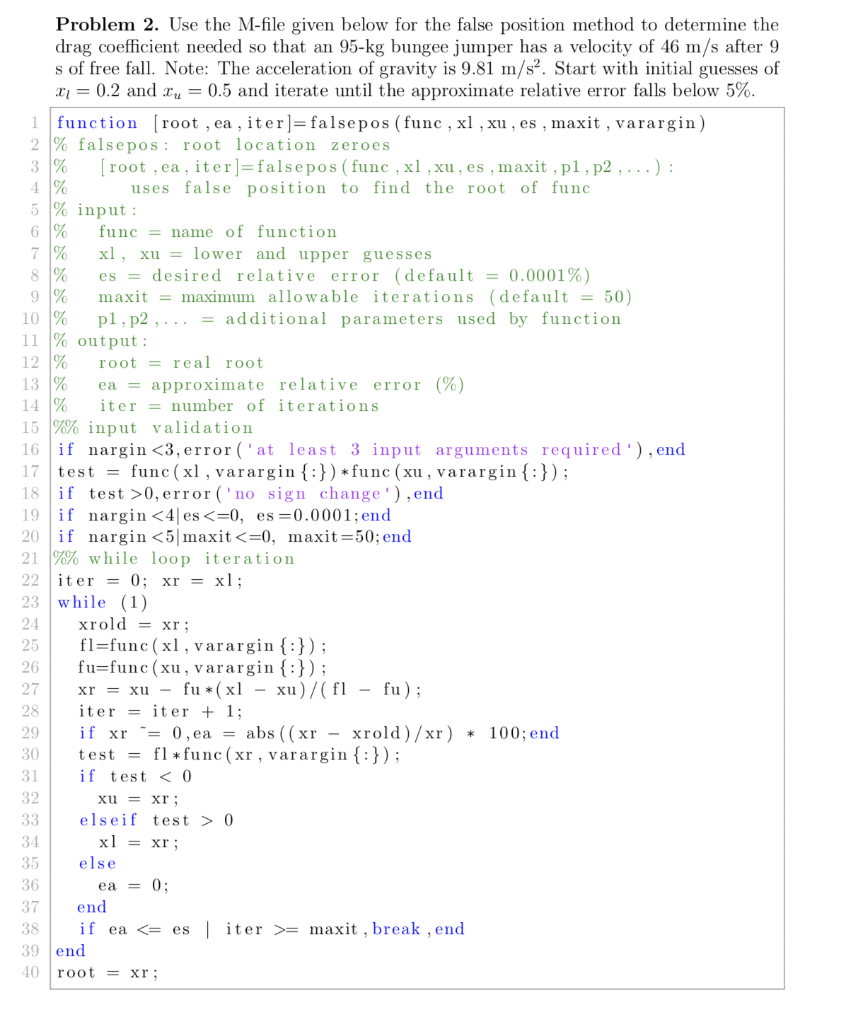
Problem 2. Use the M-file given below for the false position method to determine the drag coefficient needed so that an 95-kg bungee jumper has a velocity of 46 m/s after 9 s of free fall. Note: The acceleration of gravity is 9.81 m/s2. Start with initial guesses of XI 0.2 and 2.u-0.5 and iterate until the approximate relative error falls below 5% lfunction [root , ea, iter falsepos (func, xl , xu, es maxit, varargin) 2% falsepos: root location zeroes root ,ea, iter falsepos (func x,xu, es,maxit , pl,p2,.. uses false position to find the root of func 5 % input : 6 % func= name of function 7% xi, xu= lower and upper guesses 8% es= desired relative error (default= 0.0001%) 9% maxit-maximum allowable iterations (default-50) 10% p1,p2,...-additional parameters used by function 11 % output: 12% root= real root 13% ea= approximate relative error (%) 14% iter= number of iterations 15|%% input validation 16 if nargin 0, error ('no sign change,end 19| if narginAles = maxit, break, end 39 end 40 | root = xr ; ea = 0
Step by Step Solution
There are 3 Steps involved in it

Get step-by-step solutions from verified subject matter experts
 Study Help