







Question: PLEASE HELP!! The selectivity filter is quite narrow and K+ ions must shed their hydration layer to enter it. Describe what happens to a hydrated



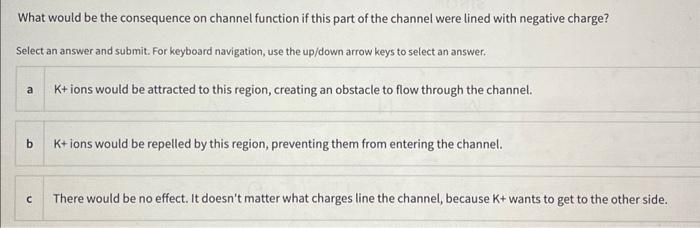

The selectivity filter is quite narrow and K+ ions must shed their hydration layer to enter it. Describe what happens to a hydrated K+ ion as it moves into the selectivity filter. Be sure to discuss energy changes that occur (i.e., breaking and reforming interactions). Describe how the springy cuff of aromatic amino acid residues that surround the selectivity filter contribute to the inability of Na+ ions to be transported. Refer specifically to energetics of interactions. What challenge must be overcome for a K+ ion to exit the selectivity filter? How do the authors hypothesize that this happens? What would be the consequence on channel function if this part of the channel were lined with negative charge? Select an answer and submit. For keyboard navigation, use the up/down arrow keys to select an answer. a K+ ions would be attracted to this region, creating an obstacle to flow through the channel. b K+ ions would be repelled by this region, preventing them from entering the channel. c There would be no effect. It doesn't matter what charges line the channel, because K+ wants to get to the other side. What is the helix dipole effect? How does the structure of this protein use the helix dipole effect to support movement of ions through the channel (see Figure 7 and "Summary" of the Potassium Ion Channel paper)
Step by Step Solution
There are 3 Steps involved in it

Get step-by-step solutions from verified subject matter experts
 Study Help