







Question: Please help to answer this short question: Does the CEO or President of the company decide to move an idea to the next stage?Why? Copy
Please help to answer this short question:
Does the CEO or President of the company decide to move an idea to the next stage?Why?
Copy of conversation attached:
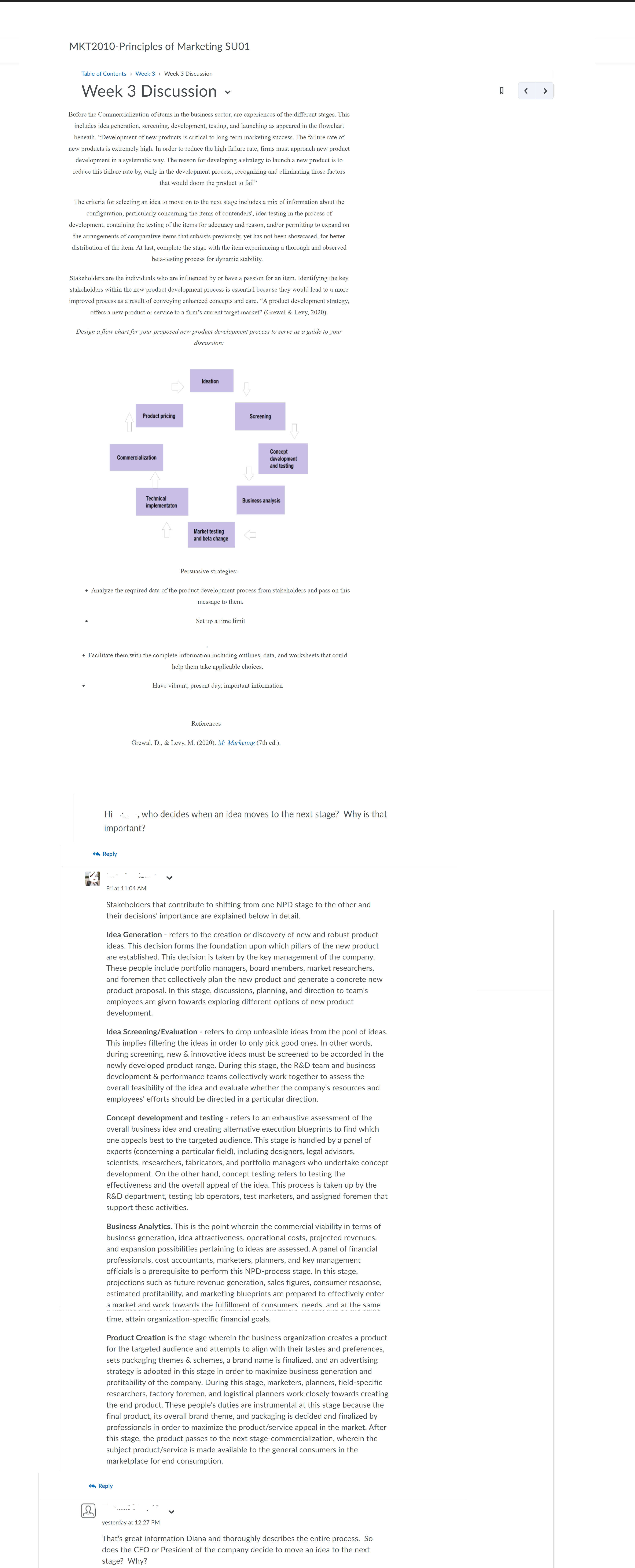
MKT2010-Principles of Marketing SU01 Table of Contents > Week 3 > Week 3 Discussion Week 3 Discussion Before the Commercialization of items in th ices of the different stages. This includes idea generation, screening, devel and launching as appeared in the flowchart beneath. "Development of ne ccess. The failure rate of ew products is extremely high. In order to reduce the high failure rate, firms must approach new product development in a systematic way. The reason for de a strategy to launch a new product is to reduce this failure rate by, early in the development pro and eliminating those factors roduct to fail" The criteria for selecting an idea to move includes a mix of information about the configuration, particularly concerning the items of esting in the process of development, containing the testing of the items for adequacy and reason, and/or permitting to expand on the arrangements of comparative items tha wcased, for better distribution of the item. At last, complete the stage with the item experiencing a thorough and observed beta-testing process for dynamic stability. Stakeholders are the individuals who are influenced by or have a passion for an item. Identifying the key stakeholders within the new product development proce cause they would lead to a more improved process as a act development strategy, offers a new product or service to a firm's current target market" (Grewal & Levy, 2020). Design a flow chart for your proposed new product development process to serve as a guide to your discussion: Ideation Product pricing creening Commercialization Concept and thetime Technical Business analysis implementation Market testing and beta change Persuasive strategies: Analyze the required data of the product development process from stakeholders and pass on this message to them. Set up a time limit Facilitate them with the complete information including outlines, data, and worksheets that could help them take applicable choices. Have vibrant, present day, important information References Grewal, D., & Levy, M. (2020). M: Marketing (7th ed.). who decides when an idea moves to the next stage? Why is that important? Reply Fri at 11:04 AM Stakeholders that contribute to shifting from one NPD stage to the other and their decisions' importance are explained below in detail. Idea Generation - refers to the creation or discovery of new and robust product ideas. This decision forms the foundation upon which pillars of the new product are established. This decision is taken by the key management of the company. These people include portfolio managers, board members, market researchers, and foremen that collectively plan the new product and erate a concrete new product proposal. In this stage, discu and direction to team's employees are given towards exploring different options of new product development. Idea Screening/Evaluation - refers to dr p unfeasible ideas from the pool of ideas. This implies filtering the ideas in order to only pick good ones. In other words, during screening, new & innovative ideas must be screened to be accorded in the newly developed product range. During this stage, the R&D team and business development & performance teams co er to assess the overall feasibility of the idea and evaluate whether the company's resources and employees' efforts should be directed in a particular direction. Concept development and testing - refers to an exhaustive assessment of the overall business idea and creating alternative execution blueprints to find which one appeals best to the targeted audience. This stage is handled by a panel of experts (concerning a particular field), including designers, legal advisors, scientists, researchers, fabricators, and portfolio managers who undertake concept development. On the other hand, concept testing refers to testing the effectiveness and the overall appeal of the idea. This process is taken up by the R&D department, testing lab operators, test marketers, and assigned foremen that support these activities. Business Analytics. This is the point wherein the commercial viability in terms of business generation, idea attractiveness, oper ional costs, projected revenues, and expansion possibilities pertaining to id ed. A panel of financial professionals, cost accountants, and key management officials is a prerequisite to perform this NPD-process stage. In this stage projections such as future revenue generation, sales figures, consumer response, estimated profitability, and marketing blueprints are prepared to effectively enter a market and work towards the fulfillment of consumers' needs. and at the same time, attain organization-specific financial goals. Product Creation is the stage wherein the business organization creates a product for the targeted audience and attempts to align with their tastes and preferences, sets packaging themes & schemes, a brand name is finalized, and an advertising strategy is adopted in this stage in ord eneration and profitability of the company. During th ners, field-specific researchers, factory foremen, and logistical planners work closely towards creating the end product. These people's duties are instrumental at this stage because the final product, its overall brand theme, ided and finalized by professionals in order to m ppeal in the market. After this stage, the product passes to the next stage-commercialization, wherein the subject product/service is made available to the general consumers in the marketplace for end consumption.
Step by Step Solution
There are 3 Steps involved in it

Get step-by-step solutions from verified subject matter experts
 Study Help