Question: please help topic 1 article topic #2 article https://www.google.com/amp/s/www.foxbusiness.com/economy/kroger-closes-long-beachs-ralphs-food4less-stores-four-dollar-hero-pay.amp Topic #1 Uber for Everything! Please go to FILES.....Week 1......Uber for Everything, and read the article.
please help
topic 1 article
topic #2 article
https://www.google.com/amp/s/www.foxbusiness.com/economy/kroger-closes-long-beachs-ralphs-food4less-stores-four-dollar-hero-pay.amp
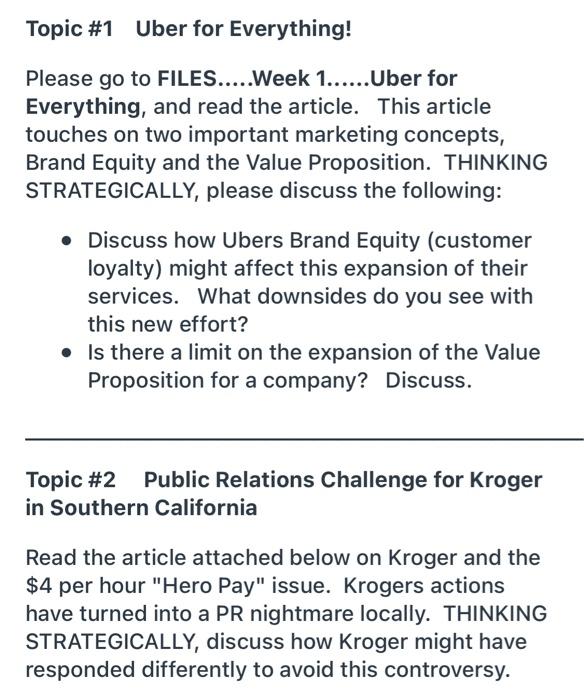
Topic #1 Uber for Everything! Please go to FILES.....Week 1......Uber for Everything, and read the article. This article touches on two important marketing concepts, Brand Equity and the Value Proposition. THINKING STRATEGICALLY, please discuss the following: Discuss how Ubers Brand Equity (customer loyalty) might affect this expansion of their services. What downsides do you see with this new effort? Is there a limit on the expansion of the Value Proposition for a company? Discuss. Topic #2 Public Relations Challenge for Kroger in Southern California Read the article attached below on Kroger and the $4 per hour "Hero Pay" issue. Krogers actions have turned into a PR nightmare locally. THINKING STRATEGICALLY, discuss how Kroger might have responded differently to avoid this controversy. Uber for everything One of the technology industry's big bets is that once a company is good at transporting one thing, it should be able to do the same for anything ANT Companies including Uber and Instacart are starting to branch out from one area --- getting people or groceries to their destination-into delivering restaurant food, prescription slegs, homes.net food and conueniens stors.items. In that vein, Uber this week Drizly, which delivers from liquor stores You can imagine the potential if courier services delivered almost anything under the sun. But will it work, and is it a good thing? It's impossible to predict whether one-stop delivery behemoths will pan out or what the ripple effects might be - both helpful and harmful. But we should pay attention to these companies moves and think critically about the stakes for small businesses, our wallets, our communities and the U.S. work force. First, the promise of Uber for everything, and then some of the complications This could be awesome. Couriers could have more work if they can pick up passengers deliver burritos and drop off cases of beer. Selling more types of stuff could reverse losses at app-based companies like Uber and DoorDash. And it's handy for people who like shopping from the sofas. Win-win-win. It could be good for local businesses and our communities, too. Imagine if a local toy shop grocery store could more easily serve both the people shopping in person and those nearby who prefer delivery. Our favorite businesses could have a second life without going broke competing against Amazon or shipping orders hundreds of miles by mail. My colleague Kate Conger told me that the pandemic has shown that many of us are cager for home delivery of everything, and that has made more tech industry watchers believe that app based companies can successfully become one-stop delivery machines It's also possible that the Uber model for anything won't work out, or that if it does it will entrench the worst aspects of delivery-by-app companies For all Uber's talk about its beautiful dual businesses in restaurant food delivery and moving people, they are wildly different. The customers might overlap, but signing up restaurants and keeping them feeling satisfied is a whole different game than moving people around Plus, cach new type of delivered goods-groceries, convenience store items, home improvement stuff and booze -- have different operations and logistics. Can one generaliste good at them all? Also worth mentioning: Many restaurants have said that app-based delivery services have been a bad bargain. Will businesses in other industries feel the same? If one-stop delivery companies aren't viable, it could hurt shoppers that have relied on them. businesses that have bet their futures on them and especially the workers who are lowest the gig-economy hierarchy If you hang around Silicon Valley long enough, you'll probably hear a line stolen from Emest Hemingway that change often happens gradually and then suddenly One order of Cheets and heer at a time, we and app companies may be remaking our habits, communities and the labor force . Topic #1 Uber for Everything! Please go to FILES.....Week 1......Uber for Everything, and read the article. This article touches on two important marketing concepts, Brand Equity and the Value Proposition. THINKING STRATEGICALLY, please discuss the following: Discuss how Ubers Brand Equity (customer loyalty) might affect this expansion of their services. What downsides do you see with this new effort? Is there a limit on the expansion of the Value Proposition for a company? Discuss. Topic #2 Public Relations Challenge for Kroger in Southern California Read the article attached below on Kroger and the $4 per hour "Hero Pay" issue. Krogers actions have turned into a PR nightmare locally. THINKING STRATEGICALLY, discuss how Kroger might have responded differently to avoid this controversy. Uber for everything One of the technology industry's big bets is that once a company is good at transporting one thing, it should be able to do the same for anything ANT Companies including Uber and Instacart are starting to branch out from one area --- getting people or groceries to their destination-into delivering restaurant food, prescription slegs, homes.net food and conueniens stors.items. In that vein, Uber this week Drizly, which delivers from liquor stores You can imagine the potential if courier services delivered almost anything under the sun. But will it work, and is it a good thing? It's impossible to predict whether one-stop delivery behemoths will pan out or what the ripple effects might be - both helpful and harmful. But we should pay attention to these companies moves and think critically about the stakes for small businesses, our wallets, our communities and the U.S. work force. First, the promise of Uber for everything, and then some of the complications This could be awesome. Couriers could have more work if they can pick up passengers deliver burritos and drop off cases of beer. Selling more types of stuff could reverse losses at app-based companies like Uber and DoorDash. And it's handy for people who like shopping from the sofas. Win-win-win. It could be good for local businesses and our communities, too. Imagine if a local toy shop grocery store could more easily serve both the people shopping in person and those nearby who prefer delivery. Our favorite businesses could have a second life without going broke competing against Amazon or shipping orders hundreds of miles by mail. My colleague Kate Conger told me that the pandemic has shown that many of us are cager for home delivery of everything, and that has made more tech industry watchers believe that app based companies can successfully become one-stop delivery machines It's also possible that the Uber model for anything won't work out, or that if it does it will entrench the worst aspects of delivery-by-app companies For all Uber's talk about its beautiful dual businesses in restaurant food delivery and moving people, they are wildly different. The customers might overlap, but signing up restaurants and keeping them feeling satisfied is a whole different game than moving people around Plus, cach new type of delivered goods-groceries, convenience store items, home improvement stuff and booze -- have different operations and logistics. Can one generaliste good at them all? Also worth mentioning: Many restaurants have said that app-based delivery services have been a bad bargain. Will businesses in other industries feel the same? If one-stop delivery companies aren't viable, it could hurt shoppers that have relied on them. businesses that have bet their futures on them and especially the workers who are lowest the gig-economy hierarchy If you hang around Silicon Valley long enough, you'll probably hear a line stolen from Emest Hemingway that change often happens gradually and then suddenly One order of Cheets and heer at a time, we and app companies may be remaking our habits, communities and the labor force









 Study Help