







Question: Please help. Use pyton please Part 4: Calculating the properties of two-dimensional neighborhoods for agent-based models While ABMs can be very easy to use, they
 Please help. Use pyton please
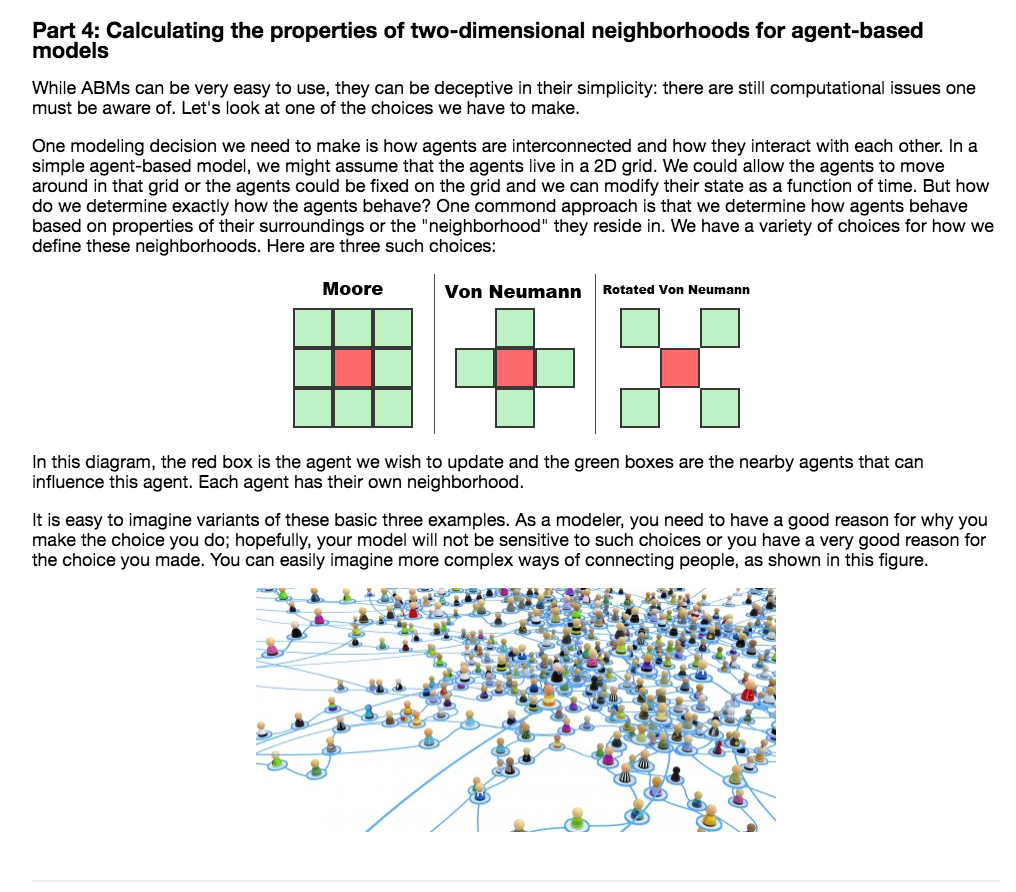
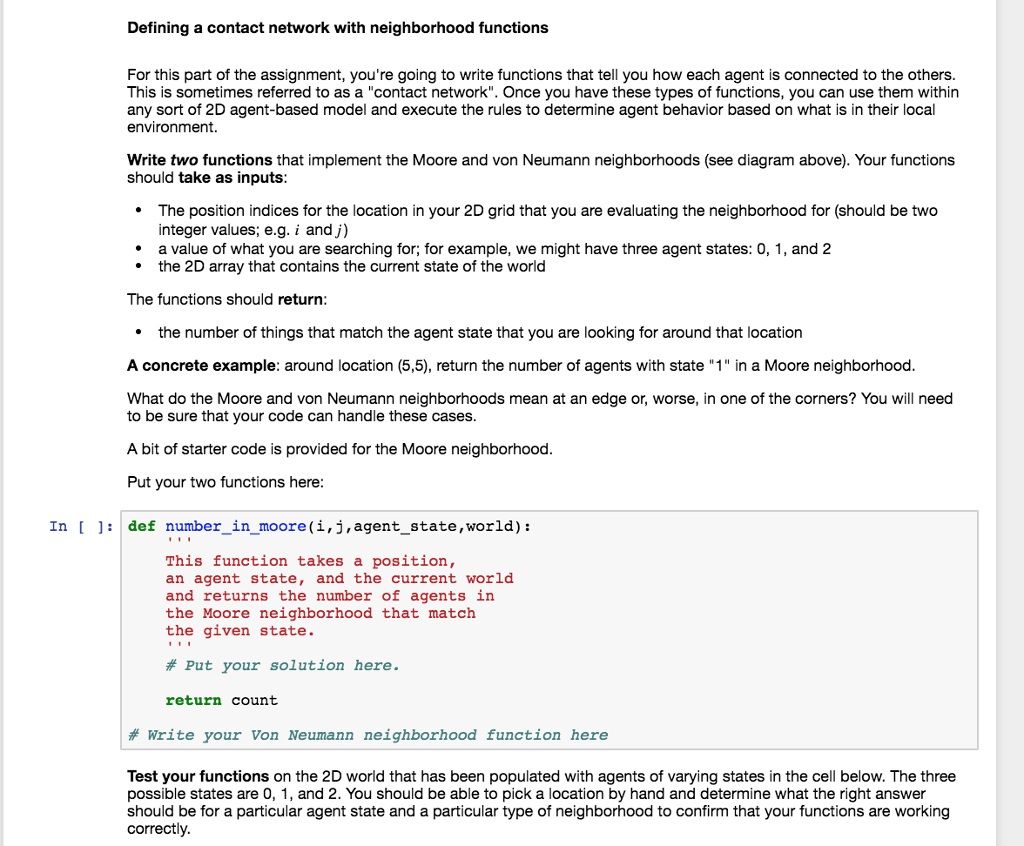
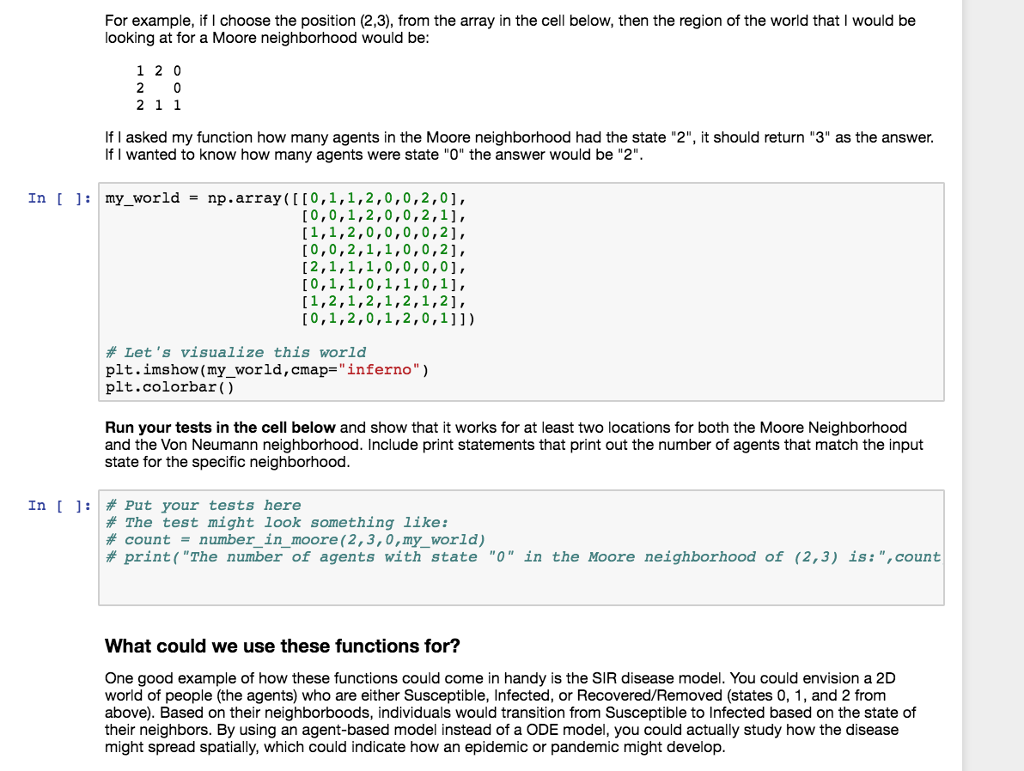
Part 4: Calculating the properties of two-dimensional neighborhoods for agent-based models While ABMs can be very easy to use, they can be deceptive in their simplicity: there are still computational issues one must be aware of. Let's look at one of the choices we have to make One modeling decision we need to make is how agents are interconnected and how they interact with each other. In a simple agent-based model, we might assume that the agents live in a 2D grid. We could allow the agents to move around in that grid or the agents could be fixed on the grid and we can modify their state as a function of time. But how do we determine exactly how the agents behave? One commond approach is that we determine how agents behave based on properties of their surroundings or the "neighborhood" they reside in. We have a variety of choices for how we define these neighborhoods. Here are three such choices Moore Von Neumann Rotated Von Neumann In this diagram, the red box is the agent we wish to update and the green boxes are the nearby agents that can influence this agent. Each agent has their own neighborhood It is easy to imagine variants of these basic three examples. As a modeler, you need to have a good reason for why you make the choice you do; hopefully, your model will not be sensitive to such choices or you have a very good reason for the choice you made. You can easily imagine more complex ways of connecting people, as shown in this figure Part 4: Calculating the properties of two-dimensional neighborhoods for agent-based models While ABMs can be very easy to use, they can be deceptive in their simplicity: there are still computational issues one must be aware of. Let's look at one of the choices we have to make One modeling decision we need to make is how agents are interconnected and how they interact with each other. In a simple agent-based model, we might assume that the agents live in a 2D grid. We could allow the agents to move around in that grid or the agents could be fixed on the grid and we can modify their state as a function of time. But how do we determine exactly how the agents behave? One commond approach is that we determine how agents behave based on properties of their surroundings or the "neighborhood" they reside in. We have a variety of choices for how we define these neighborhoods. Here are three such choices Moore Von Neumann Rotated Von Neumann In this diagram, the red box is the agent we wish to update and the green boxes are the nearby agents that can influence this agent. Each agent has their own neighborhood It is easy to imagine variants of these basic three examples. As a modeler, you need to have a good reason for why you make the choice you do; hopefully, your model will not be sensitive to such choices or you have a very good reason for the choice you made. You can easily imagine more complex ways of connecting people, as shown in this figure
Step by Step Solution
There are 3 Steps involved in it

Get step-by-step solutions from verified subject matter experts
 Study Help