







Question: please help We saw in lecture the basic inductive proof structure for proving a statement of the form VEN, P(n): . Prove PO) and for
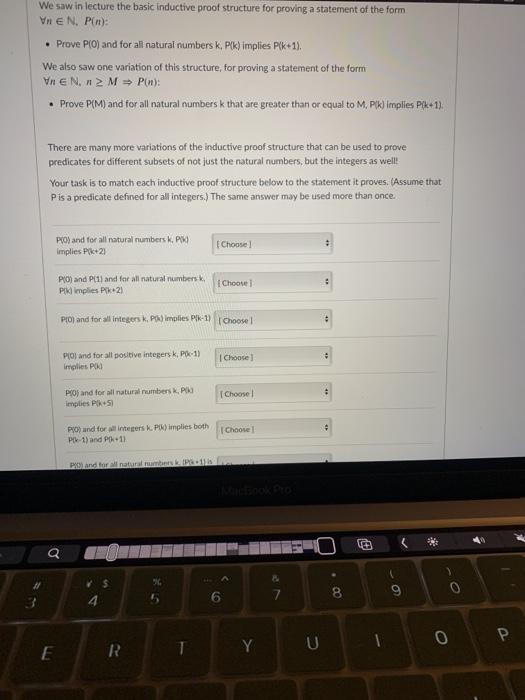
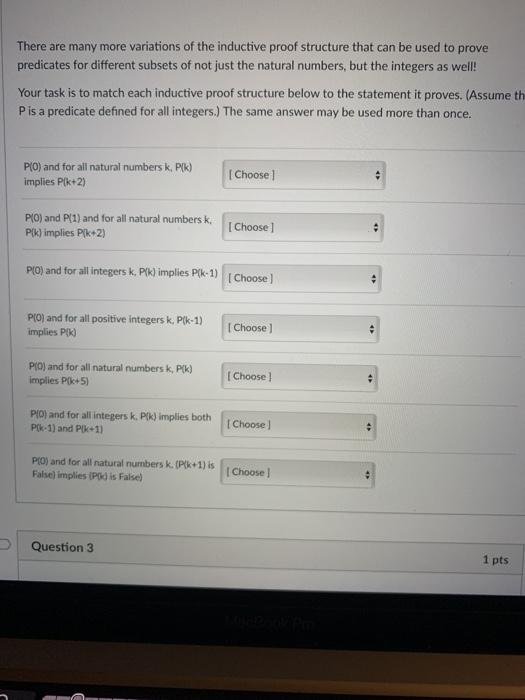
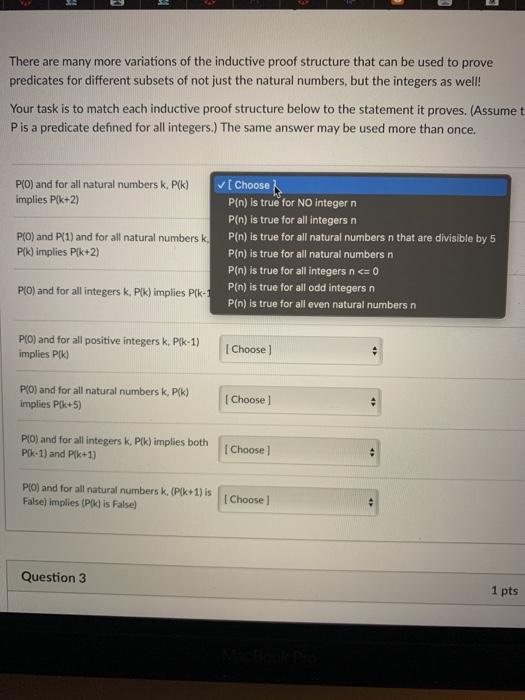
We saw in lecture the basic inductive proof structure for proving a statement of the form VEN, P(n): . Prove PO) and for all natural numbersk, Pik) implies Pik+1). We also saw one variation of this structure for proving a statement of the form VEN, 2 MP): . Prove P(M) and for all natural numbers that are greater than or equal to M, Pik) implies Pk+1). There are many more variations of the inductive proof structure that can be used to prove predicates for different subsets of not just the natural numbers, but the integers as well! Your task is to match each inductive proof structure below to the statement it proves. (Assume that Pis a predicate defined for all integers.) The same answer may be used more than once. PO) and for all natural numbers K. PIN implies Pk+21 Choose PO) and P61) and for all natural numbers Pimplies Pk 21 Choose Plo) and for all integers k. Pok imoilies Park-1) Choose Poland for all positive integers k. Pa-1) Implies PO Choose Pro and for all natural numbers, implies P51 Choose Choose PO) and for all integers k. P) implies both Pk-1) and Pk11 Pandoratum 6 Q 7 6 8 9 4 P Y U 0 E R There are many more variations of the inductive proof structure that can be used to prove predicates for different subsets of not just the natural numbers, but the integers as well! Your task is to match each inductive proof structure below to the statement it proves. (Assume th Pis a predicate defined for all integers.) The same answer may be used more than once. PO) and for all natural numbers k, P(K) implies Plk+2) [Choose PO) and P(1) and for all natural numbers k. Pik) implies Pk+2) [Choose Plo) and for all integers k. PK) implies Plk-1) (Choose) PLO) and for all positive integers k. Pik-1) implies PIK) Choose PO) and for all natural numbersk, Pik) implies Pk+5) Choose PO) and for all integers k. Plk) implies both PCk-1) and PK+11 Choose PO) and for all natural numbers k. (Pk+1) is False) implies iPod is Falsel Choose Question 3 1 pts There are many more variations of the inductive proof structure that can be used to prove predicates for different subsets of not just the natural numbers, but the integers as well! Your task is to match each inductive proof structure below to the statement it proves. (Assumet Pis a predicate defined for all integers.) The same answer may be used more than once. P(O) and for all natural numbers k. P(k) V[ Choose implies Pik+2) P(n) is true for NO integer n P(n) is true for all integers n PO) and P(1) and for all natural numbers k. Pin) is true for all natural numbers n that are divisible by 5 Pik) implies P[k+2) P(n) is true for all natural numbers n P(n) is true for all integers n
Step by Step Solution
There are 3 Steps involved in it

Get step-by-step solutions from verified subject matter experts
 Study Help