







Question: Please Help! /* Website to use: https://repl.it/languages/c Code: */ #include stdio.h int main(void) { /* Unless otherwise indicated, all statments in the code REQUIRE incrementation
Please Help!
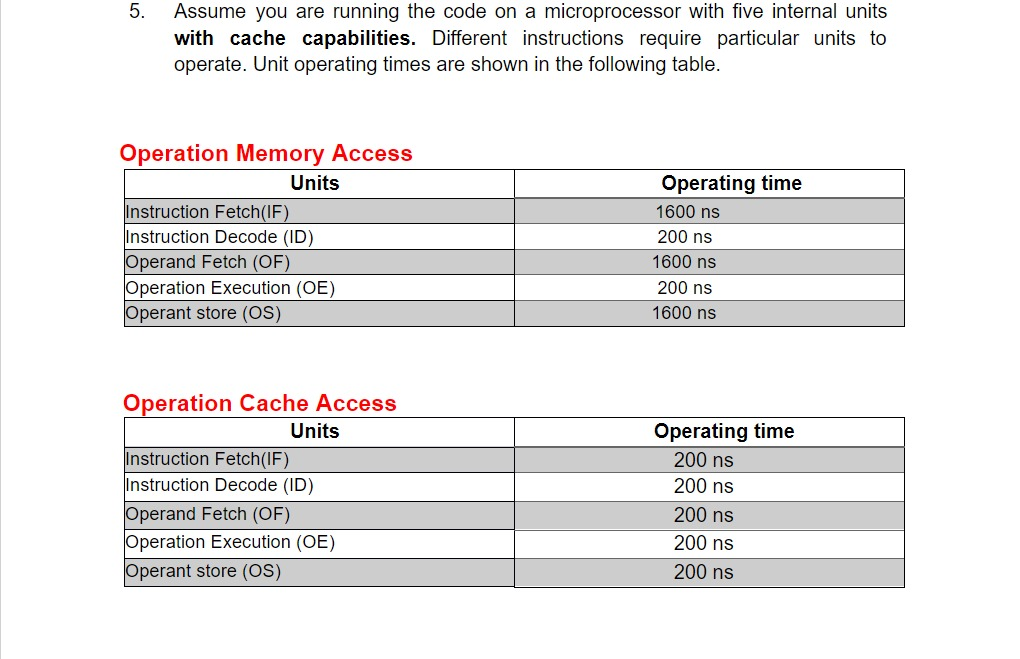
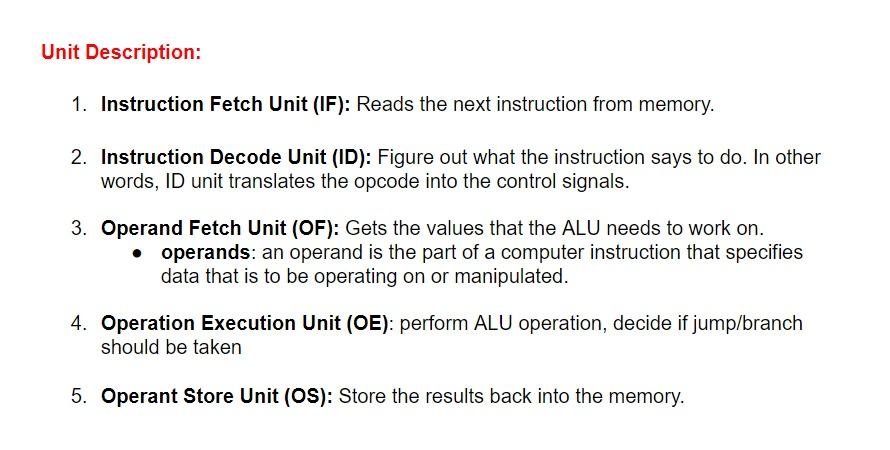
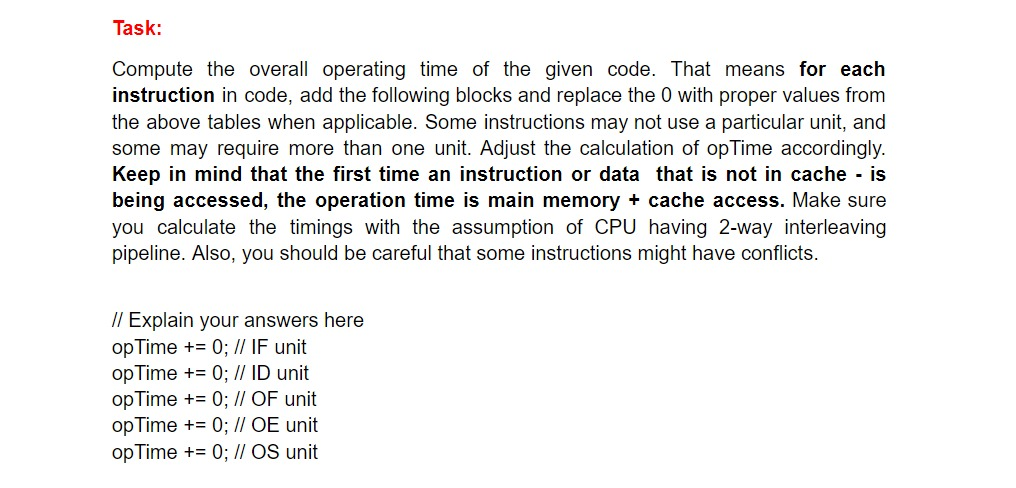
/* Website to use: https://repl.it/languages/c Code: */ #include "stdio.h" int main(void) { /* Unless otherwise indicated, all statments in the code REQUIRE incrementation of the opTime variable. The amount of time that an internal unit uses during operation is given in the pdf. There are five internal units, and different instructions require particular units to operate. opTime += 0; // IF (Instruction Fetch) unit opTime += 0; // ID (Instruction Decode) unit opTime += 0; // OF (Operand Fetch) unit opTime += 0; // OE (Operation Execution) unit opTime += 0; // OS (Operant Store) unit Keep in mind that the first time an instruction or data - that is not in cache - is being accessed, the operation time is main memory (read from memory) + cache access (save in the cache). Also, assume the cache is unlimited, thus, no saving to the main memory is required. For the purpose of this assignment, treat numbers as non-operand (constants). */ // To keep track of runtime // DO NOT include in opTime calculation! float opTime = 0.0; //An arbitrary number for use as a condition in second 'for' loop int n = 1000; //some float variables that represent registers and memory locations float x = 1; float y = 1; float z = 1; float t = 0; float k = 1; float m = 0; // Iterator declaration; In C, declaring 'i' must be done before initializing a 'for' loop // DO NOT include in opTime calculation! int i; // Assume 'for' loop instruction is read only one time, but it checks and incremants i 100 times! // Each command requires incrementing opTime variable relative to what it does. for( i = 0 ; i Machine Operation time using cache through C Programming Language Browse to https://replit/lanauaaes/c Machine Operation time using cache through C Programming Language Browse to https://replit/lanauaaes/c Step by Step Solution
There are 3 Steps involved in it
1 Expert Approved Answer
Step: 1 Unlock

Question Has Been Solved by an Expert!
Get step-by-step solutions from verified subject matter experts
Step: 2 Unlock
Step: 3 Unlock
 Study Help